

A method of processing the digitized output of a charge-coupled device (CCD) image detector has been devised to enable reduction of the error in computed centroid of the image of a point source of light. The method involves model-based estimation of, and correction for, the contributions of bias and noise to the image data. The method could be used to advantage in any of a variety of applications in which there are requirements for measuring precise locations of, and/or precisely aiming optical instruments toward, point light sources.
The principal sources of centroid error are bias and noise in the outputs from the pixels of the CCD. Noise consists mainly of fixed components (readout noise and noise from dark current) and variable components (pixel defects and shot noise from background light). Bias is caused mainly by stray light and nonuniform distribution of light in a background image. 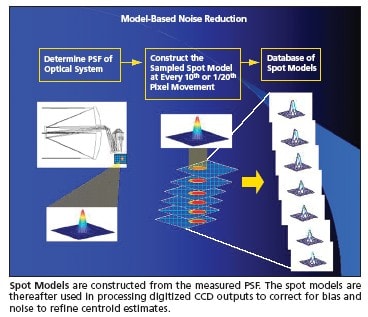
In the present method, prior to normal operations of the CCD, one measures the point-spread function (PSF) of the telescope or other optical system used to project images on the CCD. The PSF is used to construct a database of spot models representing the nominal CCD pixel outputs for a point light source projected onto the CCD at various positions incremented by small fractions of a pixel (see figure).
During normal operation of the CCD, the centroid of the image of a point source of light is initially computed from the digitized CCD pixel outputs in the conventional way. However, this initial computation of the centroid is used to retrieve the corresponding spot model that was constructed earlier. Then the boundary between noise and signal is determined by comparing the spot model with the CCD pixel outputs. Pixel positions of same pixel value of the spot model and the image data in the background area are defined as the boundary. All pixels of the image data beyond this boundary are set to zero. This effectively removes the noise and bias in the subsequent centroid estimation from the corrected image data.
This work was done by Shinhak Lee of Caltech for NASA’s Jet Propulsion Laboratory. For further information, access the Technical Support Package (TSP) free online at www.techbriefs.com/tsp under the Information Sciences category. NPO-30585
This Brief includes a Technical Support Package (TSP).
Reducing Centroid Error Through Model-Based Noise Reduction
(reference NPO-30585) is currently available for download from the TSP library.
Don't have an account?
Overview
The document titled "Reducing Centroid Error Through Model-Based Noise Reduction" is a technical support package from NASA's Jet Propulsion Laboratory (JPL) that discusses advancements in reducing errors in centroid estimation, particularly in optical systems. The focus is on a model-based noise reduction method that aims to enhance the accuracy and robustness of centroid estimations, especially in scenarios with low signal-to-noise ratios (SNR).
Centroid estimation is crucial in various applications, including imaging and tracking systems, where precise location determination of light sources is required. The document outlines the sources of centroid error, emphasizing the detrimental effects of noise and bias on the accuracy of these estimations. Conventional methods for centroid determination are briefly reviewed, highlighting their limitations in handling noise effectively.
The core of the document presents a novel model-based approach to noise reduction. This method involves creating a model that can estimate the noise level in the data and adjust the centroid calculation accordingly. By truncating pixel locations based on the model's noise estimates, the method significantly improves the accuracy of centroid estimations. The document includes simulation results that demonstrate the effectiveness of this approach, showing that it outperforms traditional methods, particularly in low SNR conditions.
The conclusion emphasizes the advantages of the model-based noise reduction technique, noting its effectiveness in reducing both noise and bias in centroid estimation. This advancement is particularly relevant for applications in aerospace and other fields where precision is paramount.
Overall, the document serves as a comprehensive overview of the research conducted at JPL regarding centroid error reduction, providing valuable insights into the methodologies employed and their implications for future technological developments. It also encourages further exploration of the topic through additional resources available from NASA's Scientific and Technical Information Program Office. The findings presented in this technical support package are expected to have broader applications beyond aerospace, potentially benefiting various scientific and commercial sectors.











