An automatic method to schedule maintenance and repair of complex systems is produced based on a computational structure called the Informed Maintenance Grid (IMG). This method provides solutions to the two fundamental problems in autonomic logistics: (1) unambiguous detection of deterioration or impending loss of function and (2) determination of the time remaining to perform maintenance or other corrective action based upon information from the system. The IMG provides a health determination over the medium-to-long-term operation of the system, from one or more days to years of study. The IMG is especially applicable to spacecraft and both piloted and autonomous aircraft, or industrial control processes.
Condition-Based Maintenance (CBM) has become popular for complex systems due to its cost and reliability advantages over traditional scheduled maintenance programs. However, CBM is frequently difficult to apply owing to system complexity and the highly stochastic nature of system use and environmental effects. A scalable solution capable of providing a substantial look-ahead capability is required. The IMG method was developed to satisfy this need.
The IMG is based upon a three-dimensional projection, relating successive computations of cross-signal features. The two short axes represent different sensed parameters from the system (typically performance parameters such as temperatures, pressures, etc.), with each pixel representing the coherency between measurements. The third axis represents time, displaying the progression of abnormalities as the system is used.
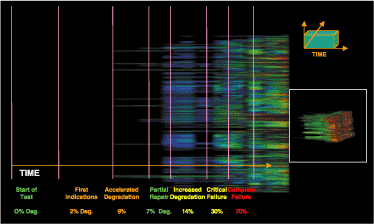
context.
Graphically, the IMG is represented (see figure) as a color-coded temporal succession of two-dimensional plots, each representing the coherence divergence from the statistical model. From this graphical object, one can easily discern the true functional operability of the system, detect the presence and impact of faults or persistent degradation, and assess the effectiveness of repairs or configurational changes. Maintenance recommendations can be derived automatically from this object, providing a continuous evaluation of the need for condition-based maintenance.
The following list outlines the necessary construction steps to apply the IMG:
- Provide examples of nominal data and partial physics models where possible for purposes of ISE training,
- Obtain example data of degraded or anomalous performance for training purposes,
- Compose a listing of preferred maintenance actions to correct faults in particular components, and
- Provide a mapping between sensed or manually supplied status variables and system operating mode.
Acceptable operating limits must be established in order to tune prognostic performance for cost effectiveness. These limits must either be set by system experts or "learned" as degradations appear in practice. Like the ISE itself, the IMG is easily upgraded once additional information is available. Limits may also be set using the same thresholds chosen for fault protection.
This work was done by Sandeep Gulati and Ryan Mackey of Caltech for NASA's Jet Propulsion Laboratory. For further information, access the Technical Support Package (TSP) free on-line at www.techbriefs.com/tsp under the Information Sciences category.
In accordance with Public Law 96-517, the contractor has elected to retain title to this invention. Inquiries concerning rights for its commercial use should be addressed to
Intellectual Property group
JPL
Mail Stop 202-233
4800 Oak Grove Drive
Pasadena, CA 91109
(818) 354-2240
Refer to NPO-20831, volume and number of this NASA Tech Briefs issue, and the page number.
This Brief includes a Technical Support Package (TSP).
Prognostics Methodolohy for Complex Systems
(reference NPO-20831) is currently available for download from the TSP library.
Don't have an account?
Overview
The document presents the Informed Maintenance Grid (IMG), a novel decision framework developed by Sandeep Gulati and Ryan Mackey at NASA's Jet Propulsion Laboratory. The IMG aims to enhance autonomic logistics and automated condition-based maintenance (CBM) across various complex systems, including aerospace, industrial processes, automotive diagnostics, and more.
The IMG technology is characterized by its scalability and efficiency, making it applicable to a wide range of domains. It addresses a fundamental challenge in maintenance: determining when servicing is necessary and assessing the risks associated with delaying maintenance under different operational contexts. The methodology is designed to evaluate the health of complex systems over extended periods, from days to years, and can track degradation in various components, subsystems, and entire fleets.
A key strength of the IMG lies in its ability to capture and present degradation history intuitively through a temporal constructor. This allows for a quantitative assessment of system health, driven by dynamic loading and estimates of system state, rather than relying solely on expert opinions or static assumptions. The IMG employs an information-theoretic framework to support robust maintenance decision-making, moving away from traditional scheduled maintenance to a more responsive, just-in-time approach.
The document also highlights the challenges faced in implementing effective CBM strategies, particularly due to the stochastic nature of aerospace missions and environments. The IMG framework is positioned as a critical solution to these challenges, providing a consistent and reliable decision support system for maintenance needs.
Additionally, the document outlines the steps involved in utilizing the IMG, including obtaining data on degraded performance for training, listing preferred maintenance actions, and mapping status variables to system operating modes. It emphasizes the importance of establishing acceptable operating limits to optimize prognostic performance and ensure cost-effectiveness.
Overall, the IMG represents a significant advancement in maintenance technology, offering a scalable and adaptable approach to managing the health of complex systems, thereby improving reliability and reducing operational costs in various industries. The work is part of ongoing efforts by NASA to innovate in the field of maintenance and logistics for complex systems.