

An atom laser now undergoing development simultaneously generates two pulsed beams of correlated 87Rb atoms. (An atom laser is a source of atoms in beams characterized by coherent matter waves, analogous to a conventional laser, which is a source of coherent light waves.) The pumping mechanism of this atom laser is based on spinor dynamics in a Bose-Einstein beam running-wave dipole trap that has been formed by focusing of a CO2-laser beam. By a technique that is established in the art, the trap is loaded from an ultra-high-vacuum magneto-optical trap that is, itself, loaded via a cold atomic beam from an upstream two-dimensional magneto-optical trap that resides in a rubidium-vapor cell that is differentially pumped condensate. By virtue of the angular-momentum conserving collisions that generate the two beams, the number of atoms in one beam is correlated with the number of atoms in the other beam. Such correlations are intimately linked to entanglement and squeezing in atomic ensembles, and atom lasers like this one could be used in exploring related aspects of Bose-Einstein condensates, and as components of future sensors relying on atom interferometry.
In this atom-laser apparatus, a Bose-Einstein condensate of about 2 × 10⁶ 87Rb atoms at a temperature of about 120 μK is first formed through all-optical means in a relatively weak single- from an adjoining vacuum chamber, wherein are performed scientific observations of the beams ultimately generated by the atom laser.
In the condensate as thus prepared, the atoms are in the magnetic-field-insensitive mF = 0 sublevel of the F = 1 state [where F is the quantum number of total resultant angular momentum (electron spin plus nuclear spin plus electron orbital angular momentum) and mF is the quantum number of the component of total resultant angular momentum along a physically distinguishable coordinate axis (typically defined by a magnetic field)]. Then the intensity of the trapping laser beam is increased to drive coherent spin-mixing evolution: The increase in the intensity of the trapping laser beam adiabatically compresses the condensate to cause 87Rb atoms to collide and thereby to undergo the angular-momentum-conserving reaction
2(mF =0)↔(mF =+1)+(mF =–1).
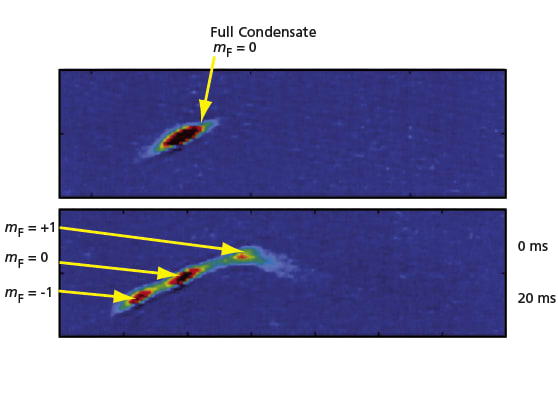
As a result of this reaction, the original condensate becomes a superposition of (1) equal numbers of atoms in the mF =+1 and mF =–1 levels and (2) some other number of atoms in the initial mF = 0 level.
Unlike the mF = 0 level, the mF = +1 and mF = –1 levels are sensitive to an applied magnetic field. Therefore, several milliseconds before turning off the optical trap, a suitably oriented magnetic field having a gradient is turned on. By virtue of their different sensitivities to the magnetic field, atoms in the mF = +1 level can be coupled out of the trap region in one direction and atoms in the mF = –1 level in a different direction (see figure), thereby generating the desired two pulsed beams containing equal numbers of atoms. (The mF = 0 atoms are affected only by the same gravitational force that affects the mF = +1 and mF = –1 atoms.)
This work was done by Robert Thompson, Nathan Lundblad, Lute Maleki, and David Aveline of Caltech for NASA’s Jet Propulsion Laboratory. NPO-43741
This Brief includes a Technical Support Package (TSP).
Dual-Beam Atom Laser Driven by Spinor Dynamics
(reference NPO-43741) is currently available for download from the TSP library.
Don't have an account?
Overview
The document is a Technical Support Package from NASA's Jet Propulsion Laboratory (JPL) concerning the innovation titled "Dual-Beam Atom Laser Driven by Spinor Dynamics," identified by NTR Number 43741. This technology is part of NASA Tech Briefs, which aims to disseminate aerospace-related developments that may have broader applications in various fields.
The dual-beam atom laser represents a significant advancement in the manipulation of atomic particles, utilizing spinor dynamics to achieve its functionality. Spinor dynamics refers to the behavior of particles with spin, which is a fundamental property of quantum mechanics. By leveraging these dynamics, the dual-beam atom laser can potentially enhance precision in various applications, including quantum computing, atomic interferometry, and other fields that require fine control over atomic states.
The document emphasizes the importance of this technology within the context of NASA's Commercial Technology Program, which seeks to promote innovations that can benefit both aerospace and non-aerospace sectors. The aim is to make the results of such developments accessible for commercial use, thereby fostering partnerships and collaborations that can lead to further advancements.
Additionally, the document provides contact information for further inquiries, specifically directing interested parties to the Innovative Technology Assets Management office at JPL. This office can provide additional insights and support regarding research and technology related to the dual-beam atom laser and its potential applications.
It is important to note that the document includes a disclaimer stating that the United States Government, nor any individual acting on its behalf, assumes liability for the use of the information contained within. The mention of trade names or manufacturers is solely for identification purposes and does not imply any official endorsement by NASA.
In summary, the Technical Support Package outlines a promising innovation in the field of atomic manipulation through the dual-beam atom laser driven by spinor dynamics. It highlights the potential applications of this technology and encourages collaboration for further development, while also providing necessary contact information for interested parties.











