

A piezoelectrically actuated shutter is undergoing development for use in experiments on laser cooling of atoms. The shutter is required to be compatible with ultrahigh vacuum [pressure of 10-9 torr (≈1.3 X 10⁻⁷ Pa) or less] and to be capable of performing reliably in the vacuum for at least one year. In operation, the shutter would enable the collection and launch of successive samples of cold atoms and would enable the interrogation of the immediately preceding sample while preventing disturbance of the atoms of that sample by light from the collection region.
A major constraint is imposed on the design and operation of the shutter by a requirement that it not generate a magnetic field large enough to perturb an atomic clock. An electromagnetically actuated shutter could satisfy all requirements except this one. Hence, it was decided to use piezoelectric instead of electromagnetic actuation.
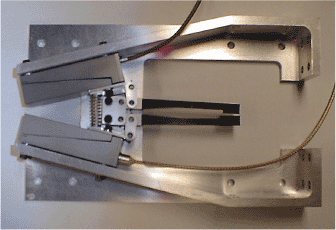
The shutter (see figure) includes two commercial piezoelectrically driven flexure stages that produce a travel of 0.5 mm. Levers mechanically amplify the travel to the required level of 1 cm. Problems that remained to be addressed at the time of reporting the information for this article included lifetime testing and correction of a tendency for shutter blades to bounce open.
This work was done by Robert Thompson and Gerhard Klose of Caltech for NASA's Jet Propulsion Laboratory. For further information, access the Technical Support Package (TSP) free on-line at www.techbriefs.com/tsp under the Mechanics category. NPO-30397.
This Brief includes a Technical Support Package (TSP).
Piezoelectrically Actuated Shutter for High Vacuum
(reference NPO-30397) is currently available for download from the TSP library.
Don't have an account?
Overview
The document discusses the development of a piezoelectrically actuated shutter designed for use in experiments involving laser cooling of atoms, specifically at NASA's Jet Propulsion Laboratory (JPL). This shutter is intended to operate in ultrahigh vacuum conditions, with a pressure of 10^-9 torr (approximately 1.3 × 10^-7 Pa) or less, and is required to function reliably for at least one year without generating significant magnetic fields that could interfere with atomic clocks.
The motivation behind this project stems from the need for a non-magnetic shutter system that can facilitate the collection and launch of successive samples of cold atoms while allowing the interrogation of the preceding sample. This capability is crucial for experiments that require precise control over atomic states without disturbance from light in the collection region.
To achieve the necessary performance, the shutter employs two commercial piezoelectric (PZT) flexure stages, which provide a travel distance of 0.5 mm. A mechanical lever system amplifies this travel to the required 1 cm. The design addresses several challenges, including lifetime testing and mitigating a tendency for the shutter blades to bounce open during operation.
The document highlights the innovative aspects of the shutter system, emphasizing its compatibility with ultrahigh vacuum environments and its non-magnetic properties, which distinguish it from traditional electromagnetic actuators. The work is part of a broader effort to improve the performance of space-based atomic clocks, which are essential for various applications in precision measurement and navigation.
The project is credited to Robert Thompson and Gerhard Klose, with further information available through the Technical Support Package (TSP) provided by NASA. The document serves as a technical brief, summarizing the novelty, problem, and solution associated with the shutter's development, and it outlines the potential impact of this technology on future scientific experiments and advancements in atomic physics.
Overall, this piezoelectrically actuated shutter represents a significant advancement in the field of experimental physics, enabling more precise studies of atomic behavior in microgravity and contributing to the ongoing exploration of fundamental physics.











