The figure shows a prototype vacuum-compatible, fast-acting, long-life shutter unit that generates very little vibratory disturbance during switching. This is one of a number of shutters designed to satisfy requirements specific to an experiment, to be performed aboard a spacecraft in flight, in which laser beams must be blocked rapidly and completely, without generating a vibratory disturbance large enough to adversely affect the power and frequency stability of the lasers. Commercial off-the-shelf laboratory shutter units — typically containing electromagnet-coil-driven mechanisms — were found not to satisfy the requirements because they are not vacuum-compatible, their actuators engage in uncompensated motions that generate significant vibrations, and their operational lifetimes are too short. Going beyond the initial outer-space application, the present vacuum compatible, fast-acting, long-life shutter units could also be used in terrestrial settings in which there are requirements for their special characteristics.
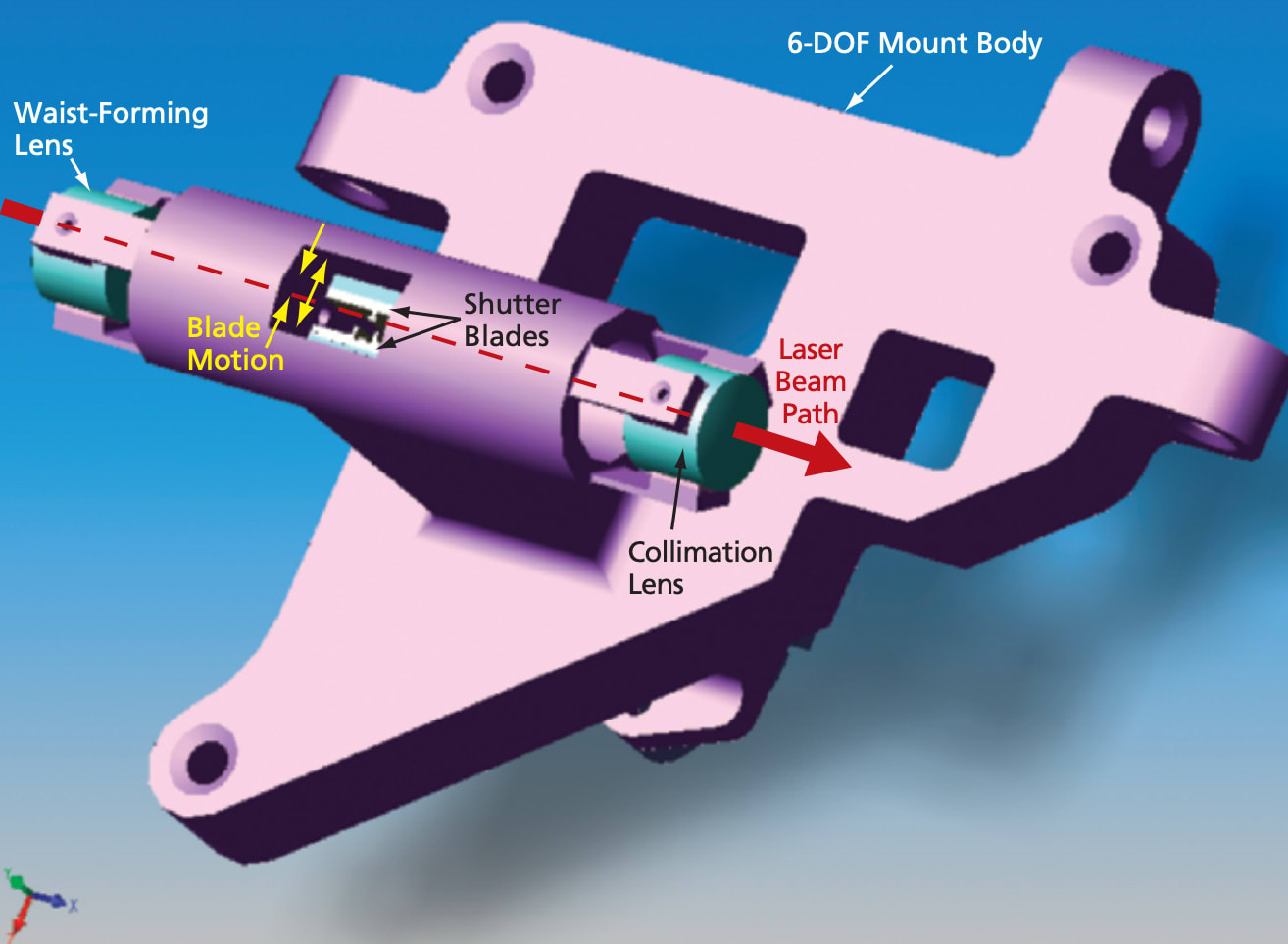
In designing these shutter units, unbalanced, electromagnetically driven mechanisms were replaced with balanced mechanisms that include commercial piezoelectric bending actuators. In each shutter unit, the piezoelectric bending actuators are configured symmetrically as opposing cantilever beams within a housing that contains integral mounts for lenses that focus a laser beam to a waist at the shutter location. In operation, the laser beam is blocked by titanium blades bonded near the free ends of the piezoelectric benders. The benders are driven by shaped electrical pulses with a maximum voltage differential of less than 60 V. Preliminary measurements indicate that rise and fall times are less than 1 ms.
This work was done by David Brinza, Donald Moore, Eric Hochberg, Tom Radey, and Albert Chen of Caltech for NASA's Jet Propulsion Laboratory. For further information, access the Technical Support Package (TSP) free on-line at www.techbriefs.com/tsp under the Mechanics category.
The software used in this innovation is available for commercial licensing. Please contact Don Hart of the California Institute of Technology at (818) 393-3425. Refer to NPO-40151.
This Brief includes a Technical Support Package (TSP).
Fast Laser Shutters With Low Vibratory Disturbances
(reference NPO-40151) is currently available for download from the TSP library.
Don't have an account?
Overview
The document is a technical support package from NASA's Jet Propulsion Laboratory, detailing the development and features of fast laser shutters designed for applications in laser cooling and atomic physics. The primary focus is on a PZT (piezoelectric ceramic) based laser shutter that offers several advantages, particularly in minimizing vibratory disturbances, which is crucial for sensitive atomic physics experiments.
Key features of the PZT laser shutter include:
-
Fast-Acting Mechanism: The shutter employs a balanced PZT bender mechanism that allows for rapid operation, with a rise and fall time of just 1 millisecond. This quick response is essential for applications requiring precise timing in laser operations.
-
Vibratory Disturbance Minimization: The design of the shutter minimizes vibratory disturbances, which is critical in experiments where even minor vibrations can affect the results. This makes the shutter particularly suitable for delicate atomic physics applications.
-
Vacuum Compatibility: The materials used in the construction of the shutter are compatible with vacuum environments, making it suitable for use in various scientific settings where vacuum conditions are necessary.
-
Compact and Low-Mass Design: The shutter is designed to be compact and lightweight, which is advantageous for integration into existing experimental setups without adding significant bulk or weight.
-
Long Life Cycle: The PZT benders used in the shutter have demonstrated a long operational life, exceeding 1 billion cycles, ensuring reliability and longevity in demanding applications.
-
Integral Lens Mounts: The device includes integral lens mounts that help form a tight beam waist at the shutter blades, enhancing the precision of the laser output.
-
Low-Voltage Operation: The shutter is driven by low-voltage electrical pulses (less than 60 V), making it energy-efficient and safe for various applications.
The document also emphasizes the broader implications of this technology, suggesting that the advancements in fast laser shutters could have wider technological, scientific, and commercial applications beyond just atomic physics. It encourages further exploration of related research and technology through NASA's Scientific and Technical Information (STI) Program Office.
Overall, this technical support package highlights a significant advancement in laser technology, showcasing how NASA's innovations can contribute to the fields of science and engineering.