

Booms and other structures consisting mainly of thin spring strips are undergoing development. These structures are designed to be lightweight, to be compactly stowable, and to be capable of springing to stable configurations at full extension once released from stowage. Conceived for use as self-deploying structures in outer space, portable structures of this type may also be useful on Earth in applications in which there are requirements for light weight and small transportation volume.
The elements common to these structures are spring strips with curved cross sections — similar to spring strips of the type commonly used as compactly stowable carpenters' measuring tapes. These structures exploit the nonlinear mechanical properties of such tapes, namely (1) strong resistance to axial buckling while they are straight and (2) ease with which they can be wound into compact rolls once they have been initially bent. For a structure that contains multiple such strips, the net effect of the combined nonlinear characteristics is the following:
- When at full extension, the structure is in a stable state, in which it is rigid and strong.
- When stowed compactly, the structure is in a state that is semistable in the sense that only a small force is needed to restrain the structure against deployment.
- The strain energy stored in the spring strips during compaction is sufficient to deploy the structure to full extension when the restraint is removed.
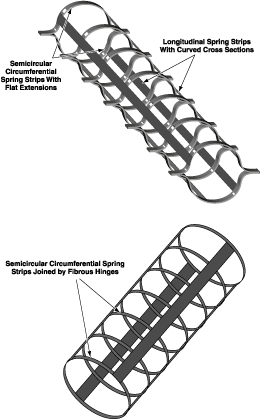
Another design features semicircular circumferential spring strips joined by fibrous hinges. The main disadvantage of this design is less strength, relative to the design described above; the main advantages are less weight and volume as well as greater safety during deployment. Still other designs feature, variously, circumferential spring strips with self-locking hinges, and deployment control devices to reduce deployment speeds.
This work was done by Houfei Fang, Michael Lou, and Nathan Palmer of Caltech for NASA's Jet Propulsion Laboratory. For further information, access the Technical Support Package (TSP) free on-line at www.techbriefs.com/tsp under the Mechanics category. NPO-30175.
This Brief includes a Technical Support Package (TSP).
Self-Deployable Spring-Strip Booms
(reference NPO-30175) is currently available for download from the TSP library.
Don't have an account?
Overview
The document discusses the development of self-deployable spring-strip booms, a lightweight and compact structural innovation designed primarily for use in outer space by NASA's Jet Propulsion Laboratory (JPL). These structures utilize thin spring strips with curved cross-sections, similar to those found in compact measuring tapes, to achieve a unique combination of mechanical properties.
The primary advantage of these spring-strip booms is their ability to be stowed compactly and deployed into a stable, rigid configuration with minimal effort. The design exploits the nonlinear mechanical characteristics of the spring strips, which provide strong resistance to axial buckling when straight and allow for easy winding into compact rolls when bent. This dual functionality enables the structures to transition between two states: a stable status, where they are fully deployed and rigid, and a semi-stable status, where they can be efficiently packaged and require only a small force to maintain.
The document outlines the motivation behind this innovation, highlighting the limitations of traditional mechanical deployable structures, which tend to be heavy, complex, and reliant on numerous moving parts and power systems. These mechanical systems are prone to failure during deployment, which poses significant risks for space missions. In contrast, the self-deployable spring-strip booms are designed to be robust, lightweight, and guaranteed to deploy successfully without the need for complex mechanisms or power sources.
The deployment process involves converting a large amount of energy into strain energy when the structure is stowed. This stored energy facilitates the transition from the semi-stable to the stable state, ensuring a reliable deployment. The document emphasizes the high packaging efficiency and the simplicity of the design, making it an attractive alternative to existing mechanical systems.
Overall, the self-deployable spring-strip booms represent a significant advancement in space structure technology, offering a solution that meets the demands for lightweight, efficient, and reliable deployment systems in space exploration. The work is part of ongoing efforts to innovate in the field of aerospace engineering, aiming to enhance the capabilities of future space missions.











