

Back actuators have been proposed as alternatives to edge actuators considered previously for use in aligning hexagonal segments of lightweight segmented astronomical mirrors planned for use in outer space. The proposed back actuators could also be useful on Earth as parts of wafer-conveyance systems in the semiconductor industry.
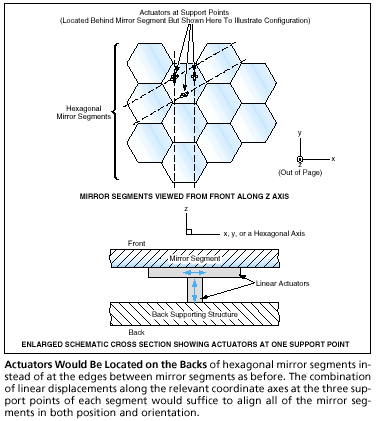 Whereas the prior edge actuators were required to impose rotations and torques (in addition to forces and displacements) at joints between mirror segments, the proposed back actuators would be required to impose only forces and displacements (sometimes accompanied by small incidental torques and rotations). The advantages of the back-actuation approach, relative to the edge-actuation approach, are that the actuation mechanisms could be made simpler and a single overall actuation scheme could incorporate what were previously separate actuation schemes for (1) orienting the mirror segments at the required angles and (2) placing the mirror segments at the required distances along the optical axis from the focus.
Each hexagonal mirror segment would be supported at three points by sets of linear actuators (see figure). The linear actuators at each support point would include one to impose displacement along the optical axis (the z axis in the figure) plus one or two to impose displacement along one or two of the hexagonal axes. The linear actuators could be, for example, shape-memory-alloy actuators or piezoelectric actuators that move in the manner of an inchworm like those described in several previous NASA Tech Briefs articles.
This work was done by Eui-Hyeok Yang and Dean Wiberg of Caltech for NASA's Jet Propulsion Laboratory. For further information, access the Technical Support Package (TSP) free on-line at www.techbriefs.com/tsp under the Mechanics category. NPO-30550
This Brief includes a Technical Support Package (TSP).
Back Actuators for Segmented Mirrors and Other Applications
(reference NPO-30550) is currently available for download from the TSP library.
Don't have an account?
Overview
The document is a technical support package from NASA's Jet Propulsion Laboratory, focusing on back actuators for segmented mirrors and their applications, particularly in space telescopes. It discusses innovative actuation mechanisms designed to align mirror segments without the complexities associated with traditional edge actuation systems.
The primary innovation presented is a bottom actuation concept that allows for the alignment of mirror segments in x-y-z directions without involving torsion or rotation mechanisms. This contrasts with the edge actuation concept, which requires a more complex system of micro actuators placed along the edges of the segments, leading to challenges in alignment due to the need for torsion and rotation adjustments.
The document highlights the advantages of using Micro-Electro-Mechanical Systems (MEMS) actuators, which offer high bandwidth control and can significantly reduce the mass of large segmented optical systems. The inchworm actuator concept is introduced, which combines piezoelectric stack actuators with two-way Shape-Memory Alloy (SMA) actuators for effective height and angle control of the mirror segments.
Figures included in the document illustrate the actuation concepts, showing how the bottom actuation system can simplify the alignment process. The proposed mechanism aims to enhance the performance of segmented mirrors by integrating most of the necessary functionalities into the actuators themselves, thereby improving the overall efficiency and effectiveness of the optical system.
The document also addresses the motivation behind the development of these actuation mechanisms, emphasizing the need for simpler, more reliable systems that can support the ambitious goals of future space telescopes. By reducing the complexity of the actuation system, the proposed solutions aim to facilitate the deployment and operation of large segmented mirrors in space, ultimately contributing to advancements in astronomical observation and research.
In summary, this technical support package outlines a significant advancement in the design and functionality of actuators for segmented mirrors, showcasing NASA's commitment to innovation in aerospace technology and its potential impact on future space exploration missions.











