

The figure depicts a micromachined silicon vibratory gyroscope that senses rotation about its z axis. The rotation-sensitive vibratory element is a post oriented (when at equilibrium) along the z axis and suspended at its base by thin, flexible silicon bands oriented along the x and y axes, respectively. Unlike in the vibratory microgyroscopes described in the immediately preceding article ["Cloverleaf Vibratory Microgyroscope With Integrated Post" (NPO-20688)] and other previous articles in NASA Tech Briefs, the rotation-sensitive vibratory element does not include a cloverleaf-shaped structure that lies (when at equilibrium) in the x-y plane.
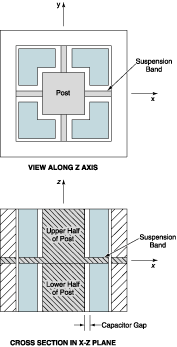
In this case, the vibrations in question are those associated with motion of the outer ends of the post in the x-y plane, and the axis of sensitivity is the z axis. The post is initially driven to oscillation of its outer (free) ends along, say, the x axis. Under rotation about the z axis, the Coriolis force causes the outer ends of the post to oscillate along the y axis also. The rotation-rate sensitivity of the microgyroscope is proportional to the rate of rotation about the z axis, the drive amplitude, and the resonance quality factor (Q) of the vibratory element.
Like the vibratory microgyroscope described in the immediately preceding article, this one is fabricated as two micromachined silicon components, which are then bonded together. In this case, the four flexible suspension bands and half of the post are made from one silicon wafer, while the other half of the post is made from another silicon wafer.
This work was done by Tony K. Tang and Roman Gutierrez of Caltech for NASA's Jet Propulsion Laboratory. For further information, access the Technical Support Package (TSP) free on-line at www.techbriefs.com under the Mechanics category.
In accordance with Public Law 96-517, the contractor has elected to retain title to this invention. Inquiries concerning rights for its commercial use should be addressed to
Intellectual Property group
JPL
Mail Stop 202-233
4800 Oak Grove Drive
Pasadena, CA 91109
(818) 354-2240
Refer to NPO-20690, volume and number of this NASA Tech Briefs issue, and the page number.
This Brief includes a Technical Support Package (TSP).
Microgyroscope With Vibrating Post as Rotation Transducer
(reference NPO-20690) is currently available for download from the TSP library.
Don't have an account?
Overview
The document presents a technical overview of a Z-Axis Vibratory Gyro developed by Roman C. Gutierrez and Tony K. Tang at NASA's Jet Propulsion Laboratory (JPL). This innovative gyroscope is designed to sense rotation about its z-axis using a micromachined silicon structure. Unlike previous vibratory microgyroscopes, this device does not incorporate a cloverleaf structure, which is a notable departure from earlier designs.
The core component of the gyroscope is a post oriented along the z-axis, suspended at its base by thin, flexible silicon bands aligned with the x and y axes. The device operates by exciting vibrations in the post electrostatically, which are then measured using capacitive proximity sensors. The rate of rotation is determined by observing the effects of the Coriolis force on these vibrations, which occur when the device is rotated about the z-axis.
The document details the construction of the gyroscope, highlighting that it is fabricated from two micro-machined silicon components that are bonded together. The flexible suspension bands and half of the post are made from one silicon wafer, while the other half of the post is made from a second wafer. This design allows for precise control and sensitivity in detecting rotational motion.
The rotation-rate sensitivity of the gyroscope is influenced by several factors, including the rate of rotation about the z-axis, the drive amplitude, and the resonance quality factor (Q) of the vibratory element. The document emphasizes the importance of these parameters in optimizing the performance of the gyroscope.
Additionally, the document includes a notice regarding the retention of title to the invention by the contractor, in accordance with Public Law 96-517, and provides contact information for inquiries about commercial use rights. It also includes disclaimers about the use of trade names and the liability of the U.S. Government regarding the information contained in the document.
Overall, this technical brief outlines a significant advancement in gyroscope technology, showcasing the innovative design and operational principles of the Z-Axis Vibratory Gyro, which has potential applications in various fields, including aerospace and navigation.











