The flight-test community routinely spends considerable time and money to determine a range of flight conditions, called a flight envelope, within which an aircraft is safe to fly. The cost of determining a flight envelope could be greatly reduced if there were a method of safely and accurately predicting the speed associated with the onset of an instability called flutter.
Several methods have been developed with the goal of predicting flutter speeds to improve the efficiency of flight testing. These methods include (1) data-based methods, in which one relies entirely on information obtained from the flight tests and (2) model-based approaches, in which one relies on a combination of flight data and theoretical models. The data-driven methods include one based on extrapolation of damping trends, one that involves an envelope function, one that involves the Zimmerman-Weissenburger flutter margin, and one that involves a discrete-time auto-regressive model. An example of a model-based approach is that of the flutterometer. These methods have all been shown to be theoretically valid and have been demonstrated on simple test cases; however, until now, they have not been thoroughly evaluated in flight tests.
For a flight test of flutter-prediction methods, the ATW was flown on four occasions during April 2001. The flight test involved measuring accelerometer responses as a series of test points. The airspeeds of these test points were increased until the onset of flutter was encountered at 460 knots of equivalent airspeed (KEAS) [≈237 m/s equivalent airspeed].
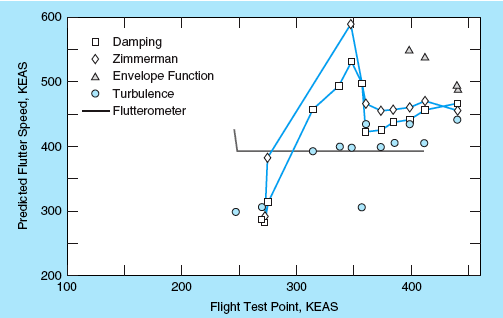
Predictions of the speed associated with flutter were computed at every test point. In each instance, the prediction was based on data from the current test point and any previous test points. The predicted speeds at the test points are plotted in Figure 1.
The predictions depicted in Figure 1 can be easily summarized. The data-based methods yield poor predictions for low-speed data but produce reasonable predictions that converge on the correct answer as the envelope is expanded to include high-speed test points. The flutterometer produces a reasonable worst-case prediction of flutter speed immediately and remains conservative throughout the envelope expansion.
An analysis of Figure 1 reveals the nature of the prediction methods. In the data-driven methods, one attempts to compute the exact speed associated with the onset of flutter. In the flutterometer (model-based) method, one attempts to obtain a conservative prediction of the worst-case flutter speed. It is expected that the data-driven methods should yield highly accurate predictions at test points close to flutter and that the particular implementation of the flutterometer should not reduce conservatism despite the analysis of data from high-speed test points.
The nature of the prediction methods indicates a method for efficient envelope expansion. A flight test should be initiated at low-speed test points and the flutterometer should be used to obtain a conservative estimate of the flutter speed. As the test proceeds, the airspeed should be increased until the system nears the speed of instability predicted by the flutterometer. At this point, the envelope should be expanded to high-speed test points by relying heavily on the data-based methods to finalize an accurate prediction of the exact speed at which flutter will be encountered.
This work was done by Rick Lind and Marty Brenner of Dryden Flight Research Center. For further information, access the Technical Support Package (TSP) free on-line at www.techbriefs.com/tsp under the Mechanics category.
DRC-01-57
This Brief includes a Technical Support Package (TSP).
Flight-Test Evaluation of Flutter-Prediction Methods
(reference DRC-01-57) is currently available for download from the TSP library.
Don't have an account?
Overview
The document is a Technical Support Package for the flight-test evaluation of flutter-prediction methods, designated as DRC-01-57, and published by NASA Tech Briefs. It is part of NASA's Commercial Technology Program, which aims to disseminate results from aerospace-related developments that have potential applications beyond their original context.
The primary focus of the document is to provide insights into flutter-prediction methods, which are critical for ensuring the safety and performance of aircraft. Flutter is a dynamic instability that can occur in structures subjected to aerodynamic forces, and accurately predicting it is essential for the design and operation of aircraft. The document likely includes methodologies, findings, and recommendations based on flight tests conducted to evaluate these prediction methods.
In addition to the technical content, the document serves as a resource for researchers, engineers, and industry professionals interested in aerospace technology. It emphasizes the importance of sharing knowledge and advancements in the field, which can lead to improved safety and efficiency in aviation.
The document also provides contact information for further assistance, directing readers to the NASA Scientific and Technical Information (STI) Program Office. This office offers additional resources and publications related to aerospace research and technology, highlighting NASA's commitment to making its findings accessible to a broader audience.
Furthermore, the document includes a disclaimer stating that the U.S. Government and its representatives do not assume liability for the use of the information contained within. It clarifies that any mention of trade names or manufacturers is for identification purposes only and does not imply endorsement by NASA.
Overall, this Technical Support Package is a valuable contribution to the field of aerospace engineering, particularly in the area of flutter prediction, and serves as a reference for ongoing research and development efforts aimed at enhancing aircraft safety and performance.