A compact, low-cost laser communications transceiver was prototyped for downlinking data at 10 Gb/s from Earth-orbiting spacecraft. The design can be implemented using flight-grade parts. With emphasis on simplicity, compactness, and light weight of the flight transceiver, the reduced-complexity design and development approach involves:
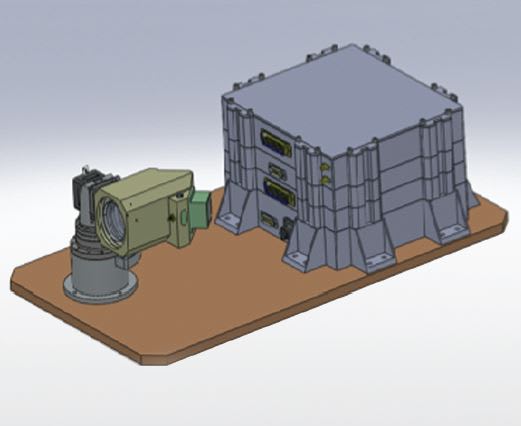
- A high-bandwidth coarse wavelength division multiplexed (CWDM) (4×2.5 or 10-Gb/s data-rate) downlink transmitter. To simplify the system, emphasis is on the downlink. Optical uplink data rate is modest (due to existing and adequate RF uplink capability).
- Highly simplified and compact 5-cmdiameter clear aperture optics assembly is configured to single transmit and receive aperture laser signals. About 2 W of 4-channel multiplexed (1,540 to 1,555 nm) optically amplified laser power is coupled to the optical assembly through a fiber optic cable. It contains a highly compact, precision-pointing capability two-axis gimbal assembly to coarse point the optics assembly. A fast steering mirror, built into the optical path of the optical assembly, is used to remove residual pointing disturbances from the gimbal. Acquisition, pointing, and tracking are assisted by a beacon laser transmitted from the ground and received by the optical assembly, which will allow transmission of a laser beam.
- Shifting the link burden to the ground by relying on direct detection optical receivers retrofitted to 1-mdiameter ground telescopes.
- Favored mass and volume reduction over power-consumption reduction. The two major variables that are available include laser transmit power at either end of the link, and telescope aperture diameter at each end of the link. Increased laser power is traded for smaller-aperture diameters.
- Use of commercially available space qualified or qualifiable components with traceability to flight qualification (i.e., a flight-qualified version is commercially available). An example is use of Telecordia-qualified fiber optic communication components including active components (lasers, amplifiers, photodetectors) that, except for vacuum and radiation, meet most of the qualifications required for space.
- Use of CWDM technique at the flight transmitter for operation at four channels (each at 2.5 Gb/s or a total of 10 Gb/s data rate). Applying this technique allows utilization of larger active area photodetectors at the ground station. This minimizes atmospheric scintillation/turbulence induced losses on the received beam at the ground terminal.
- Use of forward-error-correction and deep-interleaver codes to minimize atmospheric turbulence effects on the downlink beam.
Target mass and power consumption for the flight data transmitter system is less than 10 kg and approximately 60 W for the 400-km orbit (900-km slant range), and 12 kg and 120 W for the 2,000-km orbit (6,000- km slant range). The higher mass and power for the latter are the result of employing a higher-power laser only.
This work was done by Joseph M. Kovalik, Hamid Hemmati, Abhijit Biswas, and William T. Roberts of Caltech for NASA's Jet Propulsion Laboratory. NPO-48413
This Brief includes a Technical Support Package (TSP).
Simple Laser Communications Terminal for Downlink From Earth Orbit at Rates Exceeding 10 Gb/s
(reference NPO-48413) is currently available for download from the TSP library.
Don't have an account?
Overview
The document outlines the development of a Simple Laser Communications Terminal designed for high-speed downlink communications from Earth orbit, capable of exceeding 10 Gb/s. This project, carried out by the Jet Propulsion Laboratory (JPL) at the California Institute of Technology, is part of NASA's efforts to enhance data transmission capabilities for future Earth-observing missions.
The novelty of the implementation lies in its reduced complexity, which translates to lower costs, mass, and size. The flight subsystem is composed of two main assemblies: the Optics Assembly and the Electronics Assembly. The Optics Assembly features a 5-cm diameter telescope with high optical throughput, a quadrant detector for tracking laser beams and detecting uplink data, a miniature two-axis fine beam-pointing mirror to counteract residual vibrations, and a coarse-pointing gimbal for initial alignment. Additionally, it includes monitoring sensors and thermal control systems.
The Electronics Assembly consists of custom-designed electronics boards that prioritize high capability and compact size. This assembly includes a transmitter/modem, processor, controllers/drivers, monitoring sensors, power conditioning, thermal management, and interfaces with the host platform. The system is designed to operate within the standard C-band telecom grid, utilizing wavelengths that enhance eye safety and reduce atmospheric turbulence effects.
The document also discusses how this technology relates to current and future NASA missions, specifically mentioning Earth-observer missions such as DESDynI, HyspIRI, and ACE, which require high-bandwidth communications to fulfill their objectives. The laser communication system developed at JPL is positioned to meet these demands uniquely and cost-effectively.
Furthermore, the document outlines the testing phases for the flight system, including transfer function measurements, jitter measurements, end-to-end data transmission tests, and outdoor field tests. These tests are crucial for validating the performance and reliability of the communication system in real-world conditions.
In summary, this document presents a comprehensive overview of a cutting-edge laser communication system that promises to significantly improve data transmission capabilities for NASA's Earth-observing missions, leveraging advanced optical and electronic technologies to achieve high-speed communications in space.