A proposed method of stabilizing microwave and millimeter-wave oscillators calls for the use of feedback in optoelectronic delay lines characterized by high values of the resonance quality factor (Q). The method would extend the applicability of optoelectronic feedback beyond the previously reported class of optoelectronic oscillators that comprise two-port electronic amplifiers in closed loops with high-Q feedback circuits.
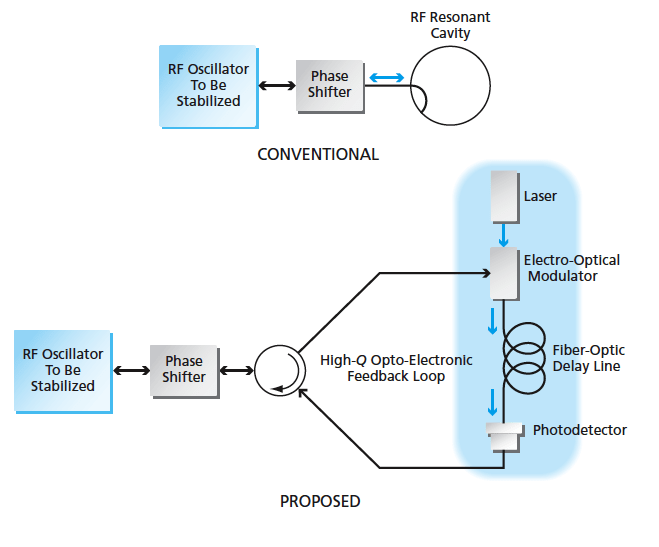
The proposed method is partly similar to two older patented methods that involve the use of fiber-optic delay lines as RF-phase-noise discriminators. However, unlike those methods, the proposed method does not call for the generation of a low-frequency signal applied to a control port of the oscillator to be stabilized. Instead, the delayed RF signal would simply be returned to the oscillator, as described below.
The lower part of the figure shows an example of the same oscillator as before, but this time stabilized by use of optoelectronic feedback according to the proposed method. The RF signal from the oscillator would be fed through a circulator to an electro-optical modulator, which would modulate the RF signal onto a laser beam. After traveling the length of an optical fiber or other optical delay line, a photodetector would demodulate the signal. The RF output of the photodetector would be returned via the circulator to the oscillator.
The return of the delayed RF signal would enforce a steady phase in an otherwise noisy free-running oscillator, thereby suppressing phase noise in the oscillations. This stabilizing effect is expected as a consequence of the frequency-pulling effect or self-injection locking observed previously in oscillators equipped with high-Q external resonant cavities.
The original tunability of the free-running oscillator would be substantially preserved in the presence of optoelectronic stabilization, except as described next: Upon tuning of the oscillator, the frequency of the oscillator would not change continuously but would jump between successive resonances of the optoelectronic feedback loop . Typical frequency jumps would likely range from a few tens of kilohertz for a kilometer-long fiber-optic delay line up to a few gigahertz for an optical microresonator.
This work was done by Lute Maleki and Vladimir Iltchenko of Caltech for NASA’s Jet Propulsion Laboratory.
In accordance with Public Law 96-517, the contractor has elected to retain title to this invention. Inquiries concerning rights for its commercial use should be addressed to:
Innovative Technology Assets Management
JPL
Mail Stop 202-233
4800 Oak Grove Drive
Pasadena, CA 91109-8099
(818) 354-2240
E-mail:
Refer to NPO-40144, volume and number of this NASA Tech Briefs issue, and the page number.
This Brief includes a Technical Support Package (TSP).
Simple Optoelectronic Feedback in Microwave Oscillators
(reference NPO-40144) is currently available for download from the TSP library.
Don't have an account?
Overview
The document is a Technical Support Package from NASA's Jet Propulsion Laboratory (JPL) concerning "Simple Optoelectronic Feedback in Microwave Oscillators," identified by the reference number NPO-40144. It is part of the NASA Tech Briefs, which aim to disseminate information about aerospace-related technological advancements that may have broader applications in various fields.
The focus of this document is on the innovative use of optoelectronic feedback mechanisms in microwave oscillators. Microwave oscillators are critical components in various applications, including telecommunications, radar systems, and satellite communications. The integration of optoelectronic feedback can enhance the performance and efficiency of these oscillators, potentially leading to advancements in signal processing and transmission.
The document emphasizes the importance of this research under the Commercial Technology Program of NASA, which seeks to promote the commercialization of aerospace technologies. By making the results of such developments available, NASA aims to foster innovation and collaboration between government, industry, and academia.
Additionally, the document provides contact information for further inquiries, specifically directing interested parties to the Innovative Technology Assets Management team at JPL. This team can provide additional insights and assistance regarding research and technology in the area of optoelectronic feedback and microwave oscillators.
It is important to note that the document contains proprietary information and is subject to U.S. export regulations, highlighting the need for compliance with applicable laws when utilizing the information provided. The disclaimer also clarifies that the U.S. Government does not assume liability for the use of the information contained within the document, nor does it endorse any specific trade names or manufacturers mentioned.
In summary, this Technical Support Package serves as a resource for understanding the advancements in microwave oscillator technology through optoelectronic feedback, promoting further exploration and potential applications in various technological domains. It reflects NASA's commitment to sharing knowledge and fostering innovation in aerospace technologies that can benefit a wider audience beyond the space sector.