The beginning of the 21st century finds optoelectronics being one of the key disciplines on technological development. Substantial progress in computer technology, communication, imaging, illumination technology, sensor technology, medical technology or production technology is based on the availability of high-performance optoelectronic components. In particular, applications in consumer electronics presuppose an ever-increasing power density and continuous miniaturization of the components, while driving down costs per power unit. This goal can only be achieved through powerful mass production concepts.
Low Outgassing
Nearly every cured adhesive shows mass loss under the influence of temperatures. This effect is called outgassing. The reason for this effect may lie in the volatilization of non-reacted or only loosely bound constituents. In addition, whole fragments may get dissolved out of the polymer at elevated temperatures, or the network even depolymerizes as a consequence of the oxidative attack.
Aside from the fact that the bonded connection may fail as a result of thermal overload, the consequences of outgassing are not relevant for many users. The situation in optoelectronics, however, is different. Outgassing products may condense on the lenses of LED packages, and thus change the emission characteristics. They may also directly interact with the LED surface and reduce the light yield.
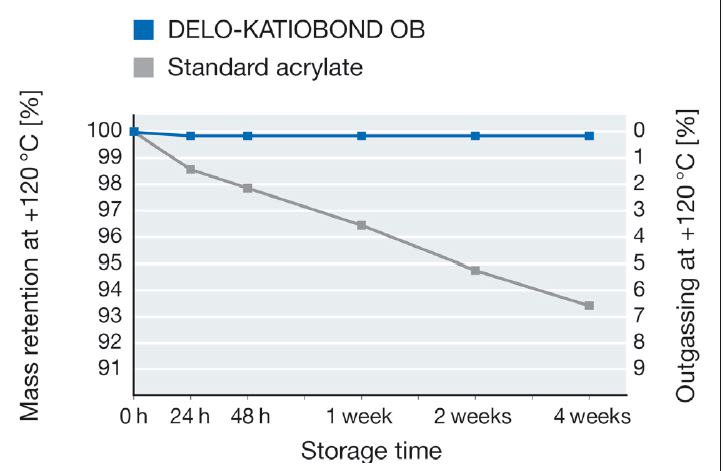
Some adhesives show very low outgassing in the magnitude of 0.1 mass% at 120°C. Their outgassing stops short ly after heating, while most light-curing acrylates already durably outgas at 120°C (Figure 1).
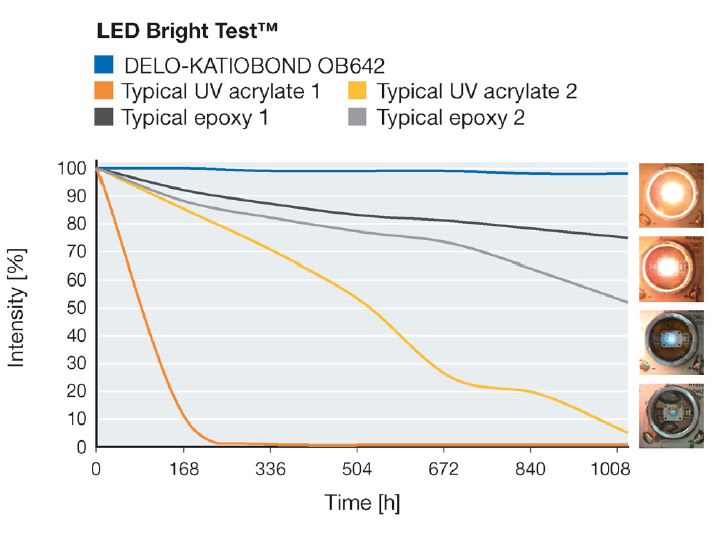
For the quantitative analysis of the outgassing products, analytical methods such as gas chromatography/mass spectroscopy (GCMS) are available. Fragments of hydrocarbons can be identified as main outgassing components of DELOOB adhesives. Many users, however, do not even know which substances are critical with regard to their application. In this case, developing application-related tests has proven to be beneficial. For example, consider the following test setup for LED applications. An LED on a printed circuit board is hermetically sealed in a housing with glass lid. A larger adhesive quantity is inserted into the housing from which material can outgas when the LED is on. By monitoring the time progress of the light intensity at the glass plate, or by visual inspection, it is possible to assess if the LEDís performance is influenced by adhesive outgassing or not.
Optical Stability
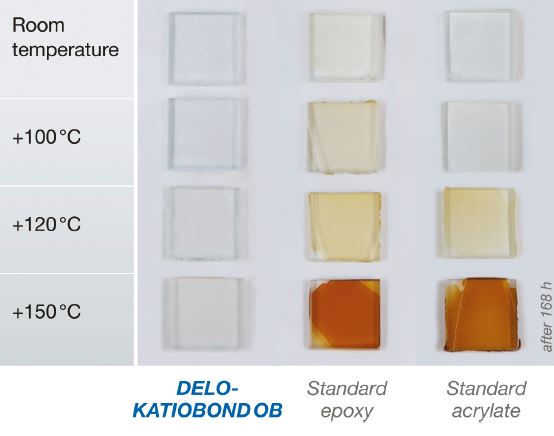
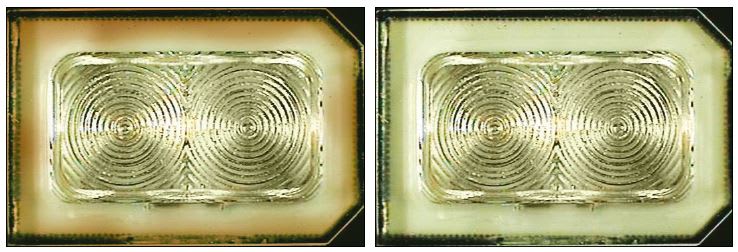
Even if the adhesive is not located directly in the beam path, users are often bothered by strong discoloration of the adhesive joint as, for example, the high-quality design of mobile phones is disturbed.
Fast Build-Up of Adhesion/Active Assembly
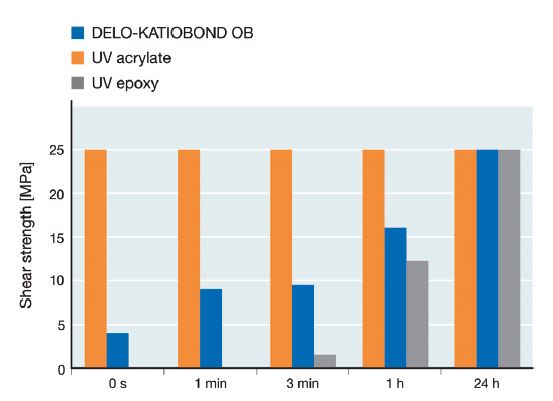
Although light-curing acrylates do not have optimal properties for optoelectronic applications, they are attractive because of their extremely fast radical curing process. Classical light-curing epoxies normally have to be irradiated for a short time as well. However, network formation is comparably slow so that the bonded components are ready for handling only after a few minutes. Curing is completed after 24 h in most cases.
With some adhesives, the polymerization of light-curing is so fast that sufficient functional strength is achieved at the end of irradiation. Therefore, higher output rates can be achieved in series production, and the materials meet the requirements of active alignment. During this process, optical components are directly aligned in production and must be fixed within seconds. It is often sufficient to quickly cure only one spot for the time being.
Low-Temperature Curing
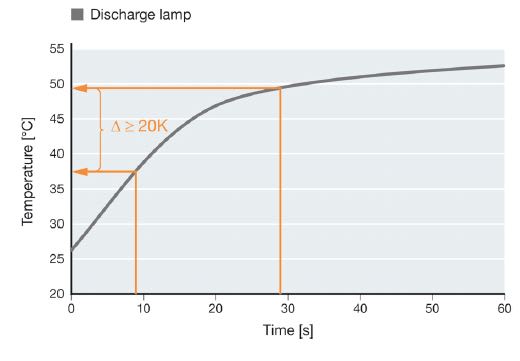
Light-curing adhesives can be cured at room temperature. This is an ideal answer to the requirements of optical components in terms of positioning accuracy and thermal loading capacity. However, components may heat up upon intensive irradiation by curing lamps. Black components, for example, can easily heat up to more than 100°C if the radiation intensity is high. With respect to the control of the temperature increase, the use of LED curing lamps is ideal. As the wavelength is optimally adjusted to the adhesiveís photoinitiator, adhesive curing is efficient without delivering radiation in wavelength ranges that does not contribute to curing, but heats up the substrate.
Reliability
Reliable Dispensing of Minute Quantities
In the production process of optoelectronic components, the vast number of the components to be bonded per time unit is not the only factor that presents a challenge. In the specific case of these components, it is also necessary to reliably dispense minute adhesive volumes of often clearly less than one milligram. Adhesives for such processes must optimally be adapted to the selected dispensing systems in terms of rheology, and must be absolutely homogeneous.
For more information, Click Here