The Robot Sequencing and Visualization Program (RSVP) is being used in the Mars Science Laboratory (MSL) mission for downlink data visualization and command sequence generation. RSVP reads and writes downlink data products from the operations data server (ODS) and writes uplink data products to the ODS. The primary users of RSVP are members of the Rover Planner team (part of the Integrated Planning and Execution Team (IPE)), who use it to perform traversability/ articulation analyses, take activity plan input from the Science and Mission Planning teams, and create a set of rover sequences to be sent to the rover every sol (see figure).
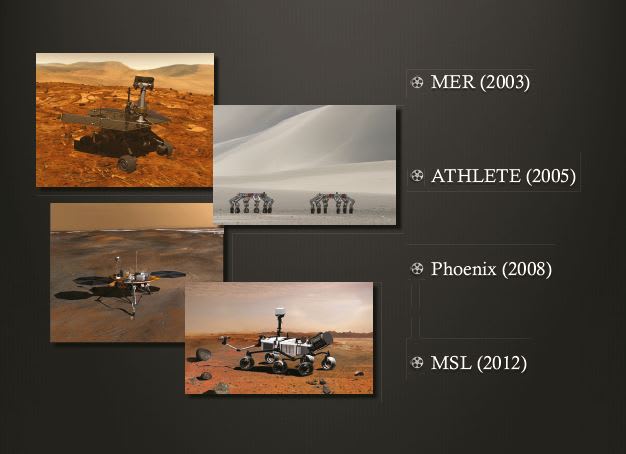
The second component of RSVP is called HyperDrive, a set of high-fidelity computer graphics displays of the Martian surface in 3D and in stereo. The Rover Planners can explore the environment around the rover, create commands related to motion of all kinds, and see the simulated result of those commands via its underlying tight coupling with flight navigation, motor, and arm software. This software is the evolutionary replacement for the Rover Sequencing and Visualization software used to create command sequences (and visualize the Martian surface) for the Mars Exploration Rover mission.
This work was done by Brian K. Cooper, Scott A. Maxwell, Frank R. Hartman, John R. Wright, Jeng Yen, Nicholas T. Toole, and Zareh Gorjian of Caltech; and Jack C. Morrison of Northrop Grumman for NASA’s Jet Propulsion Laboratory.
This software is available for commercial licensing. Please contact Dan Broderick at
This Brief includes a Technical Support Package (TSP).
Robot Sequencing and Visualization Program (RSVP)
(reference NPO-48690) is currently available for download from the TSP library.
Don't have an account?
Overview
The document outlines the Robot Sequencing and Visualization Program (RSVP) developed by NASA's Jet Propulsion Laboratory (JPL). RSVP is a sophisticated tool designed to enhance the exploration of Martian terrain and facilitate the operation of robotic systems in various space missions. It combines a data-driven text-based user interface known as the Robot Sequence Editor (RoSE) with a 3D visualization program called HyperDrive. This combination allows operators to create safe and verified command sequences for rovers, maximizing scientific returns from missions.
RSVP is inherently multimission, meaning it can be adapted for various types of space exploration, including surface missions, orbital missions, and planned human-assisted roles. The program is designed to accommodate both long time delay missions, such as those to Mars, and short time delay missions, like those to the Moon or asteroids. This flexibility makes RSVP a valuable asset for a wide range of space exploration scenarios.
The document highlights the program's capability to drive Athlete Robots in astronaut-controlled scenarios, particularly in the context of NASA's Constellation program. This demonstrates RSVP's applicability not only for robotic missions but also for potential human-robot interactions in future space exploration.
The technical support package emphasizes the importance of RSVP in creating immersive visualizations of remote environments, which aids in complex rover driving and arm manipulation. The interactive rehearsal interface provided by HyperDrive allows operators to virtually explore terrains before executing commands, ensuring a higher level of safety and efficiency in operations.
Overall, RSVP represents a significant advancement in robotic mission planning and execution, leveraging cutting-edge technology to enhance our understanding of extraterrestrial environments. The document serves as a technical brief, providing insights into the program's capabilities, applications, and the innovative technologies that support NASA's ongoing exploration efforts. It underscores the importance of such tools in the broader context of aerospace-related developments and their potential for wider technological, scientific, and commercial applications.