The harmful properties of lunar dust, such as small size, glass composition, abnormal surface area, and coatings of imbedded nanophase iron, lead to a unique coupling of the dust with microwave radiation. This coupling can be exploited for rapid sintering of lunar soil for use as a construction material that can be formed to take on an infinite number of shapes and sizes.
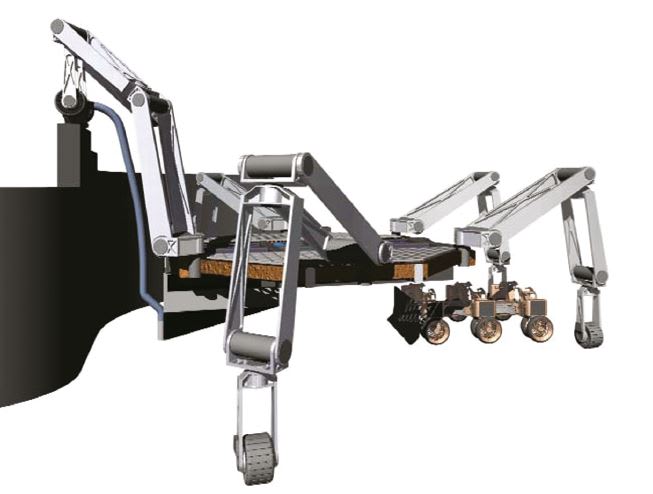
In support of long-duration human missions to the lunar surface, a variety of in situ derived structures have been proposed that would enhance the utility of a permanent outpost, provide safety for the outpost elements, and mitigate the generation of dust. Using regolith in a variety of ways, it has been proposed that berms, paving, walls, roads, and other structures could be constructed to serve as permanent outpost. However, the means of creating the in situ structures with hardened surfaces remains a challenge.
A lunar regolith processing system mounted on the underside of ATHLETE will deliver correctly sized regolith particles to a microwave print head via a material handling system. The microwave print head with tunable microwave chamber then lays down a layer of melted regolith as the ATHLETE arm traces a pre-defined path forming a layer of printed structure in any desired shape. The process is repeated for subsequent layers, allowing the system to construct hard walls, vaults, domes, paving, and other in situ structures. Since any solid structure can be printed in this way, the construction mechanism is named Freeform Additive Construction System (FACS), using a Microwave Sinterator (MS) as a print head. Structures can be modeled in advance using CAD systems, and then sent to the lunar system to “make a FACS (FAX)” of the structure on the lunar surface.
The key to the microwave heating of lunar soil is the coupling of certain microwave frequencies to specific materials. This will improve the efficiency of the device and expedite heating of the soil. Since lunar soil is composed of a variety of materials, a broadband microwave emitter must be used such as a magnetron or a traveling wave tube amplifier. The microwave energy must be aimed into a resonant chamber containing the regolith. The frequency, the chamber, or both will need to be autonomously tuned to excite frequencies that couple the microwave energy with the regolith. This will create a more efficient heating of the regolith.
The novelty of the FACS concept lies in the unique capability of the ATHLETE system as a positioning system, coupled with an efficient material handling system and the ability of the adjustable microwave chamber MS print head to produce hard structures in the vacuum environment of space, and result in a digitally printed in situ structure using in situ raw materials.
The simplest application of this technology is a microwave road-paver. This device will be able to create hard surfaces in the immediate area of astronauts for walkways, roadways, or landing pads. These hard surfaces will mitigate the effects of dust by limiting the exposure in the immediate area of habitats and minimizing the amount of dust kicked up by the descent engines of landing spacecraft.
This work was done by Alan S. Howe, Brian H. Wilcox, Martin B. Barmatz, Michael B. Mercury, Michael A. Seibert, and Richard R. Rieber of Caltech for NASA’s Jet Propulsion Laboratory. NPO-48291
This Brief includes a Technical Support Package (TSP).
Microwave Sinterator Freeform Additive Construction System (MS-FACS)
(reference NPO-48291) is currently available for download from the TSP library.
Don't have an account?
Overview
The document titled "Microwave Sinterator Freeform Additive Construction System (MS-FACS)" is a technical support package prepared by NASA's Jet Propulsion Laboratory (JPL) in April 2008. It outlines the development and functionality of a microwave sintering system designed for additive construction, particularly in extraterrestrial environments such as the Moon.
The MS-FACS utilizes a microwave sintering process to construct structures using lunar regolith, which is the loose material found on the Moon's surface. The system is designed to operate in conjunction with the ATHLETE (All-Terrain Hex-Legged Extra-Terrestrial Explorer) robotic platform, which plays a crucial role in the construction process. The microwave sinterer is positioned between two legs of the ATHLETE, allowing for precise movement and operation.
Key features of the MS-FACS include the ability to construct walls that can reach nearly twice the height of the ATHLETE itself. The system employs a flexible screw conveyor to transport regolith to a lower membrane hopper, where it can be collected and processed. The ATHLETE is capable of moving sideways to facilitate the construction of free-form structures, enhancing the versatility of the system.
The document also includes a block diagram of the sintering system, detailing components such as the emitter chamber, power system, and various adjustment mechanisms. These components work together to ensure efficient microwave emission and material processing, which are critical for the successful construction of durable structures on the Moon.
Additionally, the document emphasizes the broader implications of the MS-FACS technology, suggesting that the advancements made in this area could have applications beyond aerospace, potentially benefiting various industries through innovative construction techniques.
For further inquiries or assistance regarding the technology, the document provides contact information for the Innovative Technology Assets Management office at JPL, indicating NASA's commitment to sharing knowledge and fostering partnerships in technological development.
Overall, the MS-FACS represents a significant step forward in additive manufacturing and construction technology, particularly for future lunar missions, highlighting NASA's ongoing efforts to explore and utilize extraterrestrial resources effectively.