

The Highly Accelerated Life Testing (HALT) process subjects test articles to accelerated combined environments of thermal, dynamic, voltage, and current to find weak links in a given product design. The technique assesses fatigue reliability of electronic packaging designs used for long-duration deep space missions by testing using a wide temperature range (–150 to +125 °C), and dynamic acceleration range of up to 50g. HALT testing uses repetitive, multiple-axis vibration combined with thermal cycling on test articles to rapidly precipitate workmanship defects, manufacturing defects, and thermal cycling-related weak links in the design. This greatly reduces the product development time by rapidly finding problems and qualifying the packaging design quickly. Test vehicles were built using advanced electronic package designs using the surface mount technology process.
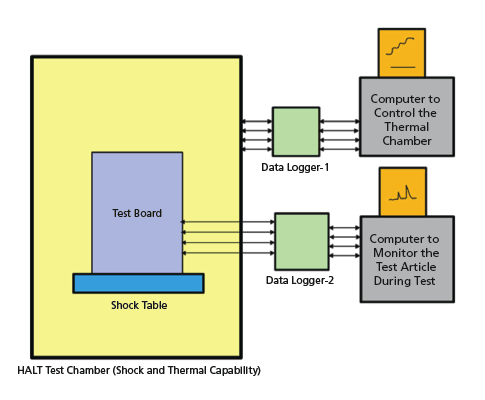
All of the advanced electronic packages were daisy-chained independently to monitor the continuity of the individual electronic packages. Continuity of the packages was monitored during the HALT testing using a dedicated data logging system. This innovation allowed users to test the board to up to 50g shock levels, and temperatures of +125 to –150 °C, and also different combinations of these factors. The equipment system can deliver 50g at room temperature, but the highest g levels were lower than it can deliver, especially at the extremes of the cold temperatures tested.
Several tests were performed by subjecting the test boards to various g levels, dwell durations, and the hot and cold temperature levels. Several of the advanced electronic packages showed signs of continuity problems, including plastic ball grid arrays (PBGAs), BGAs, MLFs, and QFPs. The PBGA package circuit became completely open while others showed signs of continuity variations that could lead to failures if the tests were conducted further. The failure of the PBGA occurred within 12 hours of accelerated testing using dynamic and thermal loads.
In comparison, the PBGA package failed a thermal-cycle-only test with a temperature range from –150 to +125 °C, after 959 thermal cycles. Each thermal cycle took about 2.33 hours, and a total test-time-to-fail PBGA was 2,237 hours (or ≈ 3.1 months) due to thermal cycling fatigue alone.
Further research efforts are in progress to understand the HALT processes PBGA and other packages.
This work was done by Rajeshuni Ramesham of Caltech for NASA’s Jet Propulsion Laboratory. NPO-49182
This Brief includes a Technical Support Package (TSP).
HALT Technique to Predict the Reliability of Solder Joints in a Shorter Duration
(reference NPO-49182) is currently available for download from the TSP library.
Don't have an account?
Overview
The document discusses the application of the Highly Accelerated Life Testing (HALT) technique to assess the fatigue reliability of electronic packaging designs, specifically focusing on solder joints. Conducted by the Jet Propulsion Laboratory (JPL) under NASA, the study aims to enhance the reliability of electronic components used in aerospace applications.
The HALT technique is designed to identify potential failure modes in electronic packages by subjecting them to extreme environmental conditions. The testing involves a wide temperature range from -150°C to +125°C and acceleration levels of up to 50g. The experimental setup includes various test boards that are exposed to different g levels, dwell durations, and temperature extremes to simulate real-world stresses.
Key findings from the study indicate that advanced electronic packages, such as plastic ball grid arrays (PBGA), ball grid arrays (BGA), micro-lead-frames (MLF), and quad flat-packs (QFP), exhibit varying degrees of reliability under these conditions. Notably, the PBGA package was found to be completely open, while other designs showed signs of continuity problems, highlighting the importance of design considerations in ensuring reliability.
The document outlines the experimental approach, detailing the specific temperature and g level combinations used during testing. For instance, tests were conducted at temperatures of 25°C, 75°C, 100°C, and 125°C, with varying g levels for different durations, including 0.5 hours and 10 minutes. These rigorous testing conditions are intended to accelerate the aging process of the components, allowing for quicker identification of potential failures.
In addition to the experimental results, the document emphasizes the significance of HALT in predicting the reliability of solder joints, which are critical for the performance of electronic systems in space missions. The findings contribute to the broader understanding of electronic packaging reliability and provide a framework for future research and development in this area.
Overall, the document serves as a technical support package for the HALT technique, offering insights into its methodology, results, and implications for the aerospace industry. It underscores NASA's commitment to advancing technology and ensuring the reliability of electronic systems in challenging environments.











