

The figure depicts selected aspects of a six-degree-of-freedom (6-DOF) stage for mechanical adjustment of an optical component. The six degrees of freedom are translations along the Cartesian axes (x, y, and z) and rotations about these axes (θx, θy, and θz, respectively). Relative to prior such stages, this stage offers advantages of compactness, stability, and robustness, plus other advantages as described below.
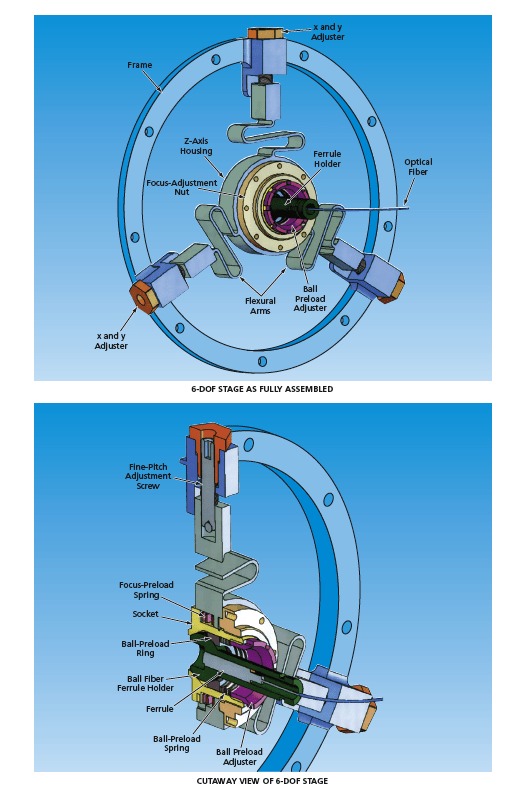
The stage was designed specifically as part of a laser velocimeter and altimeter in which light reflected by a distant object is collected by a Cassegrainian telescope and focused into a single-mode, polarization-maintaining optical fiber. The stage is used to position and orient the input end of the optical fiber with respect to the focal point of the telescope. Stages like this one can also be adapted for use in positioning and orienting other optical components, including lenses, prisms, apertures, and photodetectors.
The optical fiber or other optical component is mounted in a ferrule that is, in turn, mounted in a ferrule holder that is an extension of the ball part of a ball-and-socket assembly that enables adjustment in all three rotational degrees of freedom. The position of the ferrule within the ferrule holder is set so that the center of the input face of the optical component lies at the center of the ball. As a result of this setting, rotational adjustment is not accompanied by undesired translational adjustment.
The subassembly comprising the ball, ferrule holder, and optical component is spring-loaded into the socket, and the spring load can be adjusted by means of a threaded ball-preload adjuster. The ferrule holder and the ball-preload adjuster are equipped with external surfaces that mate with special-purpose adjustment tools. The spring load is chosen to make the frictional torque between the ball and the socket small enough that rotational adjustments can be made, yet large enough that the ball and socket retain their relative angular position once the angular adjustment has been completed and the rotational-adjustment tools removed.
Optionally, the ball-and-socket assembly as described thus far could be used alone as a rotation-only stage. However, in the original application, the ball-and-socket assembly is mounted within a z-axis housing that, as its name suggests, enables translational adjustment along the z axis (focus adjustment). The socket is in threaded engagement with a focus-adjustment nut that can be turned about the z axis to make the adjustment. An anti-rotation pin that is free to translate along a z-oriented slot prevents undesired rotation of the socket about the z axis during focus adjustment. A focus-preload spring exerts a z-axis preload between the socket and the z-axis housing to prevent backlash in the focus adjustment.
Optionally, the z-axis-adjusting mechanism as described above could be used alone as a z-axis-translation stage. However, in the original application, it is mounted in an x–y translation stage that includes three flexural arms positioned at equal angular intervals on a circular frame. The radial position of the outer end of each flexural arm can be varied by means of a fine-pitch adjustment screw. Initially, all three adjustment screws are set at approximately the midpoints of their ranges, thereby placing all three flexural arms in tension and approximately centering the z-axis housing in the circle. Thereafter, the screws are turned, singly or in pairs as needed, to make fine adjustments to bring the optical component into x and y alignment. Care must be taken during these adjustments to maintain all three flexural arms in tension so as to prevent backlash. The x–y adjustment resolution is much finer than the thread pitch of the adjustment screws. Optionally, like the rotational and z-axis sub-stages, the x–y stage could be used by itself.
This work was done by Syed Shafaat and Daniel Chang of Caltech for NASA's Jet Propulsion Laboratory.
NPO-45273
This Brief includes a Technical Support Package (TSP).
Compact 6-DOF Stage for Optical Adjustments
(reference NPO-45273) is currently available for download from the TSP library.
Don't have an account?
Overview
The document outlines NASA's development of a Compact 6-Degrees of Freedom (DOF) Stage for Optical Adjustments, specifically designed for applications such as laser velocimetry and altimetry. The need for this technology arose during the development of a small form factor laser velocimeter and altimeter, where existing 6 DOF stages were either too large or lacked the required precision.
The innovative design features a unique ball and socket arrangement that allows for simultaneous adjustments along multiple axes, achieving high precision in alignment. The fiber tip is positioned at the center of rotation, ensuring that adjustments in the rotational axes (θX, θY, θZ) do not cause unwanted translations along the X or Y axes. This decoupling of axes minimizes interaction between adjustments, enhancing stability and accuracy.
The stage incorporates a Flexural X/Y Adjuster with three arms, allowing for both X and Y axis adjustments using a single component. This design not only simplifies the assembly but also improves the resolution of adjustments, which can exceed the thread pitch of traditional adjuster screws. The system is preloaded, ensuring that the position of the fiber is retained after adjustments without the need for secondary locking mechanisms.
Key advantages of the 6 DOF stage include its adaptability to various applications, the ability to incorporate sub-assemblies into higher-level assemblies, and the customization of flexure configurations to meet specific requirements. The design is robust, temperature-insensitive, and compact, making it suitable for flight usage due to its all-metal construction.
The document emphasizes the importance of high-resolution, small increment movements (preferably sub-micron), stability, and minimal inter-axis interaction in the adjustment stage. It also highlights the potential for this multi-degrees of freedom stage to be utilized beyond fiber optics, applicable to other components requiring precise alignment.
In summary, NASA's Compact 6-DOF Stage represents a significant advancement in optical adjustment technology, addressing the challenges of size, precision, and stability in high-performance applications. The design's innovative features and adaptability make it a valuable tool for various scientific and commercial applications, showcasing NASA's commitment to advancing aerospace technology.











