

An optoelectronic system distributes a reference signal of low noise and highly stabilized phase and frequency (100 MHz) from an atomic frequency standard to a remote facility at a distance up to tens of kilometers. The reference signal is transmitted to the remote station as amplitude modulation of an optical carrier signal propagating in an optical fiber. The stabilization scheme implemented in this system is intended particularly to suppress phase and frequency fluctuations caused by vibrations and by expansion and contraction of the optical fiber and other components in diurnal and seasonal heating and cooling cycles.
The system (see figure) comprises several subsystems, the main one being (1) a hydrogen-maser or linear-ion-trap frequency standard in an environmentally controlled room in a signal-processing center (SPC), (2) a stabilized fiber-optic distribution assembly (SFODA), (3) a compensated sapphire oscillator (CSO) in an environmentally controlled room in the remote facility, (4) thermally stabilized distribution amplifiers and cabling from the environmentally controlled room to end users, and (5) performance-measuring equipment. Two of these subsystems, considered as separate entities, were the subjects of prior NASA Tech Briefs articles: The SFODA was described in "Improved Stabilization of Delay in an Optical Fiber" (NPO-19353), Vol, 21, No. 2 (February 1997), page 4a; and "Alternative for Stabilization of Delay in an Optical Fiber" (NPO-19075), Vol. 21, No. 2 (February 1997), page 6a. The CSO was described in "Temperature-Compensated Sapphire Microwave Resonator" (NPO-19414), Vol. 20, No. 3 (March 1996), page 14a.
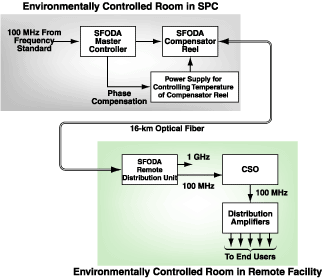
To recapitulate: The SFODA includes the transmitter in which the output of the frequency standard is used to modulate the optical distribution signal, the optical fiber used for long-distance transmission, a compensator reel (a wound, electrically controllable fiber-optic delay line in series with the long-distance optical fiber), signal retransmission optics in the remote facility, and equipment in the SPC that measures the overall round-trip propagation delay of the reference signal and adjusts the temperature of the compensator-reel to maintain the overall propagation delay as nearly constant as possible. The CSO is a sapphire-dielectric-ring microwave resonator that operates in a "whispering-gallery" electromagnetic mode and features a paramagnetic-spin-tuned design that provides temperature compensation for ultrahigh frequency stability.
The SFODA and the CSO work in unison in their environmentally controlled rooms to satisfy stringent requirements for stability of frequency and phase: While the SFODA helps to ensure long-term stability, the CSO helps to ensure short-term stability. In this system, the 100-MHz signal is first multiplied to 1 GHz before applying it as modulation to the optical carrier. At the remote site, a low-noise 100-MHz voltage-controlled oscillator (VCO) that is part of the SFODA is phase-locked to the 1-GHz signal to preserve coherence with the frequency standard. In turn, the CSO is phase-locked to the output of the VCO. The cleaned-up signal is then measured and distributed to end users.
This work was done by Malcolm Calhoun, Robert Tjoelker, William Diener, G. John Dick, Rabi Wang, and Albert Kirk of Caltech for NASA's Jet Propulsion Laboratory.For further information, access the Technical Support Package (TSP) free on-line at www.techbriefs.com/tsp under the Computers/Electronics category.
NPO-30490
This Brief includes a Technical Support Package (TSP).
Stabilized Fiber-Optic Distribution of Reference Frequency
(reference NPO-30490) is currently available for download from the TSP library.
Don't have an account?
Overview
The document is a NASA Technical Support Package detailing advancements in the "Stabilized Fiber-Optic Distribution of Reference Frequency," specifically aimed at enhancing the distribution of low-noise, highly stabilized reference signals for applications such as the NASA Deep Space Network (DSN). The primary focus is on the technology used to generate and distribute reference frequency signals, which are crucial for precise spacecraft tracking and communication.
The system comprises several key subsystems: a hydrogen-maser or linear-ion-trap frequency standard located in an environmentally controlled room, a stabilized fiber-optic distribution assembly (SFODA), a compensated sapphire oscillator (CSO), thermally stabilized distribution amplifiers, and performance-measuring equipment. The SFODA plays a critical role in modulating the output of the frequency standard to create an optical distribution signal, which is transmitted over long distances via optical fiber. The system is designed to mitigate phase and frequency fluctuations caused by environmental factors such as vibrations and temperature changes.
The CSO, a sapphire-dielectric-ring microwave resonator, is engineered to provide temperature compensation, ensuring ultrahigh frequency stability. This design is particularly beneficial for maintaining the integrity of the reference signal over varying conditions. The document also references prior NASA Tech Briefs that describe the SFODA and CSO in more detail, highlighting their innovative features and contributions to the overall system.
The technology is particularly relevant for the Cassini radio science experiments, where stable reference signals are essential for accurate data collection and analysis. The document emphasizes the importance of these advancements in supporting deep space missions and improving the reliability of communication systems.
In summary, this Technical Support Package outlines a sophisticated optoelectronic system that enhances the distribution of reference frequency signals, showcasing NASA's commitment to innovation in space exploration technology. The integration of advanced components and stabilization techniques positions this system as a significant improvement over previous methods, ensuring that low-noise, stable signals are effectively delivered to remote facilities, thereby supporting critical scientific endeavors.











