

According to a proposal, basic x-ray lithography would be extended to incorporate a technique, called "inverse tomography," that would enable the fabrication of microscopic three-dimensional (3D) objects. The proposed inverse tomo-lithographic process would make it possible to produce complex shaped, submillimeter-sized parts that would be difficult or impossible to make in any other way. Examples of such shapes or parts include tapered helices, paraboloids with axes of different lengths, and even Archimedean screws that could serve as rotors in microturbines.
The proposed inverse tomo-lithographic process would be based partly on a prior microfabrication process known by the German acronym "LIGA" ("lithographie, galvanoformung, abformung," which means "lithography, electroforming, molding"). In LIGA, one generates a precise, high-aspect ratio pattern by exposing a thick, x-ray-sensitive resist material to an x-ray beam through a mask that contains the pattern. One can electrodeposit metal into the developed resist pattern to form a precise metal part, then dissolve the resist to free the metal. Aspect ratios of 100:1 and patterns into resist thicknesses of several millimeters are possible.
Typically, high-molecular-weight poly(methyl methacrylate) (PMMA) is used as the resist material. PMMA is an excellent resist material in most respects, its major shortcoming being insensitivity. Conventional x-ray sources are not practical for LIGA work, and it is necessary to use a synchrotron as the source. Because synchrotron radiation is highly collimated and its wavelength of synchrotron radiation is typically<5 Å, there is very little diffraction and the pattern of a high-contrast mask is projected deep into a resist with nearly perfect vertical sidewalls. Of course, the only three-dimensional shape that can be formed in this way is the locus of points generated by moving the mask pattern along the direction of incidence of the radiation.
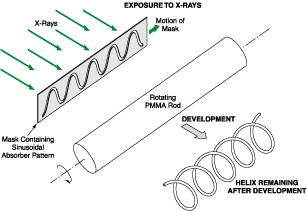
In a recently developed variant of LIGA, a rotating PMMA rod is exposed to x-rays through a stationary mask; this technique can be used to make axisymmetric structures; e.g., objects shaped like wine glasses or baseball bats. The proposed technique would also involve stenciling an x-ray image into a rotating PMMA rod, but would differ from prior techniques in that the mask would be moved in synchronism with the rod to generate a three-dimensional pattern. The synchronized motions of the mask and rod would be generated by translation and rotation stages actuated by stepping motors under control by a computer.
Describing the x-ray exposure technique in different words, a changing two-dimensional pattern would be projected into a three-dimensional one. In tomography, one decodes a three-dimensional pattern from the changing two-dimensional pattern obtained by illuminating it from a changing direction. In the proposed technique, one would essentially reverse this decoding process; that is, one would encode or construct a three-dimensional pattern by illuminating the region of interest in a changing two-dimensional pattern: That is why the proposed x-ray exposure technique is called "inverse tomography."
The figure depicts an example of the use of this technique to generate a simple helix. The two-dimensional projection (shadow) of a helix is a sinusoid. To form the helical pattern in a PMMA rod, one would project x-rays perpendicularly toward the rod through a mask with a sinusoidal pattern while rotating the rod and translating the mask along the rod at a speed of one wavelength of the sinusoid per rotation period.
This work was done by Victor White and Dean Wiberg of Caltech for NASA's Jet Propulsion Laboratory.
NPO-20593
This Brief includes a Technical Support Package (TSP).
Inverse Tomo-Lithography for Making Microscopic 3D Parts
(reference NPO20593) is currently available for download from the TSP library.
Don't have an account?
Overview
The document discusses a novel technique called "Inverse Tomo-Lithography," developed by Victor White and Dean Wiberg at NASA's Jet Propulsion Laboratory. This method extends traditional x-ray lithography to enable the fabrication of complex three-dimensional (3D) objects, particularly at submillimeter scales. The technique is particularly significant for creating intricate shapes that are difficult or impossible to manufacture using conventional methods.
Inverse Tomo-Lithography operates on the principles of inverse tomography, where a three-dimensional pattern is constructed by illuminating a region of interest with a changing two-dimensional pattern. This process involves projecting x-rays through a mask with a specific pattern while synchronously rotating and translating a poly(methyl methacrylate) (PMMA) rod, which serves as the x-ray photoresist material. The resulting exposure creates a helical structure, demonstrating the technique's capability to generate complex geometries.
The proposed method builds on a prior microfabrication process known as LIGA (lithographie, galvanoformung, abformung), which allows for the creation of high-aspect ratio patterns by exposing thick x-ray-sensitive resist materials to x-ray beams through masks. LIGA can achieve aspect ratios of 100:1 and create patterns in resist thicknesses of several millimeters. However, traditional LIGA techniques typically require synchrotron radiation due to the limitations of conventional x-ray sources.
The document highlights the advantages of the inverse tomo-lithographic process, including its ability to produce complex shapes such as tapered helices, paraboloids with varying axes, and Archimedean screws, which could be utilized as rotors in microturbines. The synchronized motion of the mask and the PMMA rod is controlled by stepping motors, allowing for precise and intricate designs.
Overall, Inverse Tomo-Lithography represents a significant advancement in microfabrication technology, offering new possibilities for the production of sophisticated 3D parts that could have applications in various fields, including aerospace, microengineering, and beyond. The document emphasizes the potential of this technique to push the boundaries of what is achievable in the realm of microscopic manufacturing.









