

Focal-plane arrays of quantum-well infrared photodetectors (QWIPs) equipped with both light-coupling diffraction gratings and metal side reflectors have been proposed, and prototypes are expected to be fabricated soon. The purpose served by the metal side reflectors is to increase quantum efficiency by helping to trap light in the photosensitive material of each pixel.
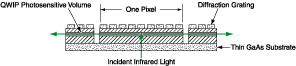
The reasons for using diffraction gratings were discussed in several prior NASA Tech Briefs articles. To recapitulate: In an array of QWIPs, the quantum-well layers are typically oriented parallel to the focal plane and therefore perpendicular or nearly perpendicular to the direction of incidence of infrared light. By virtue of the applicable quantum selection rules, light polarized parallel to the focal plane (as normally incident light is) cannot excite charge carriers and, hence, cannot be detected. Diffraction gratings scatter normally or nearly normally incident light into directions more nearly parallel to the focal plane, so that a significant portion of the light attains a component of polarization normal to the focal plane and, hence, can excite charge carriers. Unfortunately, light scattered in directions parallel or nearly parallel to the focal plane can escape sideways from the QWIP of a given pixel, as illustrated in Figure 1. The escaped light has made only a single pass through the interior photosensitive volume of the QWIP.

The quantum efficiency of the QWIP would be increased by trapping light so that it makes multiple passes through the photosensitive volume. As shown in Figure 2, the sides of the QWIP of each pixel would be coated with gold to reflect escaping light back into the interior.
This work was done by Sarath Gunapala, Sumith Bandara, John Liu, and David Ting of Caltech for NASA's Jet Propulsion Laboratory.
In accordance with Public Law 96-517, the contractor has elected to retain title to this invention. Inquiries concerning rights for its commercial use should be addressed to
Intellectual Assets Office
JPL
Mail Stop 202-233
4800 Oak Grove Drive
Pasadena, CA 91109
(818) 354-2240
E-mail: This email address is being protected from spambots. You need JavaScript enabled to view it.
Refer to NPO-30507.
This Brief includes a Technical Support Package (TSP).
Metal Side Reflectors for Trapping Light in QWIPs
(reference NPO30507) is currently available for download from the TSP library.
Don't have an account?
Overview
The document discusses advancements in quantum-well infrared photodetectors (QWIPs) developed by researchers at NASA's Jet Propulsion Laboratory (JPL). The primary focus is on enhancing the quantum efficiency of QWIPs, which are devices used to detect infrared radiation. Traditional QWIPs face limitations due to quantum mechanical selection rules that prevent normal incidence light from being absorbed effectively, resulting in a quantum efficiency of about 15%.
To address this issue, the researchers propose the use of light-coupling diffraction gratings and metal side reflectors. The diffraction gratings scatter normally incident light into directions that are more parallel to the focal plane, allowing a portion of the light to become polarized in a way that can excite charge carriers. However, light that is scattered parallel to the focal plane can escape the QWIP after a single pass through the photosensitive volume, leading to further losses.
To mitigate this loss, the researchers suggest coating the sides of each QWIP pixel with gold to reflect escaping light back into the interior. This design allows the light to make multiple passes through the photosensitive material, significantly increasing the likelihood of absorption and thereby enhancing the quantum efficiency of the QWIPs. The proposed method aims to trap infrared radiation within each pixel, potentially increasing quantum efficiency up to 100%.
The document also emphasizes that this approach can be used in conjunction with existing light-coupling techniques, providing a synergistic effect that enhances overall light coupling efficiency. The work is credited to inventors Sumith V. Bandara, Sarath D. Gunapala, John K. Liu, and David Z. Ting, and it represents a significant step forward in infrared detection technology.
In summary, the document outlines a novel solution to improve the performance of QWIPs by integrating metal side reflectors to trap light, thereby increasing the quantum efficiency of these detectors. This advancement has implications for various applications in infrared sensing and imaging, making it a noteworthy contribution to the field of photodetection technology.











