A photonic system has been devised for acquiring a radio-frequency (RF) signal from a remote receiving antenna via a long optical fiber. The system performs multiple functions, including upward or downward frequency conversion, optical amplification [more specifically, Brillouin selective sideband amplification (BSSA)] in the long optical fiber, and other functions, the combined effects of which are to eliminate sensitivity to polarization and to minimize signal fading caused by dispersion in the long optical fiber. The basic design of the system also makes it possible to use phase modulators. In comparison with amplitude modulators, phase modulators exhibit lower losses and cost less; moreover, unlike amplitude modulators, phase modulators do not require bias and thus do not present any bias-stabilization problems in design and operation.
The system (see figure) includes a signal laser, which generates an optical carrier signal. An electronic or optoelectronic local oscillator (LO) generates a stable and spectrally pure RF subcarrier signal (typically at a frequency of 10 GHz) for use in frequency conversion. This subcarrier signal is used to modulate the optical carrier signal. (Phase modulation is preferable to amplitude modulation for the reasons stated above.) The modulated optical signal is then injected, via an optical isolator and a first polarizing beam splitter (PBS1), into the long optical fiber for propagation to the remote antenna site. This is a standard single-mode optical fiber and is typically several kilometers long.
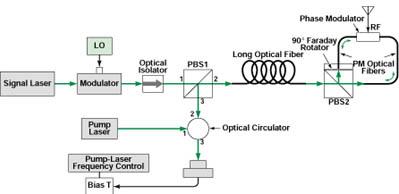
After propagation to the remote antenna site, the polarization of the modulated carrier signal is no longer linear, and it varies when the fiber is disturbed. A second polarizing beam splitter (PBS2) separates the two polarization components, and the polarization of one of these components is modified by a 90° Faraday rotator that is incorporated into PBS2. Polarization-maintaining (PM) optical fibers are used to connect the two output ports of PBS2 to opposite ends of a phase modulator, to which the RF signal from the antenna is applied. The slow axis of each PM fiber is aligned with the polarization of the PBS2 port to which it is connected. As a result of this arrangement, the two polarization components are converted to two oppositely travelling, identically polarized light beams in the phase modulator. These beams are modulated equally by the RF signal. After passing through the phase modulator, these beams are recombined by PBS2 and sent back along the long optical fiber. The net effect of this ring-arrangement/ polarization-conversion/modulation scheme is to eliminate sensitivity of the modulator to polarizing effects in the long optical fiber.
Because of the 90° Faraday rotator in the modulator ring, at every location along the long optical fiber, the light propagating backward (away from the antenna) is polarized orthogonally to the light propagating forward (toward the antenna). The backward-propagating beam is separated in PBS1 and is coupled via an optical circulator to a photodetector. The photodetector is connected to a bias T, which separates the RF, LO, and intermediate-frequency (IF) components of the photocurrent. One of these frequency components is selected and is used as a feedback control signal to lock the frequency of the pump laser to a desired modulation sideband of the signal laser, as described in the paragraph after next.
A pump laser generates a beam of light needed for BSSA. The pump beam is coupled, via the optical circulator, into port 3 of PBS1. The polarization of the pump beam is so adjusted that the pump beam leaves PBS1 through its port 2 and propagates forward along the long optical fiber. After passing through the PBS2/modulator ring, the pump beam propagates back along the long optical fiber and enters port 2 of PBS1. Because of the action of the PBS2/modulator ring, the polarization state of the backward-going pump beam is orthogonal to that of the forward-going pump beam everywhere along the fiber. The polarization state of the forward-going pump beam is also everywhere the same as that of the backward-going modulated signal beam; this condition is optimum for Brillouin amplification everywhere along the fiber and eliminates the sensitivity of the Brillouin amplification to polarization. The pump beam leaves through port 1 of PBS1 and is attenuated by the optical isolator.
By tuning the frequency of the pump laser, one can make the narrow frequency-shift (Stokes-frequency) band associated with the Brillouin backscattering of the pump laser light to overlap one of the phase-modulation sidebands of the signal beam, thereby enabling Brillouin amplification of that sideband. The amplification of this modulation sideband breaks the perfect amplitude balance of sidebands of phase modulation and thereby converts the phase modulation to amplitude modulation. One can amplify either an LO or an RF sideband to obtain amplified IF and RF signals at the receiver. When the LO sideband is chosen, the beats of the amplified LO sideband with the upper and lower RF sidebands in the photodetector produce a down-converted and an up-converted IF signal, while the beat between the amplified LO sideband and the signal carrier produces an amplified LO signal.
This work was done by X. Steve Yao of Caltech for NASA's Jet Propulsion Laboratory.
In accordance with Public Law 96-517, the contractor has elected to retain title to this invention. Inquiries concerning rights for its commercial use should be addressed to:
Technology Reporting Office, JPL, Mail Stop 249-103, 4800 Oak Grove Drive, Pasadena, CA 91109; (818) 354-2240
Refer to NPO-20759
This Brief includes a Technical Support Package (TSP).
Frequency-Converting Photonic Link with BSSA Amplification
(reference NPO20759) is currently available for download from the TSP library.
Don't have an account?
Overview
The document presents a technical support package from NASA detailing a novel photonic system designed for acquiring radio-frequency (RF) signals from remote antennas via long optical fibers. This system integrates multiple functionalities, including frequency up/down conversion, optical amplification through Brillouin selective side-band amplification (BSSA), and the elimination of polarization sensitivity and signal fading caused by fiber dispersion.
The primary advantage of this photonic link is its ability to perform complex signal processing functions that are traditionally handled in the electrical domain. By utilizing optical methods, the system enhances signal integrity and efficiency. The design employs phase modulators instead of amplitude modulators, which results in lower losses, reduced costs, and the elimination of bias stabilization issues. Phase modulators are preferred due to their simplicity and effectiveness in maintaining signal quality.
The document outlines the operational mechanism of the system, where light from a signal laser is modulated by a local oscillator (LO) signal. The modulated light is transmitted through a standard single-mode fiber, where it encounters variations in polarization due to disturbances in the fiber. To address this, a polarization beamsplitter (PBS) is used to separate the polarization components of the signal light, and a 90-degree Faraday rotator is employed to manage the polarization states. This arrangement ensures that the light beams traveling in opposite directions through the phase modulator maintain the same polarization direction, effectively eliminating polarization sensitivity.
The system demonstrates significant improvements in optical power handling capability, built-in optical amplification, and increased signal conversion efficiency. With only 9 mW of optical power over an 8 km round trip, the system achieves a link loss of 45 dB without the need for RF amplifiers, showcasing its effectiveness and efficiency.
Overall, this document highlights the advancements in photonic technology, particularly in RF signal processing, and emphasizes the potential for integrating these systems into existing RF infrastructures. The innovative use of BSSA and phase modulation techniques positions this photonic link as a promising solution for future communication systems, paving the way for more sophisticated and efficient signal processing capabilities.