A report presents a study of the efficacy of shot shifting for reducing stitching errors in diffraction gratings made by electron-beam (E-beam) lithography. Stitching errors arise from fabricating a grating as a mosaic of smaller gratings by frequently translating the grating blank. (This is done because typically, the required size of a grating exceeds that of the field swept by the electron beam.) In shot shifting, each field is written at a fraction of the total electron dose and the stage is moved the same fraction of a field width before writing the next field, so that the averaging effect of shifted multiple passes will suppress errors that arise from miscalibration between beam and translation-stage motions. In the study, a simplified linear model was used to describe the grating-writing process in the spatial-frequency domain. The origin and magnitude of stitching-error spatial-frequency sidebands was demonstrated. The effect of the multipass writing was shown to be equivalent to that of a band-pass filter that selectively nulls nearby sidebands. It was shown that M-order multipass writing suppresses only the nearest M-1 sidebands, and that increasing M results in restrictions on the allowable grating periods.
This work was done by David Dougherty, Paul Maker, and Richard Muller of Caltech for NASA's Jet Propulsion Laboratory.
NPO-21072
This Brief includes a Technical Support Package (TSP).
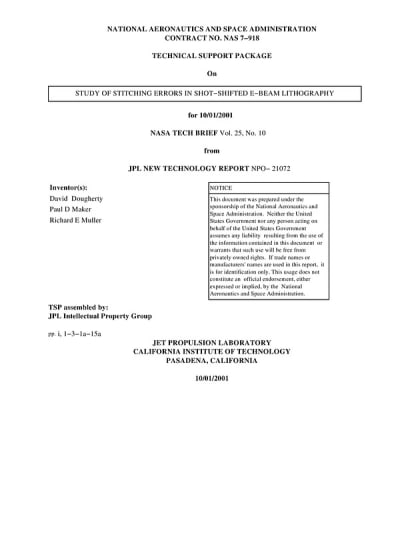
Study of Stitching Errors in Shot-Shifted E-Beam Lithography
(reference NPO-21072-) is currently available for download from the TSP library.
Don't have an account?
Overview
The document presents a study on the efficacy of shot shifting as a method to reduce stitching errors in diffraction gratings produced by electron-beam (E-beam) lithography. Stitching errors occur when a grating is fabricated as a mosaic of smaller gratings, necessitating frequent translations of the grating blank due to size limitations of the electron beam's field.
In the shot shifting technique, each field is written with a fraction of the total electron dose, and the stage is moved by the same fraction of a field width before writing the next field. This approach allows for the averaging effect of multiple shifted passes, which helps to mitigate errors stemming from miscalibration between the electron beam and the translation-stage motions.
The study employs a simplified linear model to describe the grating-writing process in the spatial-frequency domain. It demonstrates the origin and magnitude of stitching-error spatial-frequency sidebands and shows that the multipass writing effect is akin to that of a band-pass filter, which selectively nullifies nearby sidebands. The findings indicate that M-order multipass writing only suppresses the nearest M–1 sidebands, and increasing the value of M imposes restrictions on the allowable grating periods.
The research was conducted by a team from the California Institute of Technology (Caltech) for NASA’s Jet Propulsion Laboratory (JPL) and is documented in the NASA Tech Brief Vol. 25, No. 10, dated October 1, 2001. The work highlights the potential of shot shifting to enhance the precision of E-beam lithography, which is crucial for applications requiring high-quality diffraction gratings.
The document also includes a notice stating that the information was prepared under the sponsorship of NASA and clarifies that neither the U.S. Government nor any individuals acting on its behalf assume liability for the use of the information contained within. Additionally, it emphasizes that references to specific commercial products or services do not imply endorsement by the U.S. Government or JPL.
Overall, this study contributes valuable insights into improving the fabrication process of diffraction gratings, which are essential components in various optical applications, thereby advancing the field of nanofabrication and lithography.