An ultrasonic-transducer fixture containing multiple pairs of fixed transducers, plus associated electronic transducer-multiplexing circuitry have been developed to accelerate the acquisition of data on the dispersion of ultrasonic leaky Lamb waves (LLWs) in plate specimens of laminated composite (matrix/fiber) materials. The fixture and multiplexing circuitry can readily be incorporated into a previously constructed ultrasonic-LLW system that contains a single pair of movable ultrasonic transducers.
LLWs are guided waves that propagate along the surfaces of the specimens. In a typical conventional ultrasonic-LLW system, a plate specimen is immersed in water (which serves as an acoustic-coupling medium), with a transmitting and a receiving ultrasonic transducer positioned above the specimen in a pitch/catch arrangement at a specified angle of incidence, as shown in Figure 1. For each of several angles of incidence, the output of the receiving transducer is digitized and processed to extract reflection-spectrum and dispersion data. These data are then inverted, by use of special-purpose software, to obtain the coefficients of elasticity of the materials and to evaluate flaws in the specimens.
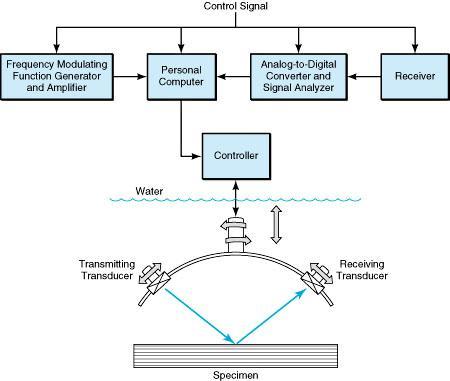
Figure 1. In a Conventional Ultrasonic-LLW System, the transmitting and receiving transducers must be moved to different positions to obtain different angles of incidence.
In the conventional system, the speed of acquisition of data is limited by the need to reposition the transducers to obtain different angles of incidence. In a system equipped with the present fixture and multiplexing circuitry, data can be acquired much more rapidly because except as explained in the next paragraph, the transducers are not repositioned during a test; instead, multiple transmitting/receiving pairs of transducers are pre-positioned at the desired angles of incidence (see Figure 2) and are switched into and out of operation in the required sequence during a test by use of the multiplexer circuits under control by a computer. The software for controlling the multiplexer circuits is part of a modified version of the software for controlling the rest of the ultrasonic-LLW system.
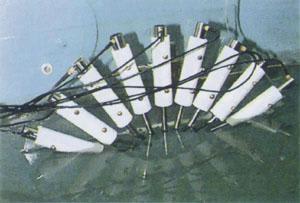
Figure 2. Transmitting/Receiving Pairs of Ultrasonic Transducers in this fixture are positioned and oriented, relative to an immersed specimen, for angles of incidence of 15°, 30°, 45°, and 60°.
In some cases, it could be necessary to acquire data with the plane of incidence at different polar angles (0°, 45°, and 90°) with respect to fibers projected onto the surfaces of the specimens in order to characterize the specimen materials completely. Even in such a case, it is not necessary to expend much time repositioning transducer pairs; all one need do is rotate the transducer fixture to each polar angle and to perform the measurement sequence there. Experiments have shown that dispersion data for four angles of incidence at one given polar-angle setting could be acquired in 7.4 seconds.
This work was done by Yoseph Bar-Cohen of Caltech and Susan Kersey, Cedric Daksla, and Anatoly Blanovsky of UCLA for NASA's Jet Propulsion Laboratory. For further information, access the Technical Support Package (TSP) free on-line at www.techbriefs.com under the category Physical Sciences
In accordance with Public Law 96-517, the contractor has elected to retain title to this invention. Inquiries concerning rights for its commercial use should be addressed to
Technology Reporting Office
JPL
Mail Stop 122-116
4800 Oak Grove Drive
Pasadena, CA 91109
(818) 354-2240
Refer to NPO-20400
This Brief includes a Technical Support Package (TSP).
Apparutus for faster Ultrasonic-Lamb-Wave Testing
(reference NPO20400) is currently available for download from the TSP library.
Don't have an account?
Overview
The document presents a novel system for faster ultrasonic testing of composite materials, specifically focusing on a Quasi Real-Time Leaky Lamb Wave (QRT-LLW) method. Developed by a team at NASA's Jet Propulsion Laboratory, this system addresses the limitations of traditional data acquisition methods in non-destructive evaluation (NDE) by significantly enhancing the speed and efficiency of the testing process.
Historically, the data acquisition phase of the Leaky Lamb Wave (LLW) method has been a bottleneck due to the mechanical movement required for transducer pairs to capture data at various angles of incidence. The new QRT-LLW system utilizes a multiplexed setup of ultrasonic transducer pairs that are electronically triggered in sequence, eliminating the need for physical movement. This innovation allows for quasi real-time measurements, which accelerates the overall testing process.
The system is designed to acquire leaky Lamb wave dispersion data, which is crucial for characterizing the elastic stiffness properties of composite materials. The data collected is processed using an inversion algorithm that correlates the measured dispersion data with analytical predictions to determine the material's stiffness constants. This capability is essential for evaluating potential flaws in composite structures, making it a valuable tool in various engineering applications.
The document outlines the technical setup, including the arrangement of transducers and the software developed to control the data acquisition process. The software not only manages the sequence of transducer activation but also displays the acquired data in real-time, allowing for immediate analysis. The system can handle a large number of data points, with scanning steps as small as 1/16-inch, which is critical for thorough inspections of large composite parts.
Figures included in the document illustrate the system's configuration and the resulting dispersion curves obtained from the testing process. The advancements reported in this document highlight the potential for improved efficiency in ultrasonic testing, paving the way for more effective monitoring and evaluation of composite materials in aerospace and other industries.
In summary, the QRT-LLW system represents a significant leap forward in ultrasonic testing technology, combining hardware and software innovations to facilitate rapid and accurate material characterization, ultimately enhancing the reliability and safety of composite structures.