Automatic valves have been proposed for shutting off flows of liquids when abnormally large accelerations occur. These valves could be used, for example, to prevent outflows of flammable, valuable, or toxic liquids from pipelines that have been struck by vehicles or that have become involved in earthquakes or explosions. Actuation of the proposed valves would not depend on sources of electrical or fluid power, which would likely be unavailable during the emergencies in which the valves would be needed. Actuation would not even depend on pressurization of the liquids to be contained. Instead, the valves would operate similarly to spring-actuated rat traps, and like such traps, the valves could also be opened or closed manually.
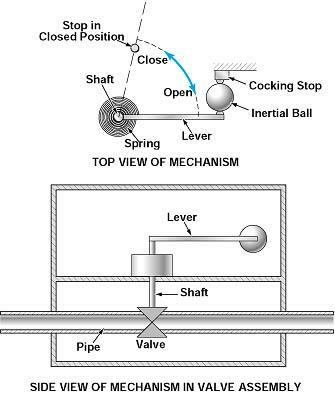
The shaft for opening and closing a typical proposed valve would be connected to a lever, which would be spring-loaded toward the closed position. The lever would be turned against the spring load to open the valve (see figure). At the fully open position, an approximately hemispherical tip on the lever would face a similar tip on a stationary cocking stop. An inertial triggering object (in a ball in the case illustrated) would be placed between the tips to keep the valve open. The ball would be held in place by spring force and associated friction. A sufficiently large acceleration would dislodge the ball, allowing the spring to turn the lever and shaft to the closed position. The triggering sensitivity would vary inversely with the inertial force needed to overcome friction to slide the ball out from between the tips; this force would depend on the choice of the materials, sizes, shapes, and surface finishes of the ball and tips.
This work was done by Andrew D. Morrison of Caltech for NASA's Jet Propulsion Laboratory. NPO-20114
This Brief includes a Technical Support Package (TSP).
Emergency-shutoff valves would be triggered by accelerations
(reference NPO20114) is currently available for download from the TSP library.
Don't have an account?
Overview
The document outlines a novel emergency shutoff valve system developed by NASA, designed to automatically close in response to sudden accelerations, such as those caused by earthquakes, explosions, or vehicle impacts. This system aims to prevent the hazardous outflow of liquids, including water, flammable fluids, and hazardous chemicals, thereby mitigating potential public danger and property damage.
The valve operates using an inertial switch mechanism that triggers the closure of the valve when an acceleration is detected. The design is entirely mechanical, meaning it does not require electric, pneumatic, or hydraulic power to function, ensuring reliability even in power outages or when fluid pressure fails. This self-actuating feature is crucial for maintaining safety during emergencies.
Two proposed designs for the inertial switch are described. The first design resembles a rat-trap mechanism, where a long lever with a weight is held in a cocked position and can be dislodged by minimal acceleration, allowing the lever to slam into place and close the valve. The second design utilizes a ball as the inertial body, which is suspended and can roll off a set point to trigger the valve closure. The effectiveness of the ball design is influenced by its weight, diameter, and density, with considerations for ensuring that the materials used do not degrade over time.
The valve is designed to be positively closed, meaning it will not reopen on its own once closed, and can be easily reset manually. This feature allows for quick restoration of service after an emergency without incurring costs associated with damaged parts. Additionally, the valve can be manually overridden, providing flexibility in operation.
The document emphasizes the importance of this technology, highlighting that no similar all-mechanical devices currently exist for the same purpose. The proposed valve system is positioned as a critical solution for preventing destructive fluid loss and enhancing public safety during unforeseen events. Overall, this innovative design represents a significant advancement in emergency response technology, with the potential to save lives and protect property.