A valve cage consists of a stackable planar structure design with paths that are azimuthally cut out and connected radially. The pattern causes the flow to move azimuthally and impinge on each other when moving to the next path, thereby reducing the fluid momentum and energy that reduces the erosion capability. The maze-like structure is easy to machine with standard machining techniques.
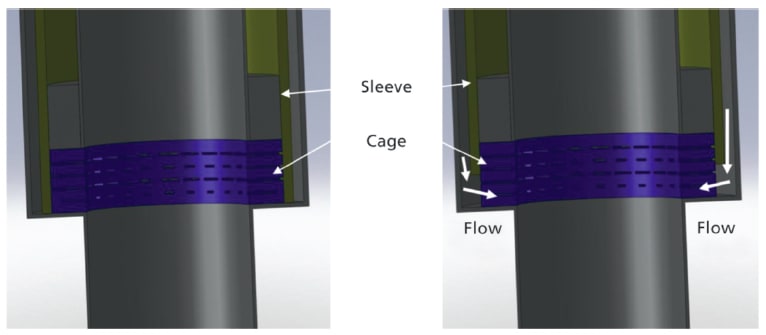
The valve cage can be used to reduce erosion due to high-pressure jet flows, reduce cavitation by increasing the flow areas in a smooth manner, and reduce valve noise associated with pressure surge. The control features that allow for fine tuning the output pressure and flow velocity include azimuthal, radial, and axial paths in the plates; impinging flows; constricting and dilating flow surfaces; redirecting flow counter and inline with main flow; and redirecting radial to axial, or azimuthal, or vice-versa. These are achieved by adjusting the width of channels, the number of channels, the angular extent of each barrier, misalignment of openings, non-planar geometry of the stackable rings, using variable shaping of the geometry of the obstructing elements that make up the individual layers, and the direction of exit flow from the plate.
This design specifically addresses the problems associated with shutting off a high-pressure valve; namely, potential pressure surge, high-pressure jets, and potential cavitation, all of which can cause damage to the valve body or to the outflow or inflow pipes.
This work was done by Stewart Sherrit, Mircea Badescu, Xiaoqi Bao, and Yoseph Bar- Cohen of Caltech for NASA’s Jet Propulsion Laboratory.
In accordance with Public Law 96-517, the contractor has elected to retain title to this invention. Inquiries concerning rights for its commercial use should be addressed to:
Innovative Technology Assets Management
JPL
Mail Stop 321-123
4800 Oak Grove Drive
Pasadena, CA 91109-8099
E-mail: This email address is being protected from spambots. You need JavaScript enabled to view it.
Refer to NPO-48745.
This Brief includes a Technical Support Package (TSP).
Planar and Non-Planar Multi-Bifurcating Stacked Radial Diffusing Valve Cages
(reference NPO48745) is currently available for download from the TSP library.
Don't have an account?
Overview
The document is a Technical Support Package from NASA's Jet Propulsion Laboratory (JPL) detailing the design and functionality of "Planar and Non-Planar Multi-Bifurcating Stacked Radial Diffusing Valve Cages." This innovative technology addresses critical challenges associated with high-pressure valves, particularly in aerospace applications.
The primary focus of the valve cage design is to mitigate issues such as pressure surges, cavitation, and noise, which can lead to damage in valve bodies and associated piping systems. The valve cages are engineered to reduce the pressure and velocity of fluid streams while allowing for an increase in flow area through a stackable plate configuration. This design can be tailored to redirect fluid flow from a radial direction to an axial or azimuthal direction, enhancing the efficiency of fluid management in high-pressure environments.
Key features of the valve cages include non-planar geometries that increase the path length of the fluid flow, allowing for smoother transitions and reduced turbulence. The document highlights the ability to efficiently machine these surface features using standard techniques like CNC machining, making the designs practical for manufacturing.
The novelty of this technology lies in its capacity to open high-pressure valves without causing jet erosion or cavitation, which are common problems in traditional valve designs. The document outlines various applications for these valve cages, particularly in high-pressure systems such as pressurized tanks and engine combustion chambers, where controlling fluid dynamics is crucial for performance and safety.
Figures included in the document illustrate the design concepts, such as the azimuthal meander that redirects flow and the kite-shaped pillars that enhance flow area. The research was conducted under NASA's sponsorship, emphasizing its relevance to aeronautical and space activities.
Overall, this Technical Support Package serves as a comprehensive overview of a significant advancement in valve technology, with potential implications for various industries beyond aerospace, including energy and fluid management systems. The document encourages further exploration and application of these innovative designs to improve the efficiency and reliability of high-pressure fluid systems.