Multiple-quantum-well AlxGa1 - xAs photodetectors that exploit transitions of electrons from quantum-well bound states to quasi-bound states are undergoing development for use at wavelengths from 6 to 25 µm. These photodetectors are intended to provide detectivities that are higher (signal-to-noise ratios that are higher) than those of predecessor quantum-well infrared photodetectors that exploit transitions of electrons from bound to continuum states.
Noise in a photodetector is associated with dark current — a component of current that flows whether or not illumination is present. The three mechanisms that contribute to dark current in a multiple-quantum-well photodetector are (1) temperature-independent quantum-mechanical sequential tunneling through the barriers between the wells, (2) thermally assisted quantum-mechanical tunneling through the last barrier into continuum states, and (3) classical thermionic emission. The problem, then, is to maximize the photocurrent/dark-current ratio; this must be done by tailoring (a) the depth of the wells (by suitable choice of the composition parameter x in the well and barrier layers) and (b) widths of the wells and barriers (by suitable choice of the thicknesses of the well and barrier layers) to obtain a multiple-quantum-well structure that is optimum for the purpose.
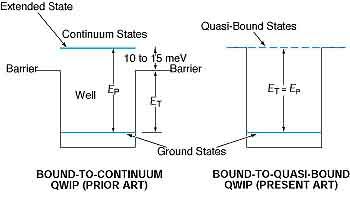
In the development of the predecessor quantum-well infrared photodetectors (QWIPs), a large part of the strategy was to narrow the quantum wells to push the second bound quantum state (first excited state) into the continuum to obtain strong bound-to-continuum intersubband absorption. The major advantage of a bound-to-continuum QWIP is that a photoexcited electron can escape from a quantum well to the continuum transport states without having to tunnel through a barrier (see Figure 1). As a result, the bias needed to collect photoelectrons efficiently can be reduced from the bias needed to collect photoelectrons via quantum tunneling as in some prior photodetectors, thereby decreasing the component of dark current attributable to sequential quantum tunneling. Moreover, because the photoelectrons do not have to tunnel through the barriers, the barriers can be thickened to reduce ground-state sequential tunneling to effect a further decrease in dark current.
In a bound-to-continuum QWIP, the energy barrier, ET, for thermionic emission is about 10 to 15 meV less than the energy, EP, needed for intersubband photoionization; that is, the extended state (or virtual level) lies 10 to 15 meV above the tops of the barriers between wells. A bound-to-quasi-bound QWIP (a device of the present type) differs from a bound-to-continuum QWIP in that the barriers are raised by 10 to 15 meV so that the first excited state lies at the tops of the barriers. The additional barrier height reduces thermionic emission over the barriers, thereby reducing the dark current. In addition, the bound-to-quasi-bound transition maximizes intersubband absorption while maintaining excellent electron transport.

As shown in Figure 2, the dark current in an experimental bound-to-quasi-bound QWIP was found to be about 1/12 that of a comparable bound-to-continuum QWIP. As a result, the signal-to-noise ratio of the bound-to-quasi-bound device is about 3.5 times that of the bound-to-continuum device.
This work was done by Sarath D. Gunapala, Jin S. Park, Gabby Sarusi, and John K. Liu of Caltech for NASA's Jet Propulsion Laboratory. In accordance with Public Law 96-517, the contractor has elected to retain title to this invention. Inquiries concerning rights for its commercial use should be addressed to
Technology Reporting Office
JPL
Mail Stop 122-116
4800 Oak Grove Drive
Pasadena, CA 91109
(818) 354-2240
Refer to NPO-19633
This Brief includes a Technical Support Package (TSP).
Bound-to-quasi-bound quantum-well infared photodetectors
(reference NPO19633) is currently available for download from the TSP library.
Don't have an account?
Overview
The document is a NASA Technical Support Package detailing advancements in bound-to-quasi-bound quantum well infrared photodetectors (QWIPs), specifically focusing on their application in detecting infrared radiation across a range of wavelengths from mid-infrared to very long wavelengths (3-18 μm). These detectors are crucial for various applications, including night vision, early warning systems, navigation, weather monitoring, and astronomy.
The report highlights a significant reduction in dark current—an undesirable characteristic that can degrade detector performance—by an order of magnitude compared to state-of-the-art bound-to-continuum QWIPs. This improvement is achieved through the use of GaAs/AlGaAs multi-quantum well structures, where the energy barrier for thermionic emission is equal to that for intersubband photoionization. In traditional bound-to-continuum detectors, the thermal energy barrier is slightly lower, leading to higher dark currents and reduced performance.
The document outlines the technical challenges associated with high dark currents, which can fill charge storage multiplexer capacitor wells quickly, necessitating lower operational temperatures and diminishing the dynamic range and signal-to-noise ratio of the detector systems. The innovative design of the bound-to-quasi-bound QWIPs addresses these issues, resulting in a dark current approximately 1/12 that of comparable bound-to-continuum devices, thereby enhancing the signal-to-noise ratio by about 3.5 times.
The report also emphasizes the commercial, scientific, and academic interest in these infrared detectors, particularly for environmental monitoring and understanding atmospheric conditions. The potential applications include monitoring global temperature profiles, relative humidity, and the distribution of atmospheric constituents, which are vital for climate studies and Earth observation missions.
The work presented in the document was conducted by a team from Caltech for NASA’s Jet Propulsion Laboratory, showcasing the collaboration between academic research and governmental space exploration efforts. The document serves as a technical disclosure of the advancements in QWIP technology, providing insights into the mechanisms of electron transport and absorption in quantum well structures, and outlines the implications for future infrared detection technologies.
Overall, this report encapsulates a significant leap forward in infrared photodetector technology, promising enhanced performance and broader application potential in various fields.