A simplified method has been developed for determining bond durability under exposure to water or high humidity conditions. It uses a small number of test specimens with relatively short times of water exposure at elevated temperature. The method is also gravimetric; the only equipment being required is an oven, specimen jars, and a conventional laboratory balance.
A new method for determining rubber/glass bond durability was devised in which finely divided substrate (glass beads) was dispersed in the elastomer and the amount of absorbed water measured by weight gain. The difference between primed and unprimed glass beads was immediately apparent, and the stability of the bond was determined by measuring the time to a sudden increase in weight gain.
The materials used in this study were: (a) EVA; an elastomer of ethylene-vinyl acetate (33 percent) copolymer, (b) spherical glass micro-beads as the substrate, and (c) a primer consisting of methacryloxy propyl trimethoxy silane. The glass micro-beads had an average diameter of 30 microns, and were primed with 5 percent by weight of the primer deposited from an alcohol solution. The test specimens were made by blending 30 percent by volume of the glass beads (primed and unprimed) into the EVA polymer with the use of a two-roll differential mill, while adding 1.5 percent of a curing (vulcanizing) agent. A heat-activated peroxide agent was used [t-Butyl-O- (2-ethylhexyl) monoperoxy carbonate]. Compounded specimens were compression molded into sheets of 0.060-in. (1.52- mm) thickness, and cured at 150 °C for 30 minutes. The curing process vulcanizes the EVA rubber and also activates the primer to create a strong bond to the glass surface.
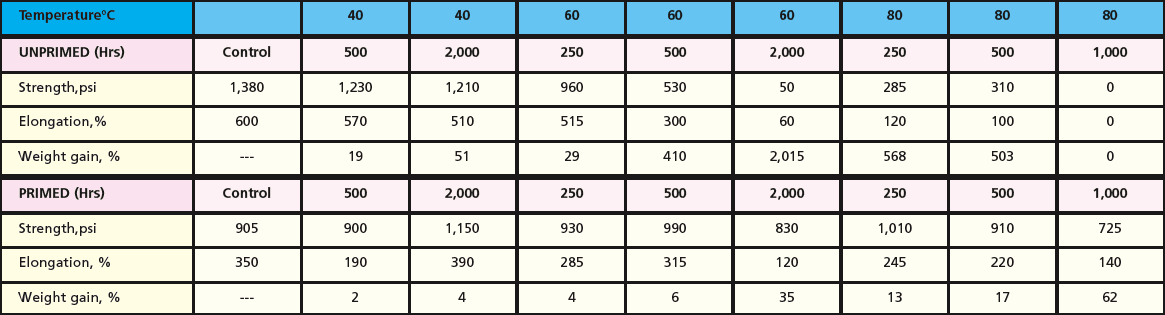
Table 1 provides strength and weight gain data for primed and unprimed specimens after water immersion at 40, 60, and 80 °C. Cured EVA rubber containing no glass beads gained only 1 weight percent water. This shows that the immense weight gain of other specimens is due to water absorption at the glass/elastomer interface. This was also verified by FTIR (Fourier Transform Infrared) spectroscopy.
The amount of water absorption in specimens containing glass beads is dramatically changed by the presence of the primer, particularly in the specimens immersed in water at the 80 °C temperature. Unprimed specimens aged in water at 60 °C for 2,000 hours showed a 2015- percent increase in weight, whereas primed glass bead specimens gained only 35 percent. Reduction in tensile strength also followed primed and unprimed specimens, and increasing exposure times and temperatures.
Importantly, this method can provide semi-quantitative measurement of the bond resistance to water by measuring the time to the sudden increase in weight. This effect is due to degradation of the primer chemistry at the interface. The longer the time to weight increase, the more effective is the primer and the more water resistant is its chemical bond.
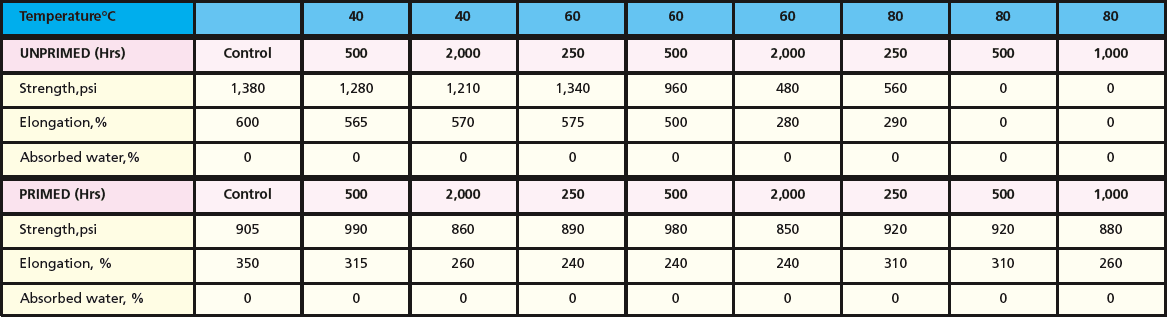
Duplicate specimens of those reported in the first table were dried to constant weight and retested for tensile strength. This was done to determine the recoverability of hydrothermal attack after water removal. Specimens containing primed glass microbeads recovered their initial properties almost entirely, whereas the unprimed glass beads, especially in the 80 °C water exposure, deteriorated too badly to be tested.
Table 2 presents the results as percentage retention of control values: This method offers a simplified way of (a) determining the effectiveness of primers used for bonding elastomers to glass, and perhaps other substrates, in environments with humidity or water exposure; (b) a semi-quantitative technique for determining bond stability; and (c) a method for determining the long term durability and onset of hydrolytic attack at the interface. This method has the advantages of requiring very few specimens and only a laboratory balance to perform measurements.
This work was done by Paul White of Caltech for NASA’s Jet Propulsion Laboratory.
NPO-43912
This Brief includes a Technical Support Package (TSP).
A Simplified Diagnostic Method for Elastomer Bond Durability
(reference NPO-43912) is currently available for download from the TSP library.
Don't have an account?
Overview
The document presents a simplified diagnostic method for assessing the durability of elastomer bonds, particularly in the context of aerospace applications. It is produced by NASA's Jet Propulsion Laboratory and addresses the challenges associated with bonding elastomeric polymers, such as rubbers, to various surfaces including glass, metals, and other polymers.
Elastomer bonds often require primers due to mismatches in chemistry, coefficients of thermal expansion, and modulus between the bonded materials. While initial bond strengths can be evaluated through standard tensile testing methods, the long-term stability of these bonds is frequently uncertain, especially when exposed to environmental factors like humidity, thermal cycling, and ultraviolet light.
The document outlines the most common cause of bond strength deterioration: water intrusion at the bond interface. Water can chemically attack the primer, leach ions from the substrate, and induce additional stress due to hygrothermal expansion. To address these issues, the document introduces a new, simplified method for evaluating bond stability under hygrothermal conditions. This method requires only a few test specimens and minimal equipment, specifically an oven and a laboratory balance.
The study utilizes ethylene-vinyl acetate (EVA) as the elastomer, spherical glass microbeads as the inorganic substrate, and a primer made from gamma-methacryloxypropyl trimethoxysilane. The glass microbeads are primed with a 5% weight solution, and the test specimens are created by blending the primed and unprimed beads into the EVA elastomer. The method measures the amount of water absorbed by the hydrophilic interface, allowing for a straightforward assessment of bond durability based on weight gain.
The findings indicate that the presence of a primer significantly reduces water absorption and enhances the mechanical properties of the bonded materials. The document emphasizes the importance of understanding the durability of elastomer bonds in humid environments and provides a practical approach to evaluating bond stability, which can be crucial for applications in aerospace and other industries where material performance is critical.
Overall, this technical support package serves as a valuable resource for researchers and engineers seeking to improve the reliability of elastomeric bonds in challenging conditions, contributing to advancements in material science and engineering.