Some changes have been incorporated into a proposed method of manufacturing regular arrays of precisely sized, shaped, positioned, and oriented carbon nanotubes. Such arrays could be useful as mechanical resonators for signal filters and oscillators, and as electrophoretic filters for use in biochemical assays.
A prior version of the method was described in "Block Copolymers as Templates for Arrays of Carbon Nanotubes," (NPO-30240), NASA Tech Briefs, Vol. 27, No. 4 (April 2003), page 56. To recapitulate from that article:
As in other previously reported methods, carbon nanotubes would be formed by decomposition of carbon-containing gases over nanometer-sized catalytic metal particles that had been deposited on suitable substrates. Unlike in other previously reported methods, the catalytic metal particles would not be so randomly and densely distributed as to give rise to thick, irregular mats of nanotubes with a variety of lengths, diameters, and orientations. Instead, in order to obtain regular arrays of spaced-apart carbon nanotubes as nearly identical as possible, the catalytic metal particles would be formed in predetermined regular patterns with precise spacings. The regularity of the arrays would be ensured by the use of nanostructured templates made of block copolymers.
A block copolymer consists of two or more sections, or "blocks," each of which consists of a tailored number of monomers of a given type linked together as in a normal polymer molecule. Some combinations of monomers (for example, styrene and methylmethacrylate) yield block copolymer molecules that, under appropriate conditions, undergo a nanoscale phase separation in which they assemble themselves into repeating structures with unit-cell dimensions that typically range between 5 and 100 nm. In other words, a block copolymer can be made to acquire a regular structure on a length scale substantially larger than the individual monomer units yet well below a macroscopic scale.
Proposed techniques for utilizing such nanostructured block copolymers as templates are generally oriented toward exploiting the differences between chemical and/or physical properties of the different materials in the adjacent nanoscale regions (for example, the hydrophilicity of the methylmethacrylate blocks and the hydrophobicity of the styrene blocks). In the version of the method described in the cited previous article, one would utilize the differences in chemical reactivities of the blocks in order to selectively remove the blocks of PMMA, without removing the adjacent blocks of the other polymer, in order to create voids into which catalytic metals could be deposited. In the present version of the method, one would exploit differences in chemical reactivities in a different way, as described below.
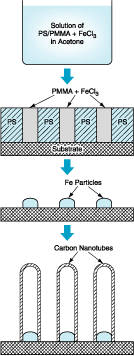
In the present version (see figure), one would begin by dissolving a PS/PMMA diblock copolymer with an ionic salt of a suitable catalytic metal (e.g., FeCl3) in a suitable amphiphilic solvent (e.g., acetone). The solution would be spin-coated onto a substrate, then heated so that the PS/PMMA block copolymer would form itself into pillars of PMMA in a PS matrix. During the heating, the Fe3+ and Cl– would be expected to migrate to the PMMA regions, wherein the local dipoles in the oxygen-containing moieties would tend to attract and bind the ions. The resulting block copolymer film would contain a regular array of iron-rich and iron free regions with nanometer dimensions. The polymer would then be oxidized away by heating to a temperature of 400 °C in air, leaving a regular array of nearly identically sized and shaped iron oxide dots on the substrate. The substrate and dots would be heated in hydrogen to reduce the iron oxide dots to iron. Thereafter, carbon nanotubes would be grown on the iron dots as described above.
This work was done by Michael Bronikowski of Caltech for NASA's Jet Propulsion Laboratory. For further information, access the Technical Support Package (TSP) free on-line at www.techbriefs.com/tsp under the Materials category.
In accordance with Public Law 96-517, the contractor has elected to retain title to this invention. Inquiries concerning rights for its commercial use should be addressed to:
Intellectual Assets Office
JPL
Mail Stop 202-233
4800 Oak Grove Drive
Pasadena, CA 91109
(818) 354-2240
E-mail: This email address is being protected from spambots. You need JavaScript enabled to view it.
Refer to NPO-30502.
This Brief includes a Technical Support Package (TSP).
Making Carbon-Nanotube Arrays Using Block Copolymers: Part 2
(reference NPO-30502) is currently available for download from the TSP library.
Don't have an account?
Overview
The document presents a technical report on a novel method for creating regular arrays of carbon nanotubes (CNTs) using metal-impregnated, nano-structured block-copolymeric (BCP) materials. Developed by Michael J. Bronikowski at NASA's Jet Propulsion Laboratory, this method addresses the need for CNTs with identical dimensions, regular spacing, and the ability to adjust the spacing between them.
The innovation lies in the use of amphiphilic BCPs, which can effectively associate with metal compounds that have corresponding philicity. This interaction allows for the formation of a structured matrix of metal oxides, which retains a regular array of nanometer-scale pores even after the BCP is removed through oxidation. The resulting structure facilitates the growth of CNTs in a controlled manner, ensuring that they are not in contact with one another, which is crucial for their performance in various applications.
The report highlights the advantages of this method over previous techniques, which often resulted in irregularly spaced or dimensionally inconsistent CNTs. By utilizing this new approach, researchers can produce CNTs that are not only uniform in size but also precisely arranged, enhancing their utility in fields such as electronics, materials science, and nanotechnology.
The document also references several key studies and patents that have contributed to the understanding and development of CNTs and BCP materials. It emphasizes the potential applications of these regular arrays of CNTs, including their use in RF filters, oscillators, and biochemical sensors, which could lead to advancements in technology and industry.
Overall, this report serves as a significant contribution to the field of nanotechnology, showcasing a method that could revolutionize the production of carbon nanotubes and expand their applications in various high-tech domains. The work was conducted under the auspices of NASA, and the findings are intended to inform further research and development in this promising area.