A chromatic modulator has been proposed to enable the separate detection of the red, green, and blue (RGB) color components of the same scene by a single charge- coupled device (CCD), active-pixel sensor (APS), or similar electronic image detector. Traditionally, the RGB color-separation problem in an electronic camera has been solved by use of either (1) fixed color filters over three separate image detectors; (2) a filter wheel that repeatedly imposes a red, then a green, then a blue filter over a single image detector; or (3) different fixed color filters over adjacent pixels. The use of separate image detectors necessitates precise registration of the detectors and the use of complicated optics; filter wheels are expensive and add considerably to the bulk of the camera; and fixed pixelated color filters reduce spatial resolution and introduce color-aliasing effects. The proposed chromatic modulator would not exhibit any of these shortcomings.
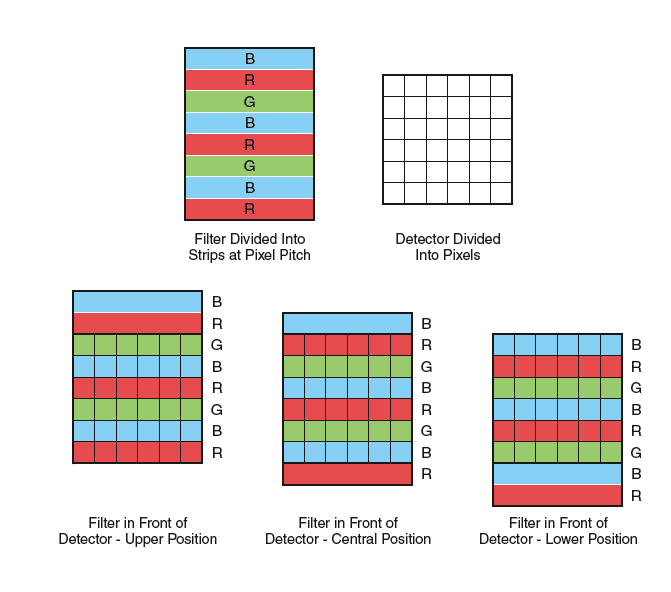
In operation, the electrostatic comb drive would be actuated to repeatedly snap the filter to the upper extreme, middle, and lower extreme positions. This action would repeatedly place a succession of the differently colored filter strips in front of each pixel of the image detector. At each filter position, each detector pixel would thus acquire information on the local brightness in the momentarily selected color. The frequency of actuation of the comb drive would be three times the frame rate of the camera, so that over one frame period, each pixel would acquire full color information. Hence, the camera would acquire full color information at full pixel resolution.
Of course, it would be necessary to time-multiplex the outputs of the pixels for processing in a manner consistent with the spatial and temporal periodicity of the color information acquired by each detector pixel. To simplify the processing, it would be desirable to encode information on the color of the filter strip over each row (or at least over some representative rows) of pixels at a given instant of time in synchronism with the pixel output at that instant. This could be accomplished by means of an alternating pattern of opaque patches over the last two pixel-column positions of each filter strip: for example, nonzero illumination at both of these column positions could signify the presence of the red filter strip, zero illumination at one of these column positions could signify the presence of the green filter strip, and zero illumination at both of these column positions could signify the presence of the blue filter strip.
This work was done by Frank Hartley and Anthony Hull of Caltech for NASA's Jet Propulsion Laboratory.
This invention is owned by NASA, and a patent application has been filed. Inquiries concerning nonexclusive or exclusive license for its commercial development should be addressed to the Patent Counsel, NASA Management Office–JPL. Refer to NPO-20896.
This Brief includes a Technical Support Package (TSP).
Chromatic Modulator for a High- Resolution CCD or APS
(reference NPO-20896) is currently available for download from the TSP library.
Don't have an account?
Overview
The document titled "Chromatic Modulator for a High-Resolution CCD or APS" is a NASA Technical Support Package (NPO-20896) that discusses advancements in electronic imaging technology, particularly focusing on color separation methods in imaging systems. Traditional approaches to color separation, such as using fixed filters over multiple imagers or employing filter wheels, present several challenges. These include increased complexity in optics, high registration requirements, bulkiness, and potential loss of resolution due to color aliasing effects, especially in high-contrast or patterned scenes.
The primary problem addressed in this document is the need for an efficient, lightweight, and robust solution for obtaining RGB (Red-Green-Blue) encoding of imaged data without sacrificing pixel resolution. The proposed solution involves a novel chromatic modulation function realized through a rectangular frame that can move in one direction between three stable states: a mechanically centered position and two electromechanically 'snapped' displacements. This design allows for the alignment of a triple colored strip filter array, where the pitch of the strips corresponds to the displacements of the frame. The discrete color strips cover different linear rows of pixels in an underlying imaging array, effectively enabling high-resolution color imaging.
The document emphasizes the potential applications of this technology beyond aerospace, suggesting that the advancements could have significant implications in various technological, scientific, and commercial fields. It is part of NASA's Commercial Technology Program, which aims to disseminate aerospace-related developments that may benefit broader industries.
For further inquiries or assistance, the document provides contact information for the Innovative Technology Assets Management at NASA's Jet Propulsion Laboratory (JPL) in Pasadena, California. It also includes a disclaimer stating that the U.S. Government does not assume liability for the use of the information contained in the document, nor does it endorse any specific trade names or manufacturers mentioned.
In summary, this Technical Support Package outlines a promising approach to improving color imaging technology, addressing the limitations of traditional methods while highlighting the potential for wider applications in various sectors.