

Innovators at the NASA Johnson Space Center (JSC) have developed an Impact and Trajectory Detection System that is capable of determining the time and location of the projectiles impact as well as the trajectory of the projectile. The system can indicate the time and location of an impact and the trajectory of that projectile using piezoelectric polymer film and sensors.
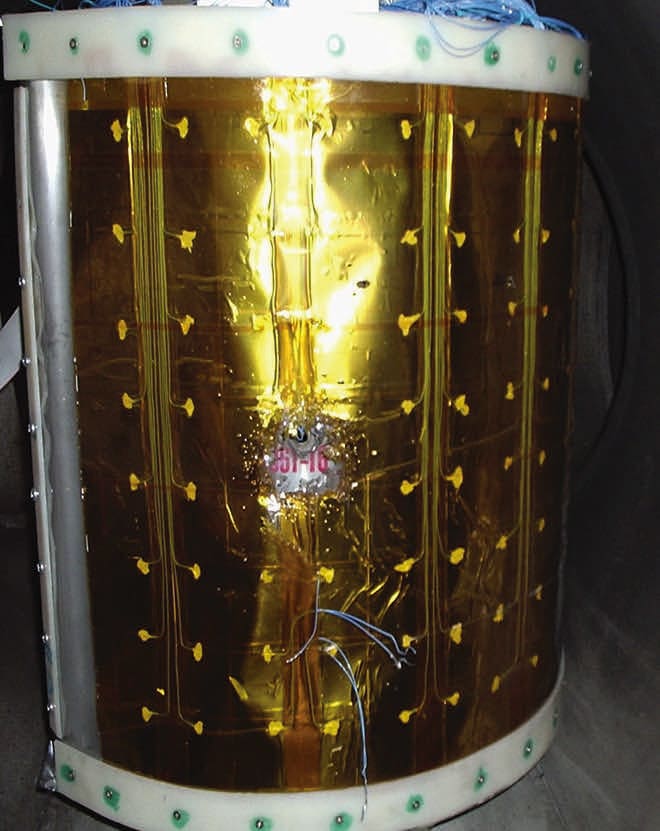
The technology is designed so that the piezoelectric film covers the area of interest, regardless of size. This film has the characteristic that when it is mechanically impacted, it develops an electrical voltage, which can be detected. When a target area of concern is covered by this film, it will give an indication of a projectile strike. By dividing the area into pixels, and attaching sensors to each pixel, the impact location and time can be obtained. A computer connected to the system communicates with the electronics, processes the raw data, and displays the raw and processed data to the system user.
The system uses a communication and control subsystem that upon projectile impact, performs a time discrimination analysis to determine the projectiles impacts location on each panel layer and the direction or trajectory of the projectile. This information can help in determining future safety measures and location placement for the area of interest.
This system is light in weight and sensitive to a wide range of impact energies and velocities. The sensor has been extensively tested and works well in vacuum conditions, ambient conditions, or under pressure conditions and can exist passively through the piezoelectric effect.
The electronics do require power, but they typically consume very low wattage. Temperature limits have minimal effect on the piezofilm and the accuracy of the film is almost 100 percent. Systems of this type could be useful in settings in which the occurrence of impacts and/or the locations of impacts are not immediately obvious and there are requirements to detect and quickly locate impacts to prevent or minimize damage.
Earth-based applications include situations where it is necessary to quickly locate impacts to prevent or minimize danger from munitions, hailstones, burglary tools, or vehicular collisions.
NASA is actively seeking licensees to commercialize this technology. Please contact NASA’s Licensing Concierge at











