

Power Electronics - April 2024
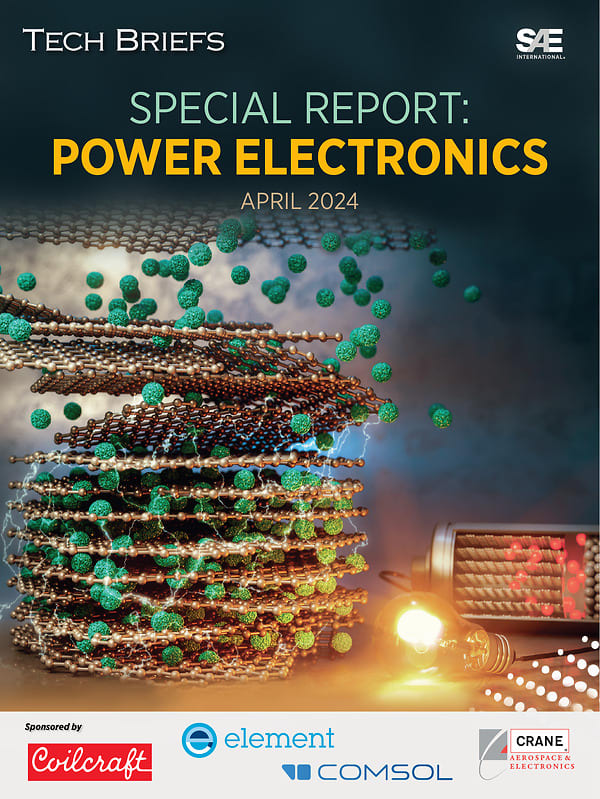
This compendium of articles from the editors of Tech Briefs and Aerospace & Defense Technology magazines looks at the latest advances in power electronics and energy storage for applications ranging from electric vehicles to spacecraft to wearable devices.
Don't have an account?
Overview
The April 2024 Special Report on Power Electronics presents a comprehensive overview of recent advancements and innovations in the field, focusing on the electrification of various industries and the integration of new technologies. The report highlights several key features and technological breakthroughs that are shaping the future of power systems.
One of the standout topics is the Space Solar Power Demonstrator (SSPD-1) developed by Caltech’s Space Solar Power Project. This initiative aims to harvest solar energy in space and transmit it to Earth. A significant component of this project is the Microwave Array for Power-transfer Low-orbit Experiment (MAPLE), which utilizes an array of lightweight, flexible microwave power transmitters. These transmitters are designed using low-cost silicon technologies and are essential for efficient energy transmission from space to designated locations on Earth. The report emphasizes the need for lightweight and flexible energy transmission arrays to minimize fuel requirements for space launches.
In the realm of electric vehicles (EVs), the report discusses the evolution of charging technologies, particularly the plug-and-charge capability. This feature allows for seamless communication between EVs and charging stations, enhancing the user experience. However, it notes that only about 30% of current EVs support this technology, indicating room for growth. The report also highlights the efforts of various stakeholders, including automakers and charging companies, to improve the reliability and availability of the EV charging infrastructure in the U.S. The Joint Office of Energy and Transportation's National Charging Experience Consortium, known as ChargeX, is mentioned as a collaborative effort aimed at enhancing the charging experience to rival that of traditional gas stations.
Another significant innovation covered in the report is the development of conductive, biodegradable wires made from designed proteins by researchers at the University of Bristol. These minuscule wires, which are compatible with conventional electronic components, are produced using harmless bacteria, eliminating the need for environmentally damaging synthetic production methods. This advancement could lead to more sustainable electronic components in the future.
The report also touches on next-generation flow battery designs and the development of stretchable micro-supercapacitors, which are intended for self-powering wearable devices. These technologies are part of ongoing research aimed at improving battery performance and efficiency, which is crucial for the growing demand for energy storage solutions.
Overall, the April 2024 Special Report on Power Electronics encapsulates the dynamic landscape of power systems, showcasing how innovative technologies are being developed to address the challenges of energy transmission, storage, and sustainability. The report underscores the importance of collaboration among various sectors to achieve a more reliable and efficient energy infrastructure, paving the way for a greener and more electrified future.











