A proposed thermoelectric device would exploit natural temperature differences between air and soil to harvest small amounts of electric energy. Because the air/soil temperature difference fluctuates between nighttime and daytime, it is almost never zero, and so there is almost always some energy available for harvesting. Unlike photovoltaic cells, the proposed device could operate in the absence of sunlight. Unlike a Stirling engine, which could be designed to extract energy from the air/soil temperature difference, the proposed device would contain no moving parts. The main attractive feature of the proposed device would be high reliability. In a typical application, this device would be used for low-power charging of a battery that would, in turn, supply high power at brief, infrequent intervals for operating an instrumentation package containing sensors and communication circuits.
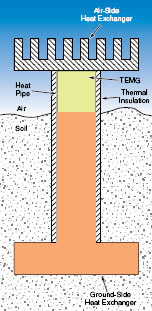
A study of factors that could affect the design and operation of the device has been performed. These factors include the thermal conductances of the soil, the components of the device, the contacts between the components of the device, and the interfaces between the heat exchangers and their environments. The study included experiments that were performed on a model of the device to demonstrate feasibility. Because a TEMG suitable for this device was not available, a brass dummy component having a known thermal conductance of 1.68 W/K was substituted for the TEMG in the models to enable measurement of heat flows. The model included a water-based heat pipe 30 in. (76.2 cm) long and 1 in. (2.54 cm) in diameter, wrapped with polyethylene insulation to reduce radial heat flow. Several different side heat exchangers were tested. On the basis of the measurements, it was predicted that if a prototype of the device were equipped with a TEMG, daily temperature fluctuations would cause its output power to fluctuate between 0 and about 0.1 mW, peaking to 0.35 mW during early afternoon.
This work was done by Jeffrey Snyder, Jean- Pierre Fleurial, and Eric Lawrence of Caltech for NASA's Jet Propulsion Laboratory. For further information, access the Technical Support Package (TSP) free on-line at www.techbriefs.com/tsp under the Physical Sciences category. NPO-30831
This Brief includes a Technical Support Package (TSP).
Thermoelectric Air/Soil Energy-Harvesting Device
(reference NPO-30831) is currently available for download from the TSP library.
Don't have an account?
Overview
The document is a technical support package from NASA's Jet Propulsion Laboratory (JPL) detailing research on thermoelectric air/soil harvesting devices. These devices utilize solid-state thermoelectric generators (TEGs) to convert temperature differentials between air and soil into electrical energy, offering a reliable power generation solution for remote applications, such as sensors and communication devices.
The introduction outlines the challenges faced by traditional thermoelectric modules, which have low specific power densities and are typically effective only at high temperature differentials. Current research at JPL focuses on developing microgenerators capable of maintaining high specific power densities even at small temperature differences. The proposed system consists of two heat exchangers: one exposed to the air and the other buried underground, facilitating heat flow across the TEG. This design allows for energy harvesting during both day and night, with an expected output of approximately 22 mW of electrical power during charge cycles.
The document emphasizes the importance of optimizing the thermal conductance of the TEG to maximize power generation. It discusses the need for the internal thermal conductance of the TEG to match the sum of all external thermal conductances to achieve optimal efficiency. The analysis includes a method for estimating the thermal conductance of passive heat sinks in contact with soil, which is crucial for predicting heat output and optimizing energy-harvesting devices.
A prototype of the energy-harvesting device was constructed and tested in the field, although initial results indicated low efficiencies at small temperature differentials. The findings suggest that the heat pipe design used in the prototype may not be suitable for low temperature and small temperature differential operations. The document concludes that further investigation and potential redesign of the heat pipe or its removal could significantly enhance the system's efficiency.
Overall, the document provides insights into the feasibility and optimization of thermoelectric energy harvesting devices, highlighting the potential for high reliability and low maintenance power solutions in remote locations. It serves as a valuable resource for understanding the advancements in thermoelectric technology and its applications in energy harvesting.