

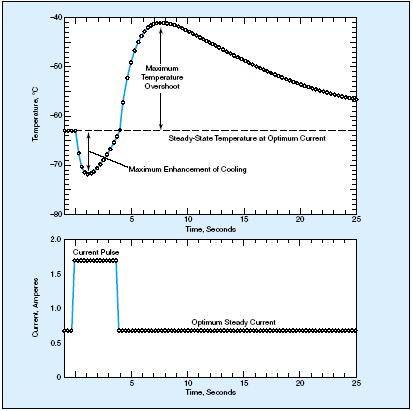
The rates of cooling afforded by thermoelectric (Peltier) devices can be increased for short times by applying pulses of electric current greater than the currents that yield maximum steady-state cooling. It has been proposed to utilize such momentary enhancements of cooling in applications in which diode lasers and other semiconductor devices are required to operate for times of the order of milliseconds at temperatures too low to be easily obtainable in the steady state. In a typical contemplated application, a semiconductor device would be in contact with the final (coldest) somewhat taller stage of a multistage thermoelectric cooler. Steady current would be applied to the stages to produce steady cooling. Pulsed current would then be applied, enhancing the cooling of the top stage momentarily.
The principles of operation are straightforward: In a thermoelectric device, the cooling occurs only at a junction at one end of the thermoelectric legs, at a rate proportional to the applied current. However, Joule heating occurs throughout the device at a rate proportional to the current squared. Hence, in the steady state, the steady temperature difference that the device can sustain increases with current only to the point beyond which the Joule heating dominates. If a pulse of current greater than the optimum current (the current for maximum steady cooling) is applied, then the junction becomes momentarily cooled below its lowest steady temperature until thermal conduction brings the resulting pulse of Joule heat to the junction and thereby heats the junction above its lowest steady temperature.
This work was done by G. Jeffrey Snyder, Jean-Pierre Fleurial, and Thierry Caillat of Caltech, and Gang Chen and Rong Gui Yang of MIT for NASA's Jet Propulsion Laboratory. For further information, access the Technical Support Package (TSP) free online at www.techbriefs.com/tsp under the Physical Sciences category. NPO-3055










