

Imagine being severely dehydrated and water literally appearing out of thin air. In other words: The air you breathe could quickly become the water that wets your whistle. Well, that scenario is one step closer to reality thanks to University of Nevada, Las Vegas spinoff WAVR Technologies.
WAVR specializes in atmospheric water harvesting — transforming water vapor in the air around us into a usable form. The technology and approach have been tested outdoors in Las Vegas. It’s effective down to 10 percent humidity, much more efficient than similar existing approaches.
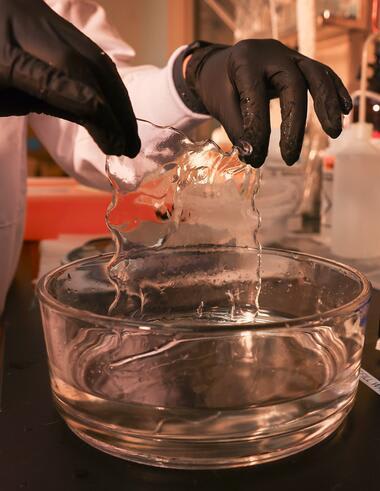
How it works is it directly captures water in a liquid salt solution that is suitable for subsequent processing into potable water or energy production. A key component in the process is a hydrogel membrane “skin,” the inspiration for which came from nature.
“We took inspiration from the tree frog,” said WAVR Co-Founder Yiwei Gao. “They don't need to drink a lot of water to stay hydrated. They just lie on the tree, and when the air flows around them, the water can be absorbed by their body — liquid through their skin. This is how we designed this whole thing.”
Gao said that others in the field have viewed the hydrogels as a sponge, swelling as they capture water. Then those hydrogels need to be wrung out to access the water.
“For instance, you can heat it up to release water,” he said, “to transfer the atmospheric water into the liquid water. Then it’s drinkable or can be used for different applications. But in our case, the advantage of our technology is we are not separating these two capture-and-release stages. Our process is continuous.”
According to Gao, they are using the hydrogel as a membrane like the skin of the tree frog, not as a sponge. The water is captured in the salty solution on the other side of that membrane. “We can capture the atmospheric water from the ambient air at a very fast speed. And this makes the footprint of this whole device much smaller."
Plus, he said, that means there’s no start-stop time window at all — the water can be captured and released on an ongoing basis at the same time. “That's how we can further increase the efficiency beyond other technologies,” he added.
WAVR Co-Founder Rich Sloan said that what you generate from this process is distilled water. It's purified water because it's boiled off, much in the same way that you would create normal distilled water.
“What determines how fast or how much are a few variables,” Sloan said. “One is what's the size of the unit that we are providing. So, that surface area essentially is directly correlated to how much vapor can be captured. And then relative humidity is another variable that's crucial.”
According to Sloan, one of the special features of this technology is that unlike almost all the other technologies in the atmospheric water-harvesting space, this operates down to 10 percent relative humidity effectively. To contrast that with the state-of-the-art processes, most of the other systems are ineffective below 50 percent relative humidity.
Sloan and the team including Gao, Ryan Phung, and Jeremy Cho co-founded WAVR and have gained an exclusive license to all of the technology, intellectual property, etc. “Now we are developing products of different sizes — 100-gallon-per-day output, 1,000-gallon-per-day output, 10,000-gallon-per-day output — with the objective of having as significant an impact as possible on water scarcity and water insecurity, and replacing that with a sustainable, incremental supply of water,” he said.
“We are going to be spending 2025 focused on pilot projects at varying scales with various customers, and WAVR Technologies will be the entity that assembles the engineers’ designs, delivers the pilots, and ultimately the production units as we move out into 2026,” Sloan said.
This article was written by Andrew Corselli, Digital Content Editor, SAE Media Group. For more information, visit here .










