

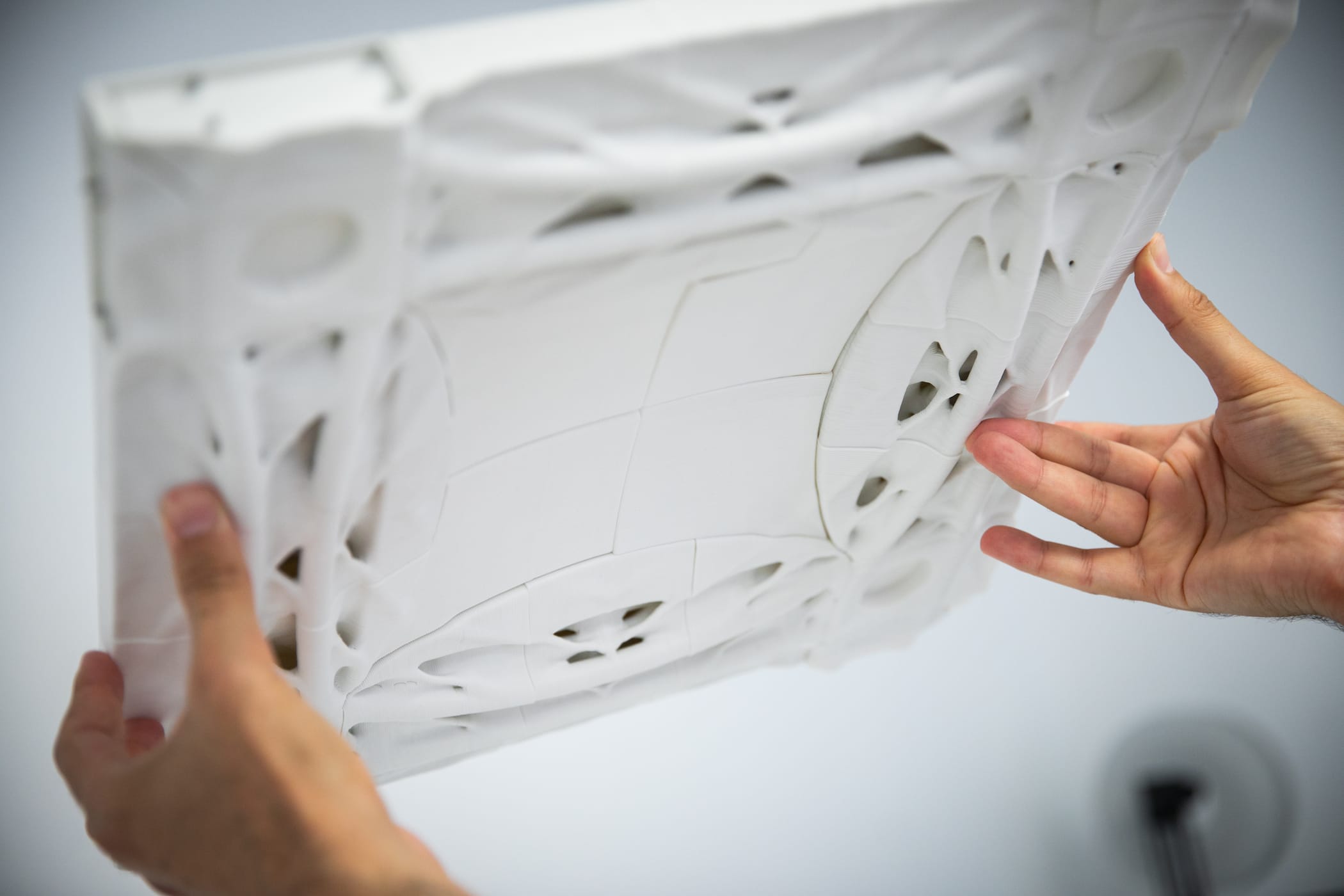
Tech Briefs: What got you started on 3D printing with concrete?
Shu Yang: I was not a concrete person; my team typically works with plastics. My research is on polymers and soft matter, colloids, liquid crystals, and composites. But I’ve worked with architects for many years because I'm driven by an interest in the aesthetics of the geometry and the real-world applications. Buildings contribute up to 40 percent of total energy consumption in the U.S. We spend an average of 22 hours daily in a building. So, the challenge is how do you save energy and make the environment healthier. That is what attracted my interest in working with buildings.
Several years ago, the Department of Energy (DOE)/ARPA-E program put out a call, “Harnessing Emissions into Structures Taking Inputs from the Atmosphere (HESTIA),” aiming for technologies that cancel out embodied emissions while transforming buildings into net carbon storage structures. There are two categories, one is for new carbon-capture/storage building materials, and the other is about whole building designs that incorporate carbon-storing materials.
Architect Masoud Akbarzadeh has been designing different geometries: polygons, and other shapes, which is exactly in sync with my interests. We have a joint National Science Foundation (NSF) grant on energy-efficient future manufacturing methodologies because of our similar interests in geometry. His lab typically works on a large structural scale, and my lab works at material innovation, often at much smaller scales. Our challenge was to make a carbon-capture/storage concrete building, using less material without sacrificing the mechanical strength.
Concrete is an interesting challenge for me — I never worked with it before. However, it's also the second most used material other than water. Infrastructure such as buildings, floors, bridges, roads — so many things are made from concrete because it has high mechanical strength and is also very cheap.

When we tackled this design, our objective was to deliver a lighter-weight material with the same mechanical strength as normal concrete but that also absorbs CO2. Cement, which is a very important ingredient of concrete, contributes a significant percentage of global CO2 emissions. So, we are interested in replacing the cement with a carbon-capture and storage material. This is where I had to wear my material scientist hat — to think about material selection. The criteria are that, one, the material has to be cheap because although you can't compete with concrete or cement on price, it has to be close. And second, it has to be abundant.
Buildings are a very large-scale application, so there's a gravity issue: how heavy it is and how much volume. But you don't want to select a material you can only use in the lab. And you also don’t want it to harm people who live in the building.
That's why I proposed using diatomaceous earth (DE) — the skeletons of algae called diatoms — which is composed of silica. And it is highly abundant in the ocean. The other thing I like about diatoms is that they have a honeycomb structure, which is well-known for its strength. Further, the skeletons are made of silica nanoparticles, which have nanoporosity and microporosity, forming hierarchical structures. So, they fit with my criteria — they can react with and capture CO2 and also enhance the concrete formation without losing its mechanical strength.
It turns out that I'm really happy with my material selection because not only does it capture CO2, but it is well-suited for concrete printing, where you have to consider the rheology — how particles flow and interact. You have to have a nozzle extruding the concrete. If a material is very viscous, it's very difficult for it to come out. It's just like your ketchup, your toothpaste, you have to squeeze to get them out. During the squeezing, the material undergoes shear thinning. Imagine you have a ketchup bottle, and you squeeze but the ketchup doesn't come out, so you shake it. Shaking moves the molecules, aligning them in the shear direction. Similarly, when you squeeze a toothpaste tube, you have a force that aligns the molecules along the shearing direction, so the paste becomes non-viscous. It is initially solid but then becomes a liquid. Once it’s a liquid it’s able to come out and flow very nicely, but after it comes out, it returns to a solid form.
With 3D printing it is very important to have this characteristic — once you squeeze the material through the nozzle, it has to immediately resolidify, so the layers are able to stand up on themselves. It turns out that DE is a kind of rheological modifier that can flow under shear.
This is one of the pluses I discovered. DE also has a lot of other benefits — because it is highly porous, inclusion of it makes our concrete lighter. Since normal concrete is very heavy, if you stack it layer by layer, the more you stack, the top will apply more and more force to the bottom layers, which could force the printed patterns to collapse. So, you need to solidify very quickly, but you also want it to be lightweight so you can stack more layers together.
Because this is a porous material, it has a lower density. And also, because it is porous, it can be soaked with water. When you make a concrete recipe, you take a bag of cement powder, you add stone pellets, and then add water to mix them together to make a paste. How you add the water is very important. It is like with a sandcastle — too much water makes it weak, and too little water makes it too dry — you need the right amount.
As you print layer by layer, the bottom will print first and then you print the top layer, which is wet, but the bottom is starting to dry. If the bottom is already dry and begins to shrink, the top is still wet and not shrinking yet. So, if the drying speed is different at different layers, cracks will occur — concrete is a brittle material, which cracks easily. However, since DE is highly porous, it will act like a reservoir to store water, and then water can be transported between the layers, from top to bottom.
So, while each printed layer has a solid form, there is water in it. If everything stays moisturized, there's not much shrinkage, so it will not fracture.
That's where I feel that as a material scientist, I can really help. My challenge is to deliver good rheological properties, low density, mechanical strength, and so on. And we need to make it work for printing the special geometry of Masoud’s design, which has a lot of curved structures. For a curve, each time you print you have to move a little bit out, so- called overhang. The layers are not perfectly stacked one on top of the other as with a straight wall, so, that is a challenge. Lightweight material is therefore very beneficial because otherwise every time you move a little between the layers in the stack, if it's too heavy, it will collapse.
With this very close collaboration between my materials group and the architecture group, we solve problems together. We go from small scale in my lab to demonstrate the rheology, and then we go to their lab to fabricate structures on a large scale.
Tech Briefs: How does this structure absorb carbon dioxide?
Yang: What is cement? It is calcium oxide. Calcium oxide, CaO, is made by heating calcium carbonate, which is CaCO3, to 2000 °C to get rid of the CO2. So, conversely, cement in your concrete recipe will react with CO2 to form calcium carbonate.
The silica in DE is very important in making this happen. It doesn't react with CO2, but it acts as a binder in concrete. If you add water to calcium oxide and silica, calcium silicate is formed, which binds everything together. Meanwhile, DE helps to recruit the CO2, which reacts with the calcium oxide (cement), to form calcium carbonate.
One form of calcium carbonate is chalk, which is weak because it has a random, amorphous structure. Another form, however, with higher mechanical strength is calcite, which is a crystalline form of calcium carbonate. So ideally, I want to form crystal-like structures, the calcite form of the material, which is very strong.
Tech Briefs: You’ve said the structure gets stronger over time — could you explain that?
Yang: With concrete, you first dry the water out of it, so it solidifies. But you need to have a chemical reaction between the calcium oxide, silica, and water, forming calcium silicate. So, the more you react, the more the materials act as a glue that binds things, and it becomes stronger. Over time, the more you absorb the CO2 into your concrete recipe, the more reaction you have, the more calcite, the crystal form of the calcium carbonate, starts to form. So that's why, over time, it can become stronger and stronger.
Tech Briefs: Will rebar still have to be used with your kind of structure?
Yang: Yes, but we want to minimize the use of rebar. That's why designing the geometry with the understanding of how the load is distributed within the concrete slabs is very important. That's the other piece where Masoud and I share a similar interest. My group does the material formulation and modeling, while his group does the building design and modeling of the mechanical stress distribution within the design.
Tech Briefs: Ultimately, what effects do you think your process can have on CO2 emissions?
Yang: The thicker you have to make the concrete to achieve the needed strength, the more cement you use, the more CO2 emissions you generate. By using 3D printing to mimic periodic honeycomb structures, which are highly porous and very strong, we can reduce the use of concrete by 60 percent without sacrificing the mechanical properties. And that is in addition to the effect of our material actually absorbing CO2.











