A method of polarimetric imaging, now undergoing development, involves the use of two photoelastic modulators in series, driven at equal amplitude but at different frequencies. The net effect on a beam of light is to cause (1) the direction of its polarization to rotate at the average of two excitation frequencies and (2) the amplitude of its polarization to be modulated at the beat frequency (the difference between the two excitation frequencies). The resulting modulated optical light beam is made to pass through a polarizing filter and is detected at the beat frequency, which can be chosen to equal the frame rate of an electronic camera or the rate of sampling the outputs of photodetectors in an array.
It is conventional to characterize the polarimetric state of incident light in terms of the Stokes vector (I, Q, U, V), where I represents the total intensity; Q represents the excess of intensity of light polarized at an angle designated as 0° over that of light polarized at a relative angle of 90°, U represents similarly the excess of intensity at 45° over that 135°, and V represents the excess of intensity of right circular polarization over left circular polarization. It has been shown theoretically that in the present method, there should be no cross-talk between the Q and U channels and that it should be possible to obtain the ratio U/I from two readings of a single photodetector taken when the polarizer is in two orientations that differ by 45°.
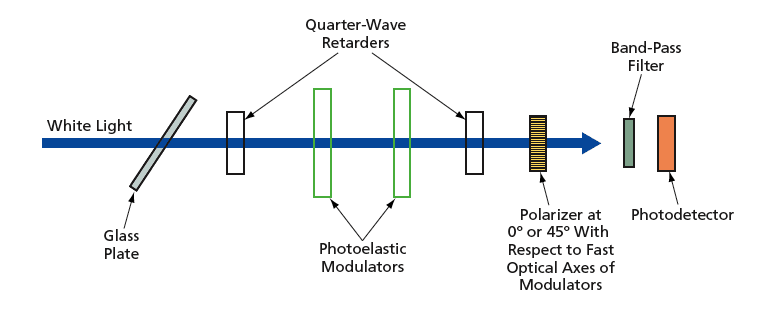
The figure schematically depicts a laboratory setup that was used to demonstrate the feasibility of the method. A collimated beam of white light was partially polarized by a glass plate at an oblique angle. The degree of polarization could be changed by rotating the glass plate. The light then passed through a circular-polarization subsystem that included (1) two photoelastic modulators having their fast axes at an angle of 0°, sandwiched between (2) two quarter-wave retarders oriented at angles of 45° and 135°, respectively. The two photoelastic modulators had resonance frequencies of about 42 kHz, differing by a beat frequency of about 9 Hz. The modulated light was then made to pass through a 0° or 45° polarizer on the way to a photodetector. A band-pass filter having a nominal pass wavelength of 672 nm with 20-nm bandwidth was mounted between the polarizer and the photodetector. Results of several experiments at various degrees of linear polarization were found to agree substantially with theoretical predictions.
This work was done by Yu Wang, Thomas Cunningham, David Diner, Edgar Davis, Chao Sun, Bruce Hancock, Gary Gutt, Jason Zan, and Nasrat Raouf of Caltech for NASA’s Jet Propulsion Laboratory. NPO-43806
This Brief includes a Technical Support Package (TSP).
Polarimetric Imaging Using Two Photoelastic Modulators
(reference NPO-43806) is currently available for download from the TSP library.
Don't have an account?
Overview
The document titled "Polarimetric Imaging Using Two Photoelastic Modulators" presents a novel technology developed by a team at NASA's Jet Propulsion Laboratory aimed at enhancing polarimetric imaging capabilities, particularly for characterizing atmospheric aerosols from Earth orbit. Traditional methods using static polarizing filters have struggled to achieve the necessary polarimetric accuracy, necessitating a new instrument architecture capable of auto-calibration in space.
The proposed system utilizes dual photoelastic modulators (PEMs) to improve measurement accuracy and eliminate crosstalk between polarization channels. This innovation allows for high-accuracy polarimetric imaging by reducing the operating frequency of the PEMs, which are critical components in the detection of polarized light. The document outlines the technical setup of the experiment, which involves a collimated white light source that becomes partially polarized by a glass plate. The experimental arrangement includes two PEMs with their fast axes aligned at 0 degrees, sandwiched between two quarter-wave retarders oriented at 45 and 135 degrees.
The results of the experiments demonstrate the system's capability to detect weakly polarized light, with a degree of linear polarization (DOLP) as low as 0.5%. The findings indicate that the dual-PEM system can effectively measure both the Stokes parameters Q and U from a single detector, making the ratio of U/I independent of the detector's efficiency. This is a significant advancement, as it allows for more reliable data collection in challenging atmospheric conditions.
Figures included in the document illustrate the experimental setup, results comparing theoretical predictions with actual measurements, and the performance of the system across varying degrees of polarization. The results align closely with theoretical expectations, confirming the effectiveness of the dual-PEM approach.
Overall, this document highlights the potential of the dual photoelastic modulator system for future space-based polarimetric imaging applications, which could lead to improved understanding and characterization of atmospheric phenomena. The technology is positioned to have broader implications beyond aerospace, with potential applications in various scientific and commercial fields. For further inquiries or information, the document provides contact details for NASA's Innovative Technology Assets Management.