As a key technology in the transition to cleaner energy, electrolyzers are critical in enabling hydrogen production without reliance on fossil fuels. However, these renewable systems face significant engineering challenges that require meticulous technical attention. They must operate under extreme conditions including high pressures and temperature fluctuations.
With the International Energy Agency predicting a 60 percent rise in green hydrogen demand by 2030, continuous technological progress is essential. Sealing technologies have emerged as critical facilitators in addressing emerging challenges, maintaining system integrity, preventing leaks, and ensuring long-term durability under demanding operating conditions. Advances in sealing technologies and material science are not merely incremental, but they are also vital developments that contribute to hydrogen’s efficient utilization as a sustainable energy resource.
The Critical Role of Electrolyzers in Green Hydrogen Production
Electrolyzers are part of a critical infrastructure in emerging clean energy conversion technologies, enabling hydrogen production through water electrolysis. These sophisticated electrochemical systems transform electrical energy into chemical energy by decomposing water molecules into hydrogen and oxygen gases through controlled electrical processes.
The technological development of electrolyzers represents a crucial pathway for decarbonization strategies across multiple sectors. These systems systematically convert electrical energy into a storable, transportable chemical energy carrier from renewable energy storage to industrial hydrogen production.
Several types of electrolyzer technologies exist, each with distinct characteristics and advantages, depending on the application, scale, and efficiency requirements.
Proton Exchange Membrane (PEM) Electrolyzers
PEM electrolyzers use a solid polymer electrolyte membrane, offering fast dynamic response, high current density, and compact design. Their ability to rapidly adjust to fluctuating power inputs makes them ideal for integration with intermittent renewable energy sources like wind and solar.
Anion Exchange Membrane (AEM)
AEM electrolyzers use a membrane that allows negatively charged ions (such as hydroxyl ions, OH -) to pass through while blocking positively charged ones. This design supports efficient hydrogen production by enabling water splitting at lower temperatures and with potentially lower-cost materials. AEM technology is gaining interest for its balance of performance and affordability, particularly in renewable energy applications.
Solid Oxide Electrolyzers
Operating at high temperatures (700 °C to 900 °C), solid oxide electrolyzers are highly thermodynamically efficient. They can utilize waste heat from industrial processes, making them an advanced solution for energy conversion and resource optimization.
Alkaline Electrolyzers
This process relies on an alkaline electrolyte solution, such as potassium hydroxide (KOH) or sodium hydroxide (NaOH), to drive the electrochemical reaction. Recognized as the most established and dependable technology in its field, alkaline electrolyzers typically use potassium hydroxide as their electrolyte to enhance electrical conductivity and improve efficiency. Due to their operation under high pressure and exposure to corrosive electrolytes, selecting the right sealing materials is critical. In these challenging conditions, gaskets are essential for preventing leaks as they maintain the integrity of the system and ensure long-term performance.
Elements Enabling Water Electrolysis

The component diagram illustrated in Figure 1 shows the layered configuration of an alkaline electrolyzer cell, highlighting the critical architectural elements that enable water electrolysis:
Cell Frames: Structural boundaries defining the anode and cathode sides of the electrochemical cell
Hydrogen (H2) Channel: Pathway for hydrogen gas generation and extraction
Oxygen (O2) Channel: Pathway for oxygen gas generation and extraction
Electrodes: Conductive surfaces facilitating electron transfer during the electrolysis process
Membrane: Selective barrier enabling ion transport while preventing direct gas mixing
Electrolyte Channel: Containing potassium hydroxide (KOH) solution, which enhances electrical conductivity and enables the electrochemical reaction.
The diagram demonstrates the systematic arrangement of components critical to efficient hydrogen production through alkaline water electrolysis.
The Demanding Requirements in Gasket Technology
Gaskets play a critical role in electrolysis process as they create reliable seals between critical components, such as the cell stack and pressure vessels, to prevent the mixing of hydrogen and oxygen, which is essential for safety and efficiency. Gaskets also help maintain internal pressure and protect against the loss of gases, which can reduce overall efficiency of the hydrogen electrolyzer.
Gaskets in electrolyzers must meet stringent performance requirements to ensure efficiency, durability, and safety in hydrogen production:
Chemical Resistance: Gaskets must withstand prolonged exposure to 30 percent potassium hydroxide (KOH) without degrading, as chemical breakdown can lead to leaks, reduced service life, and increased maintenance.
Mechanical Durability: To maintain long-term sealing performance, materials must resist creep and deformation under continuous pressure and mechanical stress, preventing seal failure.
Precision Fit and Surface Finish: Tight dimensional tolerances and optimized surface finishes are essential to achieving a reliable seal, preventing over-compression or extrusion that could lead to leakage.
Electrical Insulation: The gasket material must possess insulating properties to prevent electrical conductivity between electrolyzer components, reducing the risk of short circuits.
Thermal Stability: Gaskets must maintain their sealing integrity across a wide temperature range, enduring heat fluctuations without losing elasticity or mechanical strength.
Superior Material Properties for Optimal Sealing Performance


In the demanding environment of alkaline electrolysis, our technical team approached the sealing challenge with a pragmatic materials engineering solution. We recognized that effective gasket design requires a careful balance of material properties to withstand the harsh conditions of hydrogen production systems. To address these challenges, Omniseal Solutions developed specialized gasket materials designed to endure extreme chemical exposure, wide temperature ranges, and mechanical stress — with key objectives to enhance durability, efficiency, and safety in hydrogen production.
Our fluoropolymer material selection focused on three key compounds, each chosen for specific performance characteristics:
Fluoroloy® B11: Prioritizes wear resistance and mechanical stability
The Fluoroloy® B11 material provides exceptional durability by maintaining structural integrity when exposed to aggressive electrolytic environments. Its chemical resistance ensures consistent performance where other materials might quickly degrade. With high creep resistance similar to our proprietary formulation, a new Fluoroloy® compound, its glass fiber fillers enhance mechanical under typical operating conditions.
Fluoroloy® A46: Offers mechanical strength and thermal adaptability
The Fluoroloy® A46 material exemplifies our precise engineering approach to material selection. This high-performance polymer demonstrates exceptional chemical inertness, with a molecular composition designed to resist degradation in aggressive environments. Its remarkable compatibility extends across various mating surfaces, including metals, ceramics, and synthetic materials critical to electrolyzer design. The material’s mechanical strength is particularly noteworthy.
This polymer material maintains dimensional stability across the temperature range from -240 °C to 288 °C, a critical requirement for electrolysis systems. Its 10,000 PV (Pressure-Velocity) rating represents a pivotal performance metric, indicating the material’s ability to maintain effective sealing and minimal wear under sustained mechanical stress.
New Fluoroloy® material compound: A proprietary formulation specifically tailored to electrolyzer sealing requirements
Our proprietary new Fluoroloy® material compound represents a targeted engineering solution. Explicitly developed for hydrogen production systems, this material addresses the unique sealing challenges that conventional gasket materials cannot effectively resolve. It combines creep-resistant polymer bases with carefully selected reinforced fillers to create a robust sealing solution with excellent chemical compatibility, resulting in longer life.
By integrating these advanced materials, we have developed a gasket design that addresses the fundamental challenges of electrolyzer sealing. The approach goes beyond simple material selection, focusing instead on creating a comprehensive solution that enhances system reliability, reduces maintenance requirements, and extends operational lifecycle.
The result is a practical, engineered approach to solving a complex technical challenge — providing reliable sealing in the demanding environment of hydrogen electrolysis.

Meeting Global Industry Standards
Omniseal Solutions’ gasket technology represents a comprehensive validation approach, grounded in rigorous industry standards and extensive internal testing protocols. We recognize that theoretical material properties have limited value unless proven in reliability and effectiveness within real-world electrolyzer operating conditions.
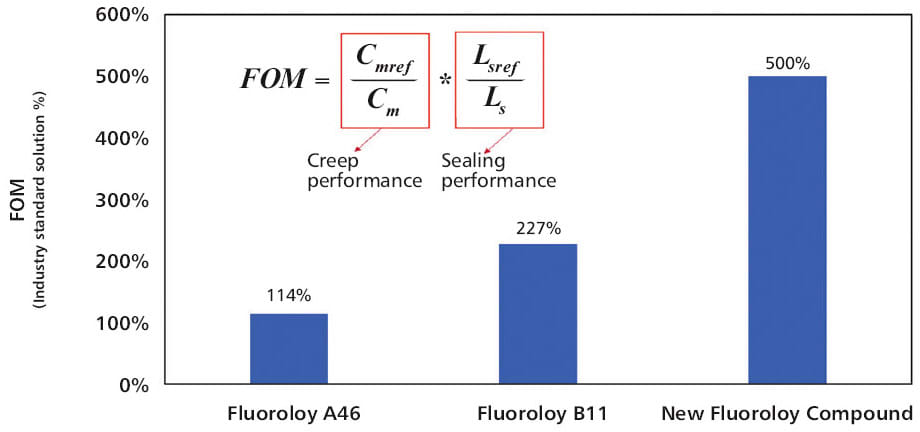
Our validation process focuses on several critical testing domains (seen in Figures 2 and 3), each designed to simulate the extreme conditions encountered in hydrogen production systems:
Thermal Cycling Evaluation — Our cyclic tests involve subjecting gasket materials to repeated temperature cycles that mimic the dynamic thermal variations typical in electrolyzer operations. These tests range from -240 °C to 288 °C, challenging the gasket material’s ability to maintain structural integrity and sealing performance through extreme temperature fluctuations.
Chemical Resistance Validation — Media compatibility testing involves exposing gasket materials to a pressurized 30 percent potassium hydroxide (KOH) solution at 85 °C. This aggressive test environment simulates the harsh electrolytic conditions our gaskets must withstand. The elevated temperature and concentrated alkaline solution provide a critical assessment of the material’s chemical stability, resistance to degradation, and long-term performance potential.
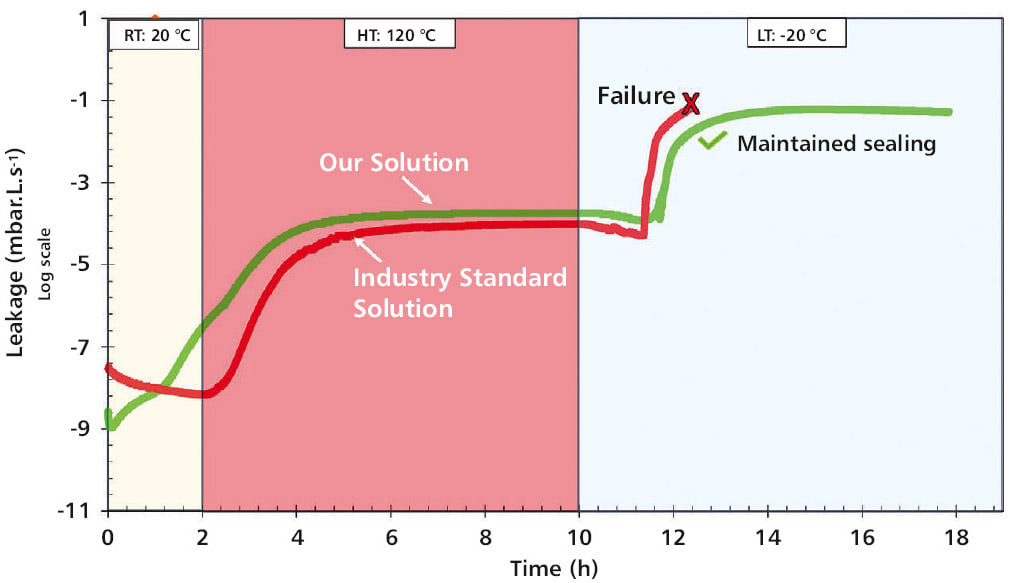
Precision Leakage Detection — Utilizing a sophisticated vacuum method with helium as a testing medium, we conduct meticulous leakage tests that simulate real-world operational conditions. This approach allows us to detect even the most minute potential failure points, providing a level of validation that goes beyond standard industry practices.
The leakage characterization graph compares the performance of our engineered sealing solution against a representative industry-standard seal under extreme temperature cycling (-20 °C to 120 °C). Experimental data demonstrates the enhanced sealing integrity of our custom-designed solution, which maintains consistent leak rates across challenging thermal gradient conditions where conventional seals experience performance degradation. The comparative analysis underscores the critical design improvements in our seal technology, highlighting its reliability and resilience
In addition to our stringent testing processes, our solutions fully comply with international recognized standards for gasket sealing performance. By adhering to European standards EN 13555 and DIN 52913, we ensure that our gaskets meet the highest reliability benchmarks, providing the durability and sealing integrity required for efficient and safe alkaline electrolyzer operation.
Combining rigorous standards compliance with exhaustive internal testing, Omniseal Solutions delivers gasket technologies that provide reliability in critical electrolyzer applications. The Figure of Merit (FOM) graph illustrates the performance of our gasket materials in terms of creep resistance and sealing capabilities. This comparison highlights how our advanced material formulation outperforms traditional options in meeting the demanding conditions of electrolyzer applications.
Through continuous improvement in sealing technologies and advanced material science, our global teams are supporting the future of green energy and hydrogen — enabling our partners to reach their goals of reducing emissions and achieving a truly clean energy future.
This article was contributed by Omniseal Solutions. For more information, visit www.omniseal-solutions.com .