

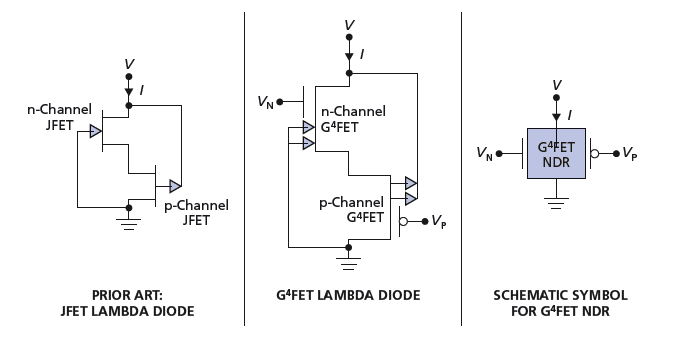
It is possible to synthesize a voltage-controlled negative-differential-resistance (NDR) device or circuit by use of a pair of complementary G4FETs (four-gate field-effect transistors). [For more information about G4FETs, please see "G4FET Implementations of Some Logic Circuits" (NPO-44007).] As shown in Figure 1, the present voltage-controlled NDR device or circuit is an updated version of a prior NDR device or circuit, known as a lambda diode, that contains a pair of complementary junction field-effect transistors (JFETs). (The lambda diode is so named because its current-versus-voltage plot bears some resemblance to an uppercase lambda.) The present version can be derived from the prior version by substituting G4FETs for the JFETs and connecting both JFET gates of each G4FET together. The front gate terminals of the G4FETs constitute additional terminals (that is, terminals not available in the older JFET version) to which one can apply control voltages VN and VP.
This work was done by Mohammad Mojarradi of Caltech; Suheng Chen, Ben Blalock, Chuck Britton, Ben Prothro, and James Vandersand of the University of Tennessee; Ron Schrimph of Vanderbilt University; and Sorin Cristoloveanu, Kerem Akarvardar, and P. Gentil of Grenoble University for NASA’s Jet Propulsion Laboratory.
In accordance with Public Law 96-517, the contractor has elected to retain title to this invention. Inquiries concerning rights for its commercial use should be addressed to:
Innovative Technology Assets Management
JPL
Mail Stop 202-233
4800 Oak Grove Drive
Pasadena, CA 91109-8099
(818) 354-2240
E-mail: This email address is being protected from spambots. You need JavaScript enabled to view it.
Refer to NPO-43929, volume and number of this NASA Tech Briefs issue, and the page number.
This Brief includes a Technical Support Package (TSP).
Complementary Paired G4FETs as Voltage- Controlled NDR Device
(reference NPO-43929) is currently available for download from the TSP library.
Don't have an account?
Overview
The document discusses the invention of Complementary Paired G4 FETs (Field Effect Transistors) as a voltage-controlled negative differential resistance (NDR) device, referenced under NASA Technical Support Package NPO-43929. This technology is particularly significant for the development of oscillators, which are essential components in electronic circuits. High-quality sine wave outputs are crucial for various applications, and the use of G4-FET transistors offers a solution to achieve this by simplifying the design of oscillator circuits.
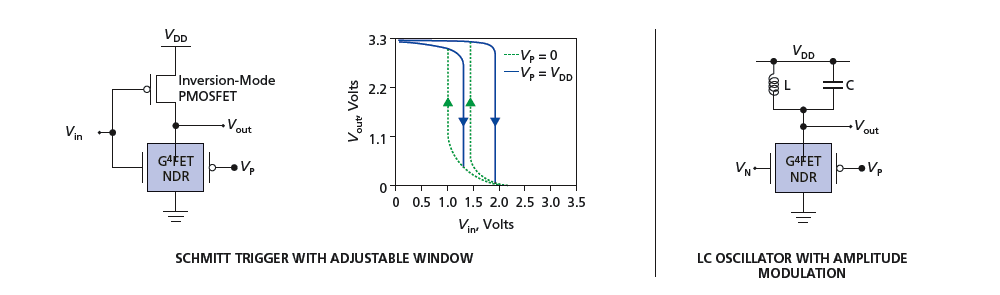
The primary problem addressed is the need for devices that can produce negative resistance, which is vital for building effective oscillators. The proposed solution involves utilizing G4-FET transistors to create a negative resistance circuit. This innovation not only facilitates the construction of high-quality sine wave oscillators but also incorporates a Schmitt trigger, which is designed to reduce noise in electronic circuits. The Schmitt trigger enhances the performance and reliability of the circuits by providing stable switching characteristics.
The document references a publication titled “Four-Gate Transistor Voltage-Controlled Negative Differential Resistance Device and Related Circuit Applications,” authored by a team of researchers including Akarvardar, K. Chen, and others, presented at the International SOI Conference in October 2006. This publication serves as a foundational source for the technical details and applications of the G4-FET technology.
The information is part of NASA's Commercial Technology Program, aimed at disseminating aerospace-related developments that have broader technological, scientific, or commercial implications. The document emphasizes the potential applications of this technology beyond aerospace, suggesting its relevance in various fields that require efficient electronic circuit designs.
For further inquiries or assistance, the document provides contact information for the Innovative Technology Assets Management at JPL, as well as an email address for additional support. It also includes a notice regarding the proprietary nature of the information and the need to comply with U.S. export regulations.
In summary, the document highlights a significant advancement in electronic circuit design through the use of G4-FETs, showcasing their potential to improve oscillator performance and reduce noise, thereby contributing to the evolution of electronic technologies.











