Inside this issue
Supplements

Overview
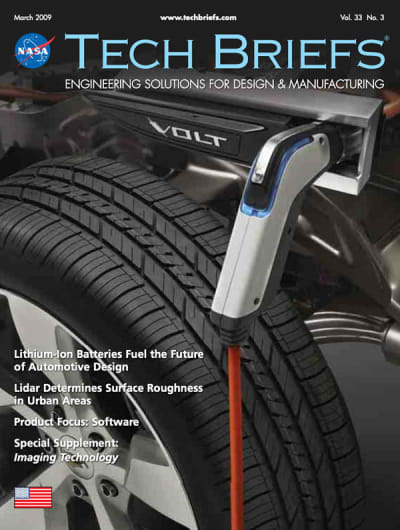
The March 2009 issue of NASA Tech Briefs presents a comprehensive overview of advancements in imaging technology and embedded systems, highlighting key innovations and trends that are shaping various industries. This edition is particularly focused on the transition to digital technologies in machine vision, the application of lidar in urban environments, and the future of automotive design powered by lithium-ion batteries.
Key Highlights:
-
Making the Move to Digital in Machine Vision: The issue opens with a special supplement titled "The State of the Art in Cameras & Vision Systems," which discusses the significant shift from analog to digital technologies in machine vision. This transition is crucial for enhancing image quality, processing speed, and overall system efficiency. The article emphasizes the benefits of digital imaging, including improved accuracy in data capture and analysis, which are essential for applications in manufacturing, quality control, and automation.
-
Imaging Techniques in Pharmaceuticals: Another notable article explores how advanced imaging techniques are being utilized to improve quality control in the pharmaceutical industry. By employing sophisticated imaging systems, companies can ensure the integrity and safety of their products, leading to better compliance with regulatory standards and enhanced consumer trust.
-
Lidar Technology: The issue also features an article on the use of lidar (Light Detection and Ranging) technology to determine surface roughness in urban areas. This innovative application of lidar allows for precise mapping and analysis of urban landscapes, which is vital for urban planning, infrastructure development, and environmental monitoring. The ability to accurately assess surface conditions can lead to improved maintenance strategies and better resource allocation in city management.
Lithium-Ion Batteries in Automotive Design: A significant focus of this issue is on the role of lithium-ion batteries in the future of automotive design. As the automotive industry shifts towards more sustainable and energy-efficient solutions, lithium-ion technology is at the forefront, enabling the development of electric and hybrid vehicles. The article discusses the advantages of lithium-ion batteries, including their high energy density, lightweight nature, and decreasing costs, which make them increasingly viable for mass-market adoption.
-
Product Focus: Software Innovations: The magazine also includes a section dedicated to software innovations that support imaging technology and embedded systems. This includes advancements in software algorithms that enhance image processing capabilities, enabling more sophisticated analysis and interpretation of visual data. These software solutions are critical for industries ranging from healthcare to manufacturing, where accurate data interpretation can lead to significant improvements in operational efficiency.
-
Future Trends and Challenges: Throughout the issue, there is a recurring theme of the challenges and opportunities presented by the rapid evolution of technology. As industries adopt more advanced imaging and embedded systems, they must also navigate issues related to data security, integration with existing systems, and the need for skilled personnel to manage these technologies. The articles encourage readers to stay informed about emerging trends and to consider the implications of these technologies on their respective fields.
Conclusion:
The March 2009 issue of NASA Tech Briefs serves as a valuable resource for professionals and enthusiasts in the fields of imaging technology and embedded systems. By showcasing the latest advancements and applications, the magazine not only highlights the current state of technology but also provides insights into future directions and potential challenges. As industries continue to embrace digital transformation, the information presented in this issue will be instrumental in guiding decision-making and fostering innovation across various sectors.
Overall, this edition encapsulates the dynamic nature of technology and its profound impact on our daily lives, encouraging readers to explore the possibilities that lie ahead in the realms of imaging and embedded systems.
Features
-
Application Briefs
Supercomputer Aids NASA’s Journey to the Moon and Mars
Radiation Detection Hardware Part of Living With a Star Experiment
Imaging Technique Improves Quality Control of Pharmaceuticals
-
Who's Who
Dr. Drake Deming, Senior Scientist, Solar System Exploration Division, Goddard Space Flight Center
Tech Briefs
-
Physical Sciences
Improved Instrument for Detecting Water and Ice in Soil
Real-Time Detection of Dust Devils From Pressure Readings
nBn Infrared Detector Containing Graded Absorption Layer
Ultra-Broad-Band Optical Parametric Amplifier or Oscillator
Atomic References for Measuring Small Accelerations
Enhancing SERS by Means of Supramolecular Charge Transfer
Particle-Image Velocimeter Having Large Depth of Field
Improved Signal Chains for Readout of CMOS Imagers
Improving 3D Wavelet-Based Compression of Hyperspectral Images
-
Manufacturing & Prototyping
Alternative Packaging for Back-Illuminated Imagers
-
Software
Symbolic Processing Combined With Model-Based Reasoning
-
Materials
Polyimide/Glass Composite High-Temperature Insulation
Damage Detection and Self-Repair in Inflatable/Deployable Structures
-
Information Sciences
Determining Surface Roughness in Urban Areas Using Lidar Data
Presentation Extensions of the SOAP
Error-Rate Bounds for Coded PPM on a Poisson Channel
Biomorphic Multi-Agent Architecture for Persistent Computing
-
Mechanics & Machinery
Quick-Connect Windowed Non-Stick Penetrator Tips for Rapid Sampling
Prediction of B-Pillar Failure in Automobile Bodies
Modeling Unsteady Cavitation and Dynamic Loads in Turbopumps
-
Electronics & Computers
Hamming and Accumulator Codes Concatenated With MPSK or QAM
Hardware Implementation of Serially Concatenated PPM Decoder
Biasable Subharmonic Membrane Mixer for 520 to 600 GHz