Accelerometer systems that would combine the best features of both conventional (e.g., mechanical) accelerometers and atom interferometer accelerometers (AIAs) have been proposed. These systems are intended mainly for use in scientific research aboard spacecraft but may also be useful on Earth in special military, geological, and civil-engineering applications.
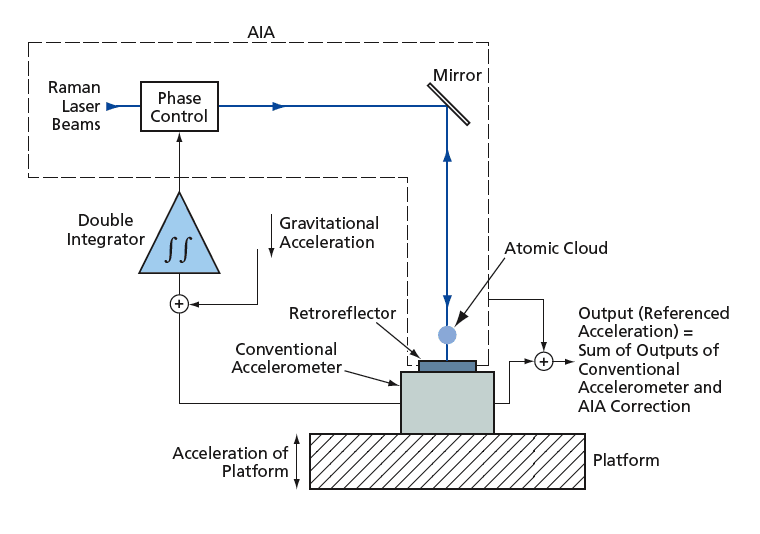
A brief description of an AIA is prerequisite to a meaningful description of a system according to the proposal. An AIA includes a retroreflector next to one end of a cell that contains a cold cloud of atoms in an ultrahigh vacuum. The atoms in the cloud are in free fall. The retroreflector is mounted on the object, the acceleration of which is to be measured. Raman laser beams are directed through the cell from the end opposite the retroreflector, then pass back through the cell after striking the retroreflector. The Raman laser beams together with the cold atoms measure the relative acceleration, through the readout of the AIA, between the cold atoms and the retroreflector.
A system according to the proposal could be realized in several alternative implementations. In the simplest implementation (see figure), the conventional accelerometer and the retroreflector of the AIA would be mounted on a platform, the acceleration of which was to be measured. The phase of the Raman laser beams is frequency-chirped to remove the known gravity acceleration. From the output of the conventional accelerometer, the equivalent phase shift of the AIA is converted through the electronic double integrator. This phase is electronically fed forward to a Raman laser phase shifter such that it cancels out the phase shift in the AIA due to the acceleration read by the conventional accelerometer. The remaining part of the AIA phase shift would be used to compute a residual acceleration that would be applied as a correction to the acceleration measurement of the conventional accelerometer.
This work was done by Lute Maleki and Nan Yu of Caltech for NASA’s Jet Propulsion Laboratory. NPO-43776
This Brief includes a Technical Support Package (TSP).
Atomic References for Measuring Small Accelerations
(reference NPO-43776) is currently available for download from the TSP library.
Don't have an account?
Overview
The document titled "Atomic References for Measuring Small Accelerations" (NPO-43776) from NASA's Jet Propulsion Laboratory discusses advancements in accelerometer technology essential for drag-free satellite operations in space science missions. These missions include mapping Earth's gravity field (e.g., GOCE and GRACE), detecting gravitational waves (e.g., LISA), and conducting tests of fundamental physics (e.g., STEP and MICROSCOPE).
Drag-free satellites operate by maintaining a free-fall test mass within the satellite, while accelerometers measure the satellite's motion relative to this test mass. The satellite's control system ensures it follows the test mass's free-fall trajectory. Current capacitive accelerometers, such as those developed by ONERA for GOCE, exhibit high sensitivity in drag-free operations. However, their performance is limited by thermal effects and other sensor errors, resulting in significantly reduced long-term stability compared to their short-term sensitivity.
The document highlights the emergence of atom interferometers (AIs) as a new class of inertial sensors that utilize the quantum properties of free-fall atoms to achieve high precision in measuring inertial forces. In ultra-high vacuum conditions, these free-fall atoms represent a true drag-free state, allowing for laser spectroscopic precision in measurements. AI-based accelerometers demonstrate not only high sensitivity but also enhanced stability and accuracy, particularly in microgravity environments. However, they have limitations in bandwidth and dynamic range compared to traditional mechanical accelerometers.
To address these limitations, the document proposes an integrated system that combines mechanical accelerometers with AI accelerometers. This system leverages the strengths of both technologies: the mechanical accelerometer provides high bandwidth measurements for short-term needs, while the AI accelerometer offers long-term stability and calibration. The integration can be achieved through feedback or feedforward loops, similar to how atomic clocks operate, ensuring precise long-term measurements.
Various implementation schemes are discussed, including electronic compensation methods that convert mechanical accelerometer measurements into equivalent AI phase shifts. This innovative approach aims to enhance the overall performance of accelerometers used in drag-free satellite missions, ultimately improving the accuracy and reliability of measurements critical for advancing space science and fundamental physics research.