

Efforts are underway to develop compact, lightweight electro-mechanical actuators based on electroactive polymers (EAPs). An actuator of this type is denoted an electroactive-polymer actuator with selectable deformation (EAPAS). The basic building blocks of these actuators are sandwich-like composite-material strips, containing EAP layers plus electrode layers, that bend when electric potentials are applied to the electrodes. Prior NASA Tech Briefs articles that have described such building blocks as parts of actuators for specific purposes include “Robot Hands With Electroactive-Polymer Fingers” (NPO-20103), Vol. 22, No. 10, (October 1998), page 78; “Robot Arm Actuated by Electroactive Polymers” (NPO-20393), Vol. 23, No. 6 (June 1999), page 12b; “Wipers Based on Electroactive Polymeric Actuators” (NPO-20371), Vol. 23, No. 2 (February 1999), page 7b; and “Miniature Electroactive-Polymer Rakes” (NPO-20613), Vol. 25, No. 10 (October 2001), page 6b.

- The pairs of benders in a given EAPAS can be electrically addressed individually, all together, or in intermediate combinations to control the displacement and/or shape of the EAPAS.
- Stacked benders can be enclosed in a protective case, effectively rendering an EAPAS a compact linear motor.
- EAPASs can be embedded in deformable “smart” structures for controlling their shapes.
- An EAPAS designed mainly as a contractile actuator (in other words, a puller) could serve as an artificial muscle: for this purpose, it would be anchored at one end and would pull on a wire (which would serve as an artificial tendon) at the other end.
- A more complex EAPAS could serve as a tactile display device.
This work was done by Yoseph Bar-Cohen of NASA’s Jet Propulsion Laboratory, Virginia Olazabal of Caltech, and Jose-Maria Sansinena of San Sebastian, Spain.
In accordance with Public Law 96-517, the contractor has elected to retain title to this invention. Inquiries concerning rights for its commercial use should be addressed to
Intellectual Property group JPL Mail Stop 202-233 4800 Oak Grove Drive Pasadena, CA 91109 (818) 354-2240
Refer to NPO-21174, volume and number of this NASA Tech Briefs issue, and the page number.
This Brief includes a Technical Support Package (TSP).
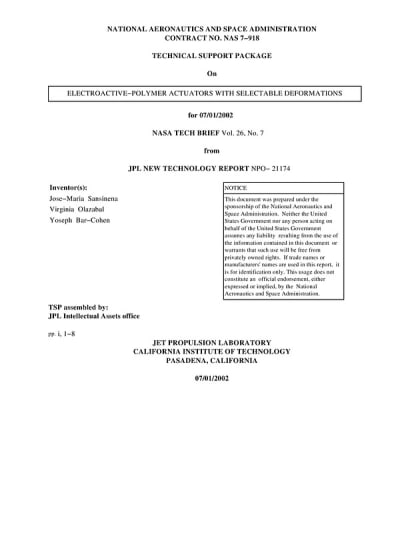
Electroactive-Polymer Actuators with Selectable Deformations
(reference NPO-21174) is currently available for download from the TSP library.
Don't have an account?
Overview
The document discusses electroactive-polymer actuators with selectable deformations (EAPAS), a technology developed by researchers at NASA's Jet Propulsion Laboratory, including Jose-Maria Sansinena, Virginia Olazabal, and Yoseph Bar-Cohen. EAPAS are innovative electromechanical actuators that utilize electroactive polymers (EAPs) to achieve movement and deformation when electric potentials are applied.
EAPAS are constructed from composite-material strips that consist of EAP layers and electrode layers. When an electric current is applied, these strips bend, allowing for various applications. The document outlines the flexibility of EAPAS in terms of material selection, actuator configurations, and operational modes, making them suitable for a wide range of tasks.
The types of EAPs that can be used in EAPAS include electronically conductive polymers, ion-exchange polymers, ferroelectric and electrostrictive polymers, graft elastomers, and ferrogels. The actuators can be designed with multiple pairs of bender strips arranged in parallel, series, or a combination of both, enabling customization to meet specific force and displacement requirements.
Several illustrative examples of EAPAS applications are provided in the document:
- Artificial Muscles: EAPAS can function as contractile actuators, mimicking muscle action by pulling on a wire, which acts as an artificial tendon.
- Tactile Display Devices: More complex configurations of EAPAS can be used to create devices that provide tactile feedback.
- Smart Structures: EAPAS can be embedded in deformable structures to control their shapes dynamically.
The document emphasizes the potential of EAPAS to revolutionize various fields, including robotics, where they can be used in applications such as robotic hands and arms, as well as in other devices requiring precise movement and control.
In conclusion, the research and development of EAPAS represent a significant advancement in actuator technology, offering lightweight, compact solutions with versatile applications. The document serves as a technical brief, summarizing the capabilities and potential uses of EAPAS while also noting that inquiries regarding commercial use should be directed to NASA's Intellectual Property group.











