

A method of processing of time-series data from sensors that monitor a dynamic physical system has been devised to enable detection of anomalies in the dynamics. The method involves computing what are initially supposed to be dynamical invariants that represent the structural and operational parameters of the system; the invariants are specified in such a way that anomalies or abnormalities in the system manifest themselves as changes in the supposed invariants. The method could be applied, for example, to telemetric data from a spacecraft or to such time-series scientific data as sea-surface temperatures measured at daily or other regular intervals.
Abnormal behavior of the system can be detected by (1) predicting the future time series from current and previous time-series values, then (2) recording the actual time series going forward from the instant of prediction, then (3) suitably analyzing the differences between the predicted and recorded values. For the purpose of the present method, it is assumed that the invariants of the system can be represented by the coefficients of a differential or time-delay equation that represents the dynamics of the system.
An important element of the mathematical basis of the method is the concept that there are two types of abnormal behavior of a dynamic system: structural and operational. Structural abnormalities are caused by changes in the underlying dynamics and thus manifest themselves mathematically as changes in the supposed invariants. Operational abnormalities can be caused by unexpected changes in initial conditions or in external forces, but the dynamical model of the system remains the same. Mathematically, operational abnormalities are described by changes in nonstationary components of the time series. Structural and operational abnormalities can occur independently of each other.
The major problems addressed by the method are how to build a dynamical model that simulates a given time series and how to develop the dynamical invariants, changes of which indicate structural abnormalities. Because the solutions of these problems are so multifaceted and complex that a description of them would greatly exceed the space available for this article, it must suffice to summarize them as follows: The solutions are based on progress in three independent fields — nonlinear dynamics, theory of stochastic processes, and artificial neural networks. One especially notable aspect of the method is that the dynamical model of a system is fitted to the previous and present time-series data by use of a feedfoward neural network that contains only one hidden layer. This technique of fitting is justified by a rigorous proof that any continuous function can be approximated by such a neural network.
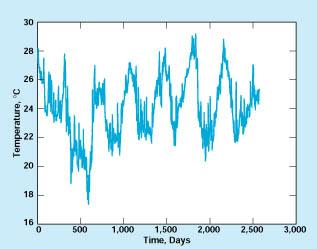
The method has been tested by applying it to daily readings of sea-surface temperature collected by an instrumented buoy from May 1987 through May 1994 (see figure). The purpose of the test was to demonstrate that anomalies in the temperature dynamics could be found by use of the present method. Using knowledge of when El Niño and La Niña occurred, an attempt was made to show that the anomalies found by the present method correspond to these phenomena in some manner. An attempt was also made to formulate a way of using the method to predict El Niño and La Niña. At the time of reporting the information for this article, no conclusions concerning the efficacy of the method had been drawn, and there appeared to be a need for more experiments.
This work was done by Sandeep Gulati and Michail Zak of Caltech for NASA's Jet Propulsion Laboratory. For further information, access the Technical Support Package (TSP) free on-line at www.nasatech.com/tsp under the Information Sciences category.
In accordance with Public Law 96-517, the contractor has elected to retain title to this invention. Inquiries concerning rights for its commercial use should be addressed to
Technology Reporting Office
JPL
Mail Stop 249-103
4800 Oak Grove Drive
Pasadena, CA 91109
(818) 354-2240
Refer to NPO-20834, volume and number of this NASA Tech Briefs issue, and the page number.
This Brief includes a Technical Support Package (TSP).
Nueral-Network Approach to Analysis of Sensor Data
(reference NPO-20834) is currently available for download from the TSP library.
Don't have an account?
Overview
The document is a technical support package from NASA, specifically detailing a neural-network approach to the analysis of sensor data. It is associated with Contract No. NAS 7-918 and is part of the NASA Tech Brief, Vol. 24, No. 11. The work is credited to inventors Sandeep Gulati and Michail Zak from the Jet Propulsion Laboratory (JPL).
The primary focus of the document is on utilizing artificial neural networks (ANNs) to analyze and interpret sensor data effectively. This approach is particularly relevant for dynamic physical systems where monitoring and anomaly detection are critical. The methodology involves computing dynamical invariants that encapsulate the structural and operational parameters of the system being monitored. By leveraging these invariants, the neural network can predict future time series data based on historical sensor readings.
A key aspect of this technique is its ability to compare predicted data against actual recorded values. This comparison allows for the identification of discrepancies that may indicate abnormal behavior or anomalies within the system. Such capabilities are essential for applications in various fields, including aerospace, where monitoring spacecraft telemetry is crucial for mission success and safety.
The document outlines the potential applications of this neural-network approach, emphasizing its utility in real-time monitoring and analysis of sensor data. By automating the detection of anomalies, the method can enhance decision-making processes and improve the reliability of systems that rely on continuous data input.
Additionally, the document includes figures and data representations that illustrate the effectiveness of the ANN in predicting sensor data and identifying anomalies. These visual aids support the technical explanations and provide a clearer understanding of the methodology's practical implications.
Overall, this technical support package presents a significant advancement in the field of sensor data analysis, showcasing how neural networks can be harnessed to improve the monitoring and operational efficiency of complex systems. The work reflects NASA's commitment to innovation and the application of cutting-edge technology in aerospace and other scientific domains.











