Windows that absorb x rays and are transparent to visible light can be made by compression molding of tantalum oxide/polymer composite materials. The main x-ray-absorbing medium in these windows is tantalum instead of lead, which is the traditional main x-ray-absorbing medium. These composite windows have been developed to replace lead-filled glass and lead-filled polymer x-ray-absorbing windows, which are unsuitable for use in some environments because of the toxicity of lead.
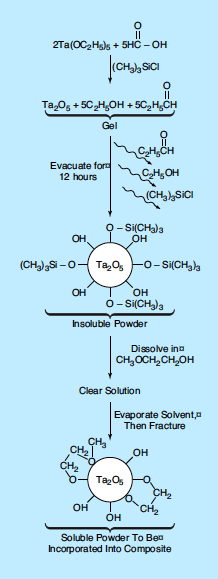
The resulting soluble oligomeric tantalum oxide clusters can be mixed in any proportion with methoxyethanol solutions of phenoxy (hydroxy aryl-alkyl ether) polymer to form a clear solution that can be cast into clear films. The films can be rendered brittle by cooling them in liquid nitrogen, then fractured while still brittle to produce a molding powder. Provided that the weight percentage of the tantalum oxide component of the powder is ≤60, the powder can be compression molded at a temperature of 150°C to obtain a transparent plate. Alternatively, a film of the tantalum oxide/ phenoxy composite can be cast on one of two sheets of polycarbonate of bisphenol A, then sandwiched between the two polycarbonate sheets under heat and pressure to obtain a laminated window with desirable mechanical and optical properties.
This work was done by Stephen T. Wellinghoff of Southwest Research Institute for Johnson Space Center.
In accordance with Public Law 96-517, the contractor has elected to retain title to this invention. Inquiries concerning rights for its commercial use should be addressed to
Stephen T. Wellinghoff
Southwest Research Institute
6220 Culebra Road
San Antonio, TX 78228
Refer to MSC-22401, volume and number of this NASA Tech Briefs issue, and the page number.