

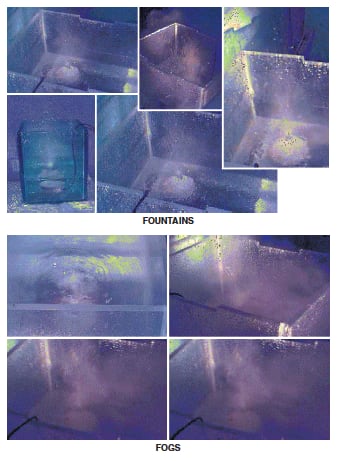
Experiments have demonstrated the feasibility of generating fountains and fogs over a body of water (see Figure 1) by utilizing high-intensity ultrasound to induce acoustic streaming, cavitation, and atomization. The transducer used in the experiments had a 10-cm diameter and a 10-cm focal length, was immersed in water at a depth approximately equal to its focal length, and was excited at various amplitudes and at various frequencies from 100 kHz to 2 MHz. It was observed in the experiments that the fountain and fog effects depend on the amplitude and frequency of excitation.
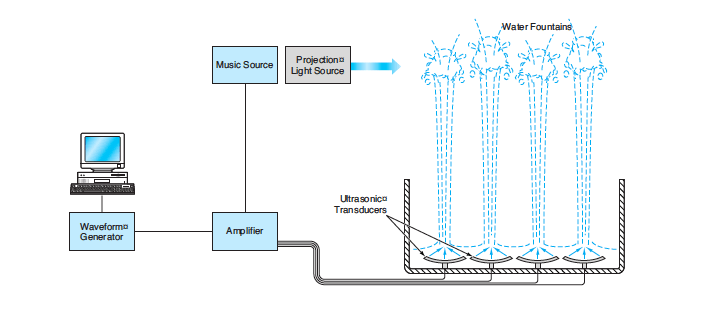
An apparatus proposed for implementing this concept is called an ultrasonically induced plumbing-free switchable multi-fountains and fog (ULIFOG) system. In addition to ultrasonic transducers immersed in a water bath, a ULIFOG system (see Figure 2) would include (1) electronic circuits to excite the ultrasonic transducers with waveforms chosen to produce the desired fountain and fog effects, (2) one or more source(s) of light (e.g., lasers or colored lamps), (3) a source of music, and (4) a computer that would control the aforementioned subsystems and would coordinate the visible and audible aspects of the display.
The mechanical simplicity occasioned by elimination of the need for pipes, valves, and pumps is an advantage over prior fountain display systems. Another advantage over such systems is much faster response: For example, in an ULIFOG system, one could change a fountain into a fog in a millisecond by switching the frequency of excitation of the applicable transducer.
This work was done by Yoseph Bar-Cohen and Stacey Walker of Caltech for NASA’s Jet Propulsion Laboratory.
This Brief includes a Technical Support Package (TSP).
Ultrasonically Induced Fountains and Fogs
(reference NPO-21064) is currently available for download from the TSP library.
Don't have an account?
Overview
The document discusses the development of an innovative system called the Ultrasonically Induced Plumbing-Free Switchable Multi-Fountains and Fog (ULIFOG) system, created by Yoseph Bar-Cohen and Stacey Walker at NASA's Jet Propulsion Laboratory (JPL). This system utilizes high-intensity ultrasound to generate dynamic visual effects, such as fountains and fogs, over a body of water without the need for traditional plumbing systems.
The ULIFOG system operates by employing multiple immersed ultrasonic transducers that can be controlled to create, modify, or eliminate fountains and fogs instantaneously. By adjusting the excitation waveforms applied to these transducers, the system can produce a variety of artistic displays. The ability to switch between fountain and fog effects in milliseconds is a significant advantage over conventional fountain systems, which rely on mechanical components like pipes and pumps.
The document highlights the experiments conducted to validate the feasibility of this technology. A transducer with a diameter of 10 cm and a focal length of 10 cm was used, immersed in water at a depth equal to its focal length. The experiments demonstrated that the fountain and fog effects are influenced by the amplitude and frequency of the ultrasound excitation, which ranged from 100 kHz to 2 MHz.
In addition to the ultrasonic transducers, the ULIFOG system includes electronic circuits for waveform excitation, light sources (such as lasers or colored lamps), a music source, and a computer for controlling the entire setup. This integration allows for synchronization of visual and auditory elements, enhancing the overall artistic experience.
The document emphasizes the mechanical simplicity and rapid response of the ULIFOG system compared to traditional fountain displays. The elimination of pipes, valves, and pumps not only simplifies the design but also allows for more versatile and creative displays.
Overall, the ULIFOG system represents a significant advancement in the field of artistic displays, combining technology and creativity to produce captivating visual effects. The research was conducted under the auspices of NASA, showcasing the potential applications of this technology in various artistic and entertainment contexts.











