

A technique for making precise, microscopic holes and grooves in glass workpieces has been invented. The technique differs from both (1) traditional macroscopic mechanical drilling and milling and (2) conventional micromachining that involves etching through photolithographically patterned masks. The technique can be used, for example, to make holes between 20 µm and 1 mm in diameter.
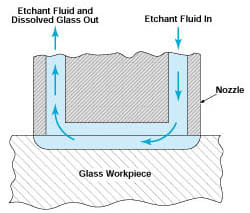
The technique involves wet chemical etching, but unlike in conventional micromachining, the etch is localized. As shown in the figure, a hole in a glass workpiece is formed by use of a nozzle that contains at least one delivery channel and at least one return channel for the flow of an etchant fluid. Both channels open out to the tip of the nozzle. By use of a pressure pump at the far end of the delivery channel and/or a suction pump at the far end of the return channel, the etchant fluid is made to flow across the tip of the nozzle. The flowing etchant dissolves and carries away the glass along the flow path in the tip region. Unlike in conventional machining, the surface of the workpiece does not become roughened by abrasion, and there is no contamination by particles of workpiece material.
The shape and width of the resulting hole or groove is determined by the size and shape of the nozzle. As etching proceeds, the nozzle is either moved deeper into the workpiece to deepen the hole or else moved laterally (along the surface of the workpiece) to lengthen the groove. The nozzle can be fabricated, to the required precision, by use of photolithography and deep trench etching. The movement of the nozzle can be automated easily with computerized control. The precision of the movement, and thus of the final product, can be as high as 1 µm; such a level of precision has been demonstrated in robotic equipment commonly used in micromachining in a clean room.
This work was done by Kirill Shcheglov and William Tang of Caltech for NASA's Jet Propulsion Laboratory. For further information, access the Technical Support Package (TSP) free on-line at www.techbriefs.com/tsp under the Manufacturing & Prototyping category.
NPO-20732
This Brief includes a Technical Support Package (TSP).
Chemical Machining of Microscopic Holes and Grooves in Glass
(reference NPO-20732) is currently available for download from the TSP library.
Don't have an account?
Overview
The document describes a novel technique for creating precise microscopic holes and grooves in glass workpieces, developed by Kirill Shcheglov and William Tang at NASA's Jet Propulsion Laboratory. This method utilizes localized wet chemical etching, distinguishing it from traditional macroscopic mechanical drilling and conventional micromachining that relies on photolithographically patterned masks.
The technique involves a specialized nozzle with at least one delivery channel and one return channel for etchant fluid. By using a pressure pump to deliver the etchant and a suction pump to remove the dissolved glass, the etching process is highly controlled and localized. This approach prevents the roughening of the workpiece surface and eliminates contamination from particles, which are common issues in mechanical machining.
The size and shape of the resulting holes or grooves are determined by the nozzle's design, and the nozzle can be moved either deeper into the workpiece to deepen holes or laterally to extend grooves. The precision of this technique can reach up to 1 μm, making it suitable for applications requiring high accuracy. The movement of the nozzle can be automated with computerized control, enhancing the efficiency and repeatability of the process.
This innovative method addresses several challenges associated with traditional etching techniques, such as mask failure and substrate damage. By delivering the etchant directly to the etching site, the need for masks is eliminated, reducing the risk of defects and contamination. The document emphasizes the advantages of this localized etching technique over both photolithographically masked etching and mechanical machining, highlighting its potential for various applications in fields requiring precise glass machining.
Overall, this technique represents a significant advancement in the field of micromachining, offering a reliable and efficient solution for creating intricate patterns in glass without the drawbacks of conventional methods. The work was conducted under NASA's sponsorship, showcasing the agency's commitment to advancing technology for various applications.











