

Sonar-beam-steering devices of the proposed type would contain no moving parts and would be considerably smaller and less power-hungry, relative to conventional multiple-beam sonar arrays. The proposed devices are under consideration for installation on future small autonomous underwater vehicles because the sizes and power demands of conventional multiple-beam arrays are excessive, and motors used in single-beam mechanically scanned systems are also not reliable.

The proposed devices would include a variety of electrically controllable acoustic prisms, lenses, and prism/lens combinations – both simple and compound. These devices would contain electrorheological fluids (ERFs) between electrodes. An ERF typically consists of dielectric particles floating in a dielectric fluid. When an electric field is applied to the fluid, the particles become grouped into fibrils aligned in rows, with a consequent increase in the viscosity of the fluid and a corresponding increase in the speed of sound in the fluid. The change in the speed of sound increases with an increase in the applied electric field. By thus varying the speed of sound, one varies the acoustic index of refraction, analogously to varying the index of refraction of an optical lens or prism. In the proposed acoustic devices, this effect would be exploited to control the angles of refraction of acoustic beams, thereby steering the beams and, in the case of lenses, controlling focal lengths.
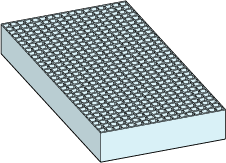
Figure 1 schematically illustrates a sonar assembly according to the proposal. A planar array of acoustic transmitting/receiving transducers would both send out acoustic signals to irradiate targets and, in the acoustic analog of a retina, sense the spatial pattern of return acoustic signals. The transmitted and return signals would be collimated and focused, respectively, by use of two acoustic lenses. The front acoustic lens would be designed to contain an ERF in multiple compartments separated by electrodes, rather than one compartment between a single pair of outer electrodes, in order to reduce the magnitudes of the potentials needed to be applied to the electrodes to vary the focal length of the lens through the required range. A prism in front of the front lens would also be constructed in layers, for the same reason. The index of refraction of the prism and, hence, the angle of refraction of the beam, would be varied by modulating the potentials applied to the prism electrodes in order to steer the outgoing and incoming acoustic beams.
The concept of ERF-filled compartments separated by electrodes could be generalized and modified to that of a multicellular device comprising a rectangular array of ERF-filled cells (see Figure 2). Electrodes would be affixed to both the row and the column walls between cells, so that an electric field of controlled magnitude and direction could be applied to the ERF within each cell. Lens shape (convex, concave, etc.) can be varied by selectively activating individual cells.
This work was done by Yoseph Bar-Cohen, Stewart Sherrit, Zensheu Chang, and Xiaoqi Bao of NASA's Jet Propulsion Laboratory; Iris Paustian and Joseph Lopes of NSWC Coastal Systems Station; and Donald Folds of Ultra-Acoustics, Inc. For further information, access the Technical Support Package (TSP) free on-line at www.techbriefs.com/tsp under the Physical Sciences category.
NPO-30884
This Brief includes a Technical Support Package (TSP).
Controllable Sonar Lenses and Prisms Based on ERFs
(reference NPO-30884) is currently available for download from the TSP library.
Don't have an account?
Overview
The document presents a technical report on a novel sonar technology called Sonar Lenses with Controllable Directivity using Electrorheological Fluids (ERF). Developed under the auspices of NASA and the Jet Propulsion Laboratory, this innovation addresses the challenges faced by small autonomous underwater vehicles (AUVs) in sonar applications, particularly in terms of size, weight, power consumption, and reliability.
The primary focus of the invention is a beam steering mechanism that operates without any physically moving parts, which is crucial for the compact design of AUVs. Traditional mechanical beam steering methods are often impractical due to their size and power requirements, while alternative multibeam phased array systems can be bulky and expensive. The disclosed technology utilizes variable index of refraction prisms made from ERF, allowing for dynamic control of beam direction and directivity. This capability is particularly beneficial for forward-looking sonar (FLS) systems, which are essential for obstacle avoidance and imaging in underwater environments.
The report outlines three modalities of ERF-filled prism designs that facilitate beam steering in sonar applications. One design modality features a prism that directs beams either upward or downward, creating a pseudo two-dimensional array. The system operates at acoustic frequencies around 1.2 MHz and is capable of producing a wide field of view with high resolution for target classification.
The document emphasizes the advantages of this technology, including its miniaturization potential and minimal power consumption, making it suitable for advanced naval missions in littoral zones. The ability to control the acoustic field's directivity enhances the performance of sonar systems while balancing trade-offs related to size, weight, and electronic complexity.
In summary, the report highlights a significant advancement in sonar technology that leverages ERF to provide a compact, efficient, and reliable solution for beam steering in underwater vehicles. This innovation not only meets the growing demands for miniaturized sensors in naval applications but also sets a new standard for future developments in sonar systems.









