

A technique for measuring optical beam shear is based on collecting light from the four quadrants of the beam and comparing the optical power collected from each quadrant with that from the other three quadrants. As used here, "shear" signifies lateral displacement of a beam of light from a nominal optical axis.
A sensor for implementing this technique consists of a modified focusing lens and a quad-cell photodetector, both centered on the nominal optical axis. The modification of the lens consists in cutting the lens into four sectors (corresponding to the four quadrants) by sawing along two orthogonal diameters, then reassembling the lens following either of two approaches described next.
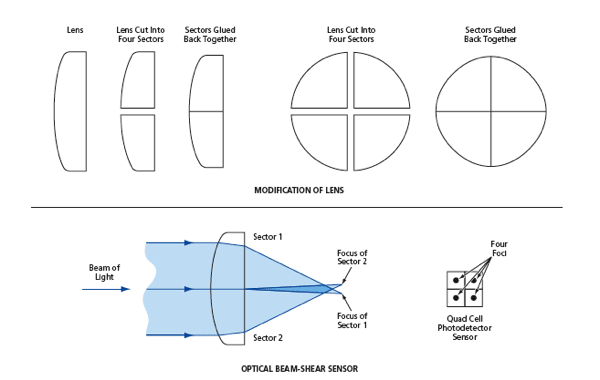
In one approach, the lens is reassembled by gluing the sectors back together. In the simplest variant of this approach, the kerf of the saw matches the spacing of the photodetector cells, so that the focus of each sector crosses the axis of symmetry to fall on the opposite photodetector cell (see figure). In another variant of this approach, the lens sectors are spaced apart to make their individual foci to fall on separate photodetector cells, without crossing the optical axis. In the case of a sufficiently wide beam, the modified lens could be replaced with four independent lenses placed in a square array, each focusing onto an independent photodetector.
This work was done by Stefan Martin and Piotr Szwaykowski of Caltech for NASA's Jet Propulsion Laboratory. For further information, access the Technical Support Package (TSP) free on-line at www.techbriefs.com/tsp under the Physical Sciences category. NPO-41746
This Brief includes a Technical Support Package (TSP).
Optical Beam-Shear Sensors
(reference NPO-41746) is currently available for download from the TSP library.
Don't have an account?
Overview
The document is a Technical Support Package from NASA’s Jet Propulsion Laboratory (JPL) concerning Optical Beam-Shear Sensors, specifically referenced as NPO-41746 in NASA Tech Briefs. It outlines the development and potential applications of this innovative technology, which is part of NASA's Commercial Technology Program aimed at disseminating aerospace-related advancements with broader technological, scientific, or commercial implications.
Optical beam-shear sensors are designed to detect minute changes in optical beams, which can be crucial for various applications, including precision measurement and monitoring in aerospace and other industries. The document emphasizes the significance of this technology in enhancing measurement accuracy and reliability, which can lead to improvements in various engineering and scientific fields.
The Technical Support Package serves as a resource for understanding the capabilities and potential uses of optical beam-shear sensors. It provides contact information for further inquiries, specifically directing interested parties to the Innovative Technology Assets Management team at JPL. This team can offer additional insights and support regarding the research and technology related to optical beam-shear sensors.
The document also includes a notice regarding the proprietary nature of the information contained within, indicating that it may be subject to export control regulations. It clarifies that the United States Government, nor any individuals acting on its behalf, assumes liability for the use of the information provided, nor does it guarantee that such use will be free from privately owned rights.
Overall, the Technical Support Package highlights the importance of optical beam-shear sensors in advancing technology and their potential for commercial applications, while also ensuring compliance with relevant regulations and providing avenues for further exploration and collaboration in this innovative field.











