

Typically, the cost of a space observatory is driven by the size and mass of the primary aperture. Generally, a monolithic aperture is much heavier and complex to fabricate (hence, more costly) than an aperture of the same size but composed of much smaller units. Formation flying technology, as applied to swarm systems in space, is an emerging discipline.
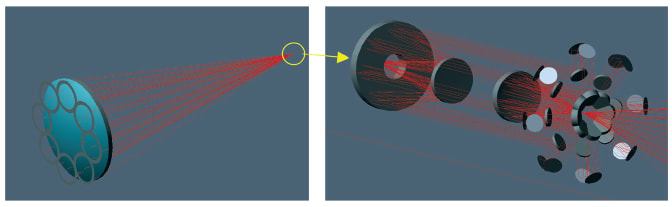
The optical imaging system, or “back end,” is contained on its own spacecraft separate from the primary optics that can both measure and correct many kinds of errors that are anticipated with a granular medium optic. This design combines several layers of sensing and control to adapt to possible misalignments and shape errors in the granular medium aperture. This innovation also combines the light from several of these “clouds” to synthesize a large, multiple-aperture system to increase light throughput and resolution, and is robust enough to use three different kinds of primary optics: reflective, refractive, and diffractive.
In the reflective optical system design, starlight reflects off of the granular patches, and is slowly focused toward the formation-flying spacecraft that collects, corrects, and combines the light from individual patches to a single detector. Light from all patches converges at an intermediate focus. The light then reflects off of a secondary mirror (Gregorian) and the light from each patch becomes collimated. The collimated light from each patch then continues to a separate adaptive optics system. A fast-steering mirror and a deformable mirror correct pointing and low- to mid-spatial frequency aberrations. An optical delay line is used to correct phasing differences between the patches, and enables Fourier transform spectroscopy. A beam-splitter is included to allow some of the light to go to a Shack-Hartmann sensor to measure aberrations in the system, and to provide a feedback mechanism to the deformable mirror. The main portion of the light continues to the collector system, a Cassegrain telescope, which combines and focuses the light from all the patches onto the science detector.
While at the smaller scale of the grain spacing there can be a certain amount of spatial disorder within each patch, at the scale of the aperture diameter the granular patches are held in formation to form a regular arrangement (in a Golay sparse aperture pattern, for example). Computational optics techniques based on speckle interferometry are used to remove the noise induced by the granularity of the patches, so an image can be synthesized at the focal plane.
The uniqueness and innovation of the concept lies in that it would be a very lightweight system, and one granular patch could combine with other patches to form much larger apertures than, for example, the 6.5-meter size of the James Webb Space Telescope. It would be easy to transport and deploy, not requiring structural elements for a backing structure (except for the confining electromagnetic system), and line-of-sight retargeting and figure control would be realized at-a-distance electromagnetically. Contrary to a monolithic aperture, this distributed system can be highly fault tolerant, self-healing, and relatively easy to package and deploy.
This work was done by Scott A. Basinger, Marco B. Quadrelli, and Mayer Rud of Caltech; and Grover Swartzlander of Rochester Institute of Technology for NASA’s Jet Propulsion Laboratory. NPO-49188
This Brief includes a Technical Support Package (TSP).
Imaging Space System Architectures Using a Granular Medium as a Primary Concentrator
(reference NPO-49188) is currently available for download from the TSP library.
Don't have an account?
Overview
The document presents insights from the NIAC Spring Symposium 2013, focusing on the Phase 1 Task 12-NIAC12B-0038, titled "OrbiAng Rainbows." It explores revolutionary imaging techniques for remote sensing and the concept of swarm guidance in space missions. Swarm guidance involves the coordination and path planning of multiple spacecraft (S/C) to optimize their movements and tasks in a collective manner.
Key functions of swarm guidance include determining the destination for each spacecraft and planning their respective paths to achieve mission objectives. This approach is essential for managing large groups of spacecraft effectively, enhancing their operational efficiency in various space applications.
The document also discusses the development of an ultra-lightweight imaging system that utilizes a cloud of granular materials. This system is characterized by its simplicity, low cost, and ability to cover large areas with low fill factors. The cloud can be easily packaged, transported, and deployed, and it features reconfigurable capabilities that allow for retargeting and repointing without mechanical means. Additionally, the system is designed to be highly fault-tolerant, minimizing vulnerability to impacts, and incorporates variable focal lengths with innovative lens designs.
Future plans outlined in the document include identifying practical methodologies for deploying and maintaining an active cloud in space, determining the conditions necessary for the cloud to function as a transmitter, receiver, or lens, and assessing key material and thermal properties. The document emphasizes the importance of understanding risk areas, such as excessive scattering and orbital debris generation, and outlines the need for autonomous optical system stabilization and manipulation.
Technical accomplishments reported include insights into the physics of disordered systems, a proposed multi-stage approach for cloud control using laser cooling, and the development of an optical system design for multiple aerosol apertures. The document concludes with a plan for completing ongoing tasks, assessing technology gaps, and preparing for Phase 2 of the project, which includes submitting abstracts to various conferences and finalizing a report on the findings.
Overall, the document highlights significant advancements in imaging systems and swarm guidance, showcasing innovative approaches to enhance space exploration and remote sensing capabilities.










