

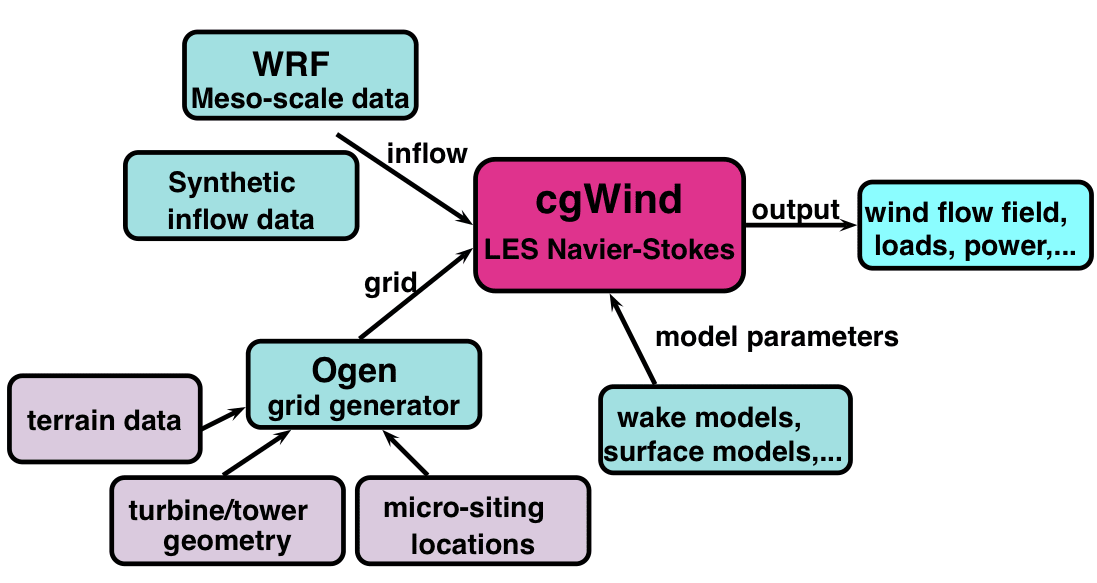
To model such systems, CgWind couples large eddy simulation (LES) models, based on the incompressible Navier-Stokes equations, with moving grid techniques that resolve the flow near the turbine blades. Both LES and detached eddy simulation methods will be available in CgWind. In particular, CgWind is incorporating nonlinear LES models that capture anisotropy at the sub-grid-scale and are well-suited for atmospheric boundary layer flows. The new modeling framework enables the use of advanced numerical methods to design and predict the performance of individual wind turbines and large-scale wind parks.
CgWind’s technology exploits the composite grid approach, which leverages the computational benefits of overlapping, structured grids to represent complex geometry. These grids are ideal for the high-order accurate compact discretizations used by CgWind as well as the matrix-free geometric multi-grid algorithm that enables large-scale, high-resolution computations with realistic geometry. The composite grid approach, also known as overlapping or Chimera grids, provides a natural and efficient mechanism for modeling bodies in relative motion. Each turbine blade and tower is meshed independently with high-quality, structured grids and assembled automatically into a collection of overlapping grids. When the geometry moves (e.g., the blades rotate or deform), the new configuration undergoes local regridding, which is orders of magnitude faster than the global remeshing methods used in many unstructured mesh approaches.
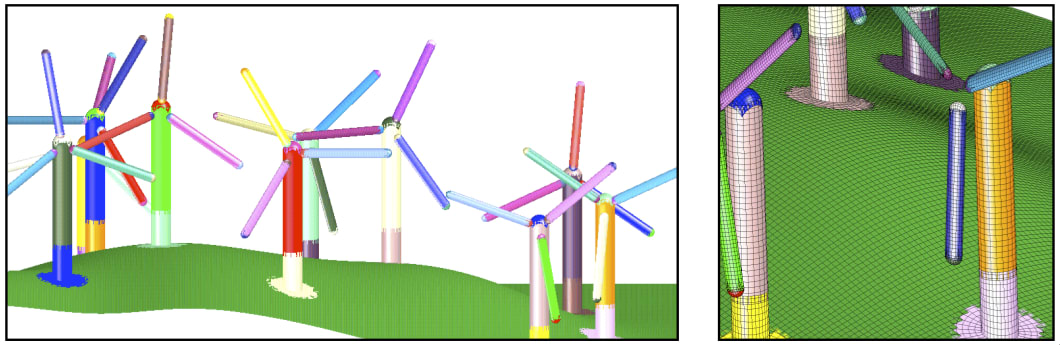
CgWind will also interface to the Weather Research and Forecasting (WRF) meso-scale model to simulate wind-farm scale problems for siting studies and wind park performance analysis. In particular, WRF can provide time varying inflow conditions to CgWind, thereby incorporating the local weather conditions. Terrain data can be imported from GIS sources, meshed, and incorporated into the model. For large-scale park models, CgWind provides an interface for wake models thereby obviating the need to highly resolve hundreds of turbines.
While currently under development at Lawrence Livermore National Laboratory, CgWind is intended to be community tool for use by turbine manufacturers, wind park designers, and wind energy researchers. The software is modular and contains well-defined interfaces for custom or proprietary wake and turbulence models. Built upon the openly available Overture software framework, CgWind will be freely downloadable.
This work was done by Kyle K. Chand, William D. Henshaw, Katherine A. Lundquist, and Michael A. Singer of Lawrence Livermore National Laboratory.
This Brief includes a Technical Support Package (TSP).
Accurate Wind Simulation Tool for Wind Turbines and Wind Farms
(reference GDM0010) is currently available for download from the TSP library.
Don't have an account?
Overview
The document discusses the Fifth International Symposium on Computational Wind Engineering (CWE2010), held in Chapel Hill, North Carolina, from May 23-27, 2010. It focuses on advanced computational methods for simulating wind flow, particularly in the context of wind turbines and wind farms.
A key aspect of the research presented is the numerical approach for solving the incompressible Navier-Stokes (INS) equations, which govern fluid dynamics. The authors employ a pressure-velocity formulation and a split-step method, where pressure is computed separately, to model the wind flow accurately. The governing equations are detailed, including terms for velocity, pressure, kinematic viscosity, and additional terms for buoyancy effects when necessary.
The document highlights the use of overlapping grid generators, such as Ogen, to construct computational grids that facilitate high-resolution simulations. Time-varying inflow conditions are derived from synthetic turbulent profiles or large-eddy simulation outputs from mesoscale atmospheric models like WRF. This allows for the computation of three-dimensional wind flow fields, which are essential for predicting turbine loads and power output.
The authors also discuss the development of high-resolution compact schemes that provide up to eighth-order accuracy, enhancing the spectral resolution compared to standard finite difference methods. These compact schemes are particularly beneficial in large-eddy simulation (LES) applications, where they can efficiently handle the complexities of fluid dynamics.
Additionally, the document references previous works that have contributed to the development of these numerical methods, including the pioneering work of Beam and Warming on implicit finite-difference algorithms. The integration of compact schemes with approximate factorization methods is explored, allowing for implicit time discretization and larger time steps while maintaining computational efficiency.
Overall, the document emphasizes the importance of advanced numerical techniques in accurately simulating wind flow around turbines, which is crucial for optimizing wind energy production. The research presented at CWE2010 reflects ongoing efforts to improve computational tools and methodologies in the field of wind engineering, ultimately contributing to more efficient and effective wind energy solutions.











