

Submillimeter-sized, transparent, solid, truncated spheres and ellipsoids for use as optical resonators in integrated microphotonic devices would be made by microfabrication techniques like those used in the electronic industry to make integrated circuits, according to a proposal. Such resonators, heretofore denoted generally as "microspheres," have been described in several recent articles in NASA Tech Briefs. In a microsphere, resonance is achieved through glancing-incidence total internal reflection in one or more "whispering-gallery" modes, in which the light propagates in equatorial planes near the surface, with an integer number of wavelengths along a nominal closed circumferential trajectory. If the surface of the resonator is sufficiently smooth and a sufficiently close approximation of a sphere or ellipsoid, then in principle, the resonance quality factor (Q) is limited only by attenuation in the resonator material; for a microsphere made of fused silica, this translates to a potential to obtain Q "e1010.
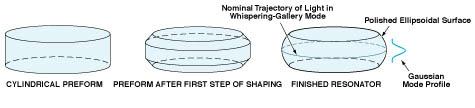
Heretofore, microspheres have been fabricated manually, in small numbers, for use in laboratory experiments. The proposal regarding adaptation of microfabrication techniques is prompted by a desire to obtain mass-producibility of such resonators with reproducibility of design, plus a capability for integration of the resonators with other photonic devices.
A typical fabrication sequence according to the proposal (see figure) would begin with preparation of a circular cylindrical disk preform of the resonator material, with a diameter between 100 and 200 µm and an axial thickness of 20 to 40 µm. Chamfers would be introduced at the top and bottom edges, and the resulting edges would be chamfered further, so that the original cylindrical surface would be made to evolve toward an ellipsoid. This shaping would be accomplished in a sequence of steps that could include a combination of thermal and mechanical treatments. Alternatively, shaping could involve wet and/or dry etching, ion milling, laser-assisted etching, chemical-assisted ion-beam etching, and/or other processes.
In the final steps of fabrication, the remaining edges would be rounded and the ellipsoidal surface smoothed to minimize roughness and thereby reduce the scattering loss of light. Final treatment could include radiative heating to fire-polish the surface to reduce the surface roughness to the subnanometer level (in effect, the molecular level).
The finished resonator would have an ellipsoidal surface near the plane of symmetry. Because of the nearly Gaussian falloff of the whispering-gallery modes away from their localization near the symmetry plane, the truncated ellipsoid would be electromagnetically indistinguishable from a full ellipsoid. Consequently, flat border surfaces could be used for mounting or heat-sinking without adverse effect on the performance of the optical cavity.
This work was done by Vladimir Iltchenko and Chi Wu of Caltech for NASA's Jet Propulsion Laboratory. For further information, access the Technical Support Package (TSP) free on-line at www.nasatech.com/tsp under the Physical Sciences category. NPO-20604
This Brief includes a Technical Support Package (TSP).
Microfabricated High-Q Optical Resonators for Microphotonics
(reference NPO-20604) is currently available for download from the TSP library.
Don't have an account?
Overview
The document is a NASA Technical Support Package detailing a proposal for the development of microfabricated high-Q optical resonators for use in integrated microphotonics. Authored by Vladimir S. Iltchenko and associated with the Jet Propulsion Laboratory (JPL), the report emphasizes the potential of submillimeter-sized, transparent, solid truncated spheres and ellipsoids, referred to as microspheres, as effective optical resonators.
The proposal highlights the application of microfabrication techniques, akin to those used in the electronics industry for integrated circuits, to create these microspheres. The significance of these resonators lies in their ability to achieve high quality factors (Q), which are crucial for minimizing losses in optical systems. The document discusses the factors influencing the quality factor, including surface roughness and geometry. It notes that while theoretical limits suggest high Q values can be achieved with perfect geometry, real-world applications often face challenges such as scattering losses due to surface imperfections.
Recent advancements have demonstrated that microspheres can achieve material-limited quality factors, with reported values between 6 to 8 million at specific wavelengths. This is attributed to their smooth surfaces, which minimize scattering losses, and their unique two-dimensional curvature that allows for effective light confinement through grazing incidence reflection. In contrast, attempts to create high-Q whispering-gallery resonators using planar waveguide technology have not surpassed quality factors of 10^4 to 10^5, primarily due to larger surface roughness and the limitations of cylindrical geometries.
The document serves as a technical overview of the potential for microspheres in enhancing the performance of microphotonic devices, emphasizing their advantages over traditional waveguide structures. It also includes a disclaimer regarding the accuracy and completeness of the information, clarifying that neither NASA nor JPL endorses any specific commercial products mentioned.
Overall, this report presents a promising avenue for research and development in microphotonics, with implications for various applications in telecommunications, sensing, and other fields where high-performance optical components are essential.











