

Machine vision has become indispensable in today’s highly automated manufacturing environments, which rely on accurate in spec tion to ensure high product quality and high process efficiency. Applications for the technology span industry, and include everything from validation of printed barcodes and text on consumer product labeling, to assembly verification of printed circuit boards, to dimensional measurement of automotive parts. The demand for vision inspection only continues to grow with increasing throughput requirements and stringent quality standards that necessitate full inspection and render manual product inspection unfeasible.
Cameras have become more modular as new smart cameras pack complete vision systems into miniaturized form factors, with lens and lighting options to address a multitude of system con figura - tions and allow for modification. Recent advances in CMOS sensor technology enable high-resolution, high-speed models that are both cost-effective and easy to use. New software developments, similarly, are scalable to accommodate applications that expand beyond their original scope; users are no longer locked into a single hardware/software technology. The software features portability from one device to another, and its current graphical subsystems produce intuitive user interfaces. In this article, we’ll explore these three technologies — sensors, lenses, and software — providing machine vision tools with a greater flexibility.
Advances in CMOS Sensor Technology

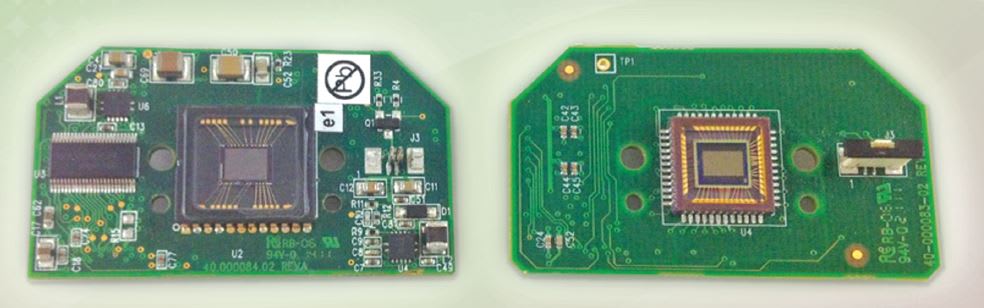
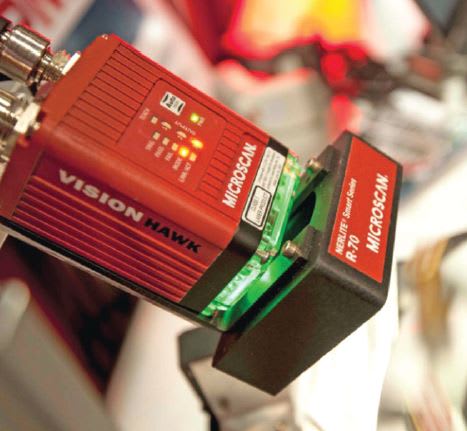
CMOS sensors feature a simple design and high-speed data transfer, thanks to their ability to quickly get rid of pixels. CCD technology is physically limited on how fast the images can exit the sensor. CMOS is very low powered and therefore builds up less heat; smaller designs are possible because the boards are less complex and require fewer components (see Figure 1). In addition, CMOS technology has the ability to take sections or windows of an image in order to further increase frame rates. Microscan’s 2MP Vision HAWK smart camera, for example, incorporates a high-resolution CMOS sensor to achieve frame rates of up to 300 frames/sec (see Figure 2).
Configurable Lens and Lighting Options
A variety of lens and lighting options are available for use with today’s modular smart cameras. Microscan’s Vision HAWK model uses interchangeable Cmount lenses and external lighting. Other new smart camera designs feature a fully integrated lens and lighting for equipment integration. Some offer the ability to “mix and match” accessory options, allowing system designs tailored to specific application needs.
Flexible Software Architecture for Portability to Multiple Devices
At the heart of any machine vision system is the image processing software. Recent camera developments provide portability to multiple hardware devices and scalability to other platforms.
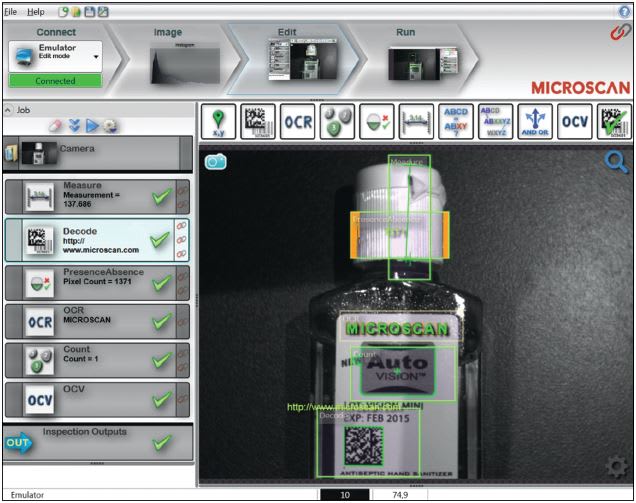
Early innovations in machine vision software have laid the foundation for today’s flexible programs, which have evolved from custom-programmed products, requiring a group of engineers to develop and deploy, to the present- day drag-and-drop interfaces with intuitive vision tools. Some programs use an object-oriented approach to describe a vision program as a sequence of steps, where each step, in turn, further processes the data produced by the preceding step.
For a machine vision system, the first piece of data is the image, with an eventual output of pass/fail. Over the years, developers have refined and enhanced the abilities of these steps, making assumptions for the user along the way to produce an easy-to-use interface with fewer parameters to navigate, while at the same time retaining the power and flexibility of the underlying architecture. Applications can therefore be created in a simple environment and then loaded into a broader structure with additional parameters for more complex functionality.
Microscan’s patented software technology recreates objects on a target platform rather than interpreting them, allowing for portability from one hardware device to another. Objects on a smart camera and PC, for example, are the exact implementation and sequence of objects; adding new functionality to a smart camera is the same as adding to a PC. By way of contrast, using an interpretive model would require two separate development efforts.
Looking Forward
Large multi-national companies are increasingly deploying machine vision technology across their plants. Scalable software that can be deployed across multiple cameras, and the flexibility to make system modifications without extensive downtime, are essential to optimizing operational efficiency in global, multi-facility environments. Employees need only be trained on one standardized platform that can be used on many cameras, instead of learning a different program for each piece of hardware. In addition, the user’s time, effort, and investment are protected if the scope of the application grows over time or requires a different hardware configuration.
As more and more industries adopt machine vision, manufacturers of the technology will continue to focus on the ease of use of their products in order to address a range of user levels. Customers are also looking for higher throughput, which means higher frame rates and/or the ability to take one image and run multiple inspections on it — not moving the object or camera and taking multiple images. A higher throughput enables faster job changeover in applications such as PCB assembly. An ongoing emphasis on ease of use will continue to make machine vision more accessible to a wider user group in the years to come.
This article was written by Cathy McBeth, Global Commercial Marketing Manager at Microscan (Renton, WA), or visit http://info.hotims.com/45604-140 .











